Home > Press > Attacking Cancer Cells with Hydrogel Nanoparticles
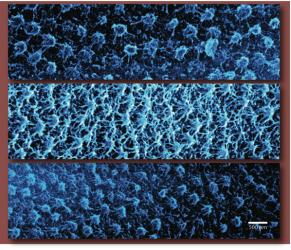 |
| Hydrogel Nanoparticles - An artistic rendering of hydrogel nanoparticles.(Credit: Andrew Lyon) |
Abstract:
One of the difficulties of fighting cancer is that drugs often hit other non-cancerous cells, causing patients to get sick. But what if researchers could sneak cancer-fighting particles into just the cancer cells? Researchers at the Georgia Institute of Technology and the Ovarian Cancer Institute are working on doing just that. In the online journal BMC Cancer they detail a method that uses hydrogels - less than 100 nanometers in size - to sneak a particular type of small interfering RNA(siRNA) into cancer cells. Once in the cell the siRNA turns on the programmed cell death the body uses to kill mutated cells and help traditional chemotherapy do it's job.
Attacking Cancer Cells with Hydrogel Nanoparticles
Atlanta, GA | Posted on February 15th, 2010Many cancers are characterized by an over abundance of epidermal growth factor receptors (EGFR). When the EGFR level in a cell is elevated it tells the cell to replicate at a rapid rate. It also turns down apoptosis, or programmed cell death.
"With our technique we're inhibiting EGFR's growth, with small interfering RNA. And by inhibiting it's growth, we're increasing the cells's apoptotic function. If we hit the cell with chemotherapy at the same time, we should be able to kill the cancer cells more effectively," said John McDonald, professor at the School of Biology at Georgia Tech and chief research scientist at the Ovarian Cancer Institute.
Small interfering RNA is good at shutting down EGFR production, but once inside the cell siRNA has a limited life span. Keeping it protected inside the hydrogel nanoparticles allows them to get into the cancer cell safely and acts as a protective barrier around them. The hydrogel releases only a small amount of siRNA at a time, ensuring that while some are out in the cancer cell doing their job, reinforcements are held safely inside the nanoparticle until it's time to do their job.
"It's like a Trojan horse," said L. Andrew Lyon, professor in the School of Chemistry and Biochemistry at Georgia Tech. "We've decorated the surface of these hydrogels with a ligand that tricks the cancer cell into taking it up. Once inside, the particles have a slow release profile that leaks out the siRNA over a timescale of days, allowing it to have a therapeutic effect."
Cells use the messenger RNA (mRNA) to generate proteins, which help to keep the cell growing. Once the siRNA enters the cell, it binds to the mRNA and recruits proteins that attack the siRNA-mRNA complex. But the cancer cell's not finished; it keeps generating proteins, so without a continuous supply of siRNA, the cell recovers. Using the hydrogel to slowly release the siRNA allows it to keep up a sustained attack so that it can continue to interrupt the production of proteins.
"We've shown that you can get knock down out to a few days time frame, which could present a clinical window to come in and do multiple treatments in a combination chemotherapy approach," said Lyon.
"The fact that this system is releasing the siRNA slowly, without giving the cell time to immediately recover, gives us much better efficiency at killing the cancer cells with chemotherapy," added McDonald.
Previous techniques have involved using antibodies to knock down the proteins.
"But oftentimes, a mutation may arise in the targeted gene such that the antibody will no longer have the effect it once did, thereby increasing the chance for recurrence," said McDonald.
The team used hydrogels because they're non-toxic, have a relatively slow release rate, and can survive in the body long enough to reach their target.
"It's a well-defined architecture that you're using the intrinsic porosity of that material to load things into, and since our particles are about 98 percent water by volume, there's plenty of internal volume in which to load things," said Lyon.
Currently, the tests have been shown to work in vitro, but the team will be initiating tests in vivo shortly.
####
About Georgia Institute of Technology
The Georgia Institute of Technology is one of the nation's premier research universities. Ranked seventh among U.S. News & World Report's top public universities, Georgia Tech's more than 20,000 students are enrolled in its Colleges of Architecture, Computing, Engineering, Liberal Arts, Management and Sciences. Tech is among the nation's top producers of women and minority engineers. The Institute offers research opportunities to both undergraduate and graduate students and is home to more than 100 interdisciplinary units plus the Georgia Tech Research Institute.
For more information, please click here
Contacts:
David Terraso
Communications and Marketing
404-385-2966
Copyright © Georgia Institute of Technology
If you have a comment, please Contact us.Issuers of news releases, not 7th Wave, Inc. or Nanotechnology Now, are solely responsible for the accuracy of the content.
Bookmark:


| Related News Press |
News and information
 Simulating magnetization in a Heisenberg quantum spin chain April 5th, 2024
NRL charters Navy’s quantum inertial navigation path to reduce drift April 5th, 2024
Discovery points path to flash-like memory for storing qubits: Rice find could hasten development of nonvolatile quantum memory April 5th, 2024
Nanomedicine
New micromaterial releases nanoparticles that selectively destroy cancer cells April 5th, 2024
Good as gold - improving infectious disease testing with gold nanoparticles April 5th, 2024
Researchers develop artificial building blocks of life March 8th, 2024
Announcements
NRL charters Navy’s quantum inertial navigation path to reduce drift April 5th, 2024
Discovery points path to flash-like memory for storing qubits: Rice find could hasten development of nonvolatile quantum memory April 5th, 2024
Nanobiotechnology
New micromaterial releases nanoparticles that selectively destroy cancer cells April 5th, 2024
Good as gold - improving infectious disease testing with gold nanoparticles April 5th, 2024
Researchers develop artificial building blocks of life March 8th, 2024
Alliances/Trade associations/Partnerships/Distributorships
Chicago Quantum Exchange welcomes six new partners highlighting quantum technology solutions, from Chicago and beyond September 23rd, 2022
University of Illinois Chicago joins Brookhaven Lab's Quantum Center June 10th, 2022
 |
||
 |
||
| The latest news from around the world, FREE | ||
 |
||
|
|
||
| Premium Products | ||
 |
||
|
Only the news you want to read!
Learn More |
||
 |
||
|
Full-service, expert consulting
Learn More |
||
|
|
||