Home > Press > Silver Nanoparticles May One Day Be Key to Devices That Keep Hearts Beating Strong and Steady
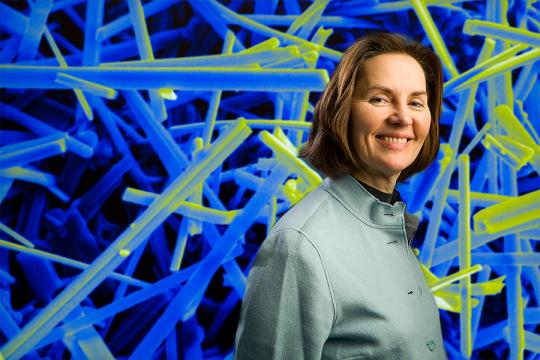 |
| Takeuchi is tuning new battery materials at the atomic level in order to realize more powerful, longer-lasting implantable biomedical devices. |
Abstract:
Diamonds and gold may make some hearts flutter on Valentine's Day, but in a University at Buffalo laboratory, silver nanoparticles are being designed to do just the opposite.
Silver Nanoparticles May One Day Be Key to Devices That Keep Hearts Beating Strong and Steady
Buffalo, NY | Posted on February 13th, 2010The nanoparticles are part of a new family of materials being created in the laboratory of SUNY Distinguished Professor and Greatbatch Professor of Advanced Power Sources Esther Takeuchi, PhD, who developed the lithium/silver vanadium oxide battery. The battery was a major factor in bringing implantable cardiac defibrillators (ICDs) into production in the late 1980s. ICDs shock the heart into a normal rhythm when it goes into fibrillation.
Twenty years later, with more than 300,000 of these units being implanted every year, the majority of them are powered by the battery system developed and improved by Takeuchi and her team. For that work she has earned more than 140 patents, believed to be more than any other woman in the United States. Last fall, she was one of four recipients honored in a White House ceremony with the National Medal of Technology and Innovation.
ICD batteries, in general, now last five to seven years. But she and her husband and co-investigator, SUNY Distinguished Teaching Professor of Chemistry Kenneth Takeuchi, PhD, and Amy Marschilok, PhD, UB research assistant professor of chemistry, are exploring even-better battery systems, by fine-tuning bimetallic materials at the atomic level.
Their research investigating feasibility for ICD use is funded by the National Institutes of Health, while their investigation of new, bimetallic systems is funded by the U.S. Department of Energy.
So far, their results show that they can make their materials 15,000 times more conductive upon initial battery use due to in-situ (that is, in the original material) generation of metallic silver nanoparticles. Their new approach to material design will allow development of higher-power, longer-life batteries than was previously possible.
These and other improvements are boosting interest in battery materials and the revolutionary devices that they may make possible.
"We may be heading toward a time when we can make batteries so tiny that they -- and the devices they power -- can simply be injected into the body," Takeuchi says.
Right now, her team is exploring how to boost the stability of the new materials they are designing for ICDs. The materials will be tested over weeks and months in laboratory ovens that mimic body temperature of 37 degrees Celsius.
"What's really exciting about this concept is that we are tuning the material at the atomic level," says Takeuchi. "So the change in its conductivity and performance is inherent to the material. We didn't add supplements to achieve that, we did it by changing the active material directly."
She explains that new and improved batteries for biomedical applications could, in a practical way, revolutionize treatments for some of the most persistent diseases by making feasible devices that would be implanted in the brain to treat stroke and mental illness, in the spine to treat chronic pain or in the vagal nerve system to treat migraines, Alzheimer's disease, anxiety, even obesity.
And even though batteries are an historic technology, they are far from mature, Takeuchi notes. This spring, she is teaching the energy storage course in UB's School of Engineering and Applied Sciences and the class is filled to capacity. "I've never seen interest in batteries as high as it is now," she says.
####
About University at Buffalo
The University at Buffalo is a premier research-intensive public university, a flagship institution in the State University of New York system and its largest and most comprehensive campus. UB's more than 28,000 students pursue their academic interests through more than 300 undergraduate, graduate and professional degree programs. Founded in 1846, the University at Buffalo is a member of the Association of American Universities.
For more information, please click here
Contacts:
Ellen Goldbaum
716-645-4605
Copyright © University at Buffalo
If you have a comment, please Contact us.Issuers of news releases, not 7th Wave, Inc. or Nanotechnology Now, are solely responsible for the accuracy of the content.
Bookmark:


| Related News Press |
News and information
 Simulating magnetization in a Heisenberg quantum spin chain April 5th, 2024
NRL charters Navy’s quantum inertial navigation path to reduce drift April 5th, 2024
Discovery points path to flash-like memory for storing qubits: Rice find could hasten development of nonvolatile quantum memory April 5th, 2024
Govt.-Legislation/Regulation/Funding/Policy
NRL charters Navy’s quantum inertial navigation path to reduce drift April 5th, 2024
Discovery points path to flash-like memory for storing qubits: Rice find could hasten development of nonvolatile quantum memory April 5th, 2024
Chemical reactions can scramble quantum information as well as black holes April 5th, 2024
Possible Futures
Discovery points path to flash-like memory for storing qubits: Rice find could hasten development of nonvolatile quantum memory April 5th, 2024
With VECSELs towards the quantum internet Fraunhofer: IAF achieves record output power with VECSEL for quantum frequency converters April 5th, 2024
Announcements
NRL charters Navy’s quantum inertial navigation path to reduce drift April 5th, 2024
Discovery points path to flash-like memory for storing qubits: Rice find could hasten development of nonvolatile quantum memory April 5th, 2024
Energy
Development of zinc oxide nanopagoda array photoelectrode: photoelectrochemical water-splitting hydrogen production January 12th, 2024
Shedding light on unique conduction mechanisms in a new type of perovskite oxide November 17th, 2023
Inverted perovskite solar cell breaks 25% efficiency record: Researchers improve cell efficiency using a combination of molecules to address different November 17th, 2023
The efficient perovskite cells with a structured anti-reflective layer – another step towards commercialization on a wider scale October 6th, 2023
Battery Technology/Capacitors/Generators/Piezoelectrics/Thermoelectrics/Energy storage
What heat can tell us about battery chemistry: using the Peltier effect to study lithium-ion cells March 8th, 2024
A battery’s hopping ions remember where they’ve been: Seen in atomic detail, the seemingly smooth flow of ions through a battery’s electrolyte is surprisingly complicated February 16th, 2024
Nanobiotechnology
New micromaterial releases nanoparticles that selectively destroy cancer cells April 5th, 2024
Good as gold - improving infectious disease testing with gold nanoparticles April 5th, 2024
Researchers develop artificial building blocks of life March 8th, 2024
 |
||
 |
||
| The latest news from around the world, FREE | ||
 |
||
|
|
||
| Premium Products | ||
 |
||
|
Only the news you want to read!
Learn More |
||
 |
||
|
Full-service, expert consulting
Learn More |
||
|
|
||