Home > Press > Setting Out to Discover New, Long-lived Elements
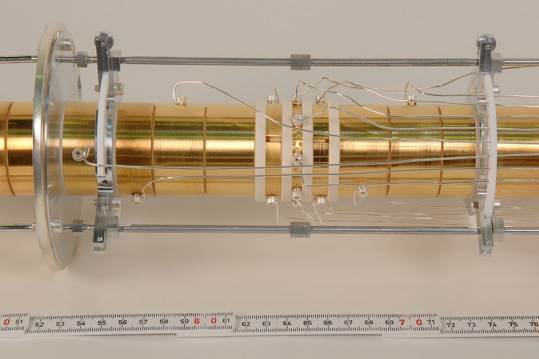 |
| The picture shows the Penning trap, which is part of the Shiptrap experiment. A magnetic field parallel to the tube forces the arriving ions onto a spiral course inside the tube. The ions’ spiraling frequency is used to directly calculate their atomic mass. |
Abstract:
For the first time, "ion traps" were used to measure super heavy elements
Setting Out to Discover New, Long-lived Elements
Darmstadt, Germany | Posted on February 11th, 2010Besides the 92 elements that occur naturally, scientists were able to create 20 additional chemical elements, six of which were discovered at the GSI Helmholtz Centre for Heavy Ion Research in Darmstadt. These new elements were produced artificially with particle accelerators and are all very short-lived: they decay in a matter of a split second. However, scientists predict the existence of even heavier elements with an extreme longevity, leaving them to only decay after years. These elements form an island of stability. Scientists at the GSI Helmholtz Centre for Heavy Ion Research in Darmstadt have developed and applied a measuring apparatus that might allow them to discover such long-lived elements, reports the renowned scientific journal Nature.
An international team of scientists headed by Michael Block was able to trap atoms of the element 102, nobelium, in an ion trap. This is the first time in history that a so-called super heavy element had been trapped. Trapping the element allowed the research team to measure the atomic mass of Nobelium with unprecedented accuracy. The atomic mass is one of the most essential characteristics of an atom. It is used to calculate the atom's binding energy, which is what keeps the atom together. The atom's binding energy determines the stability of an atom. With the help of the new measuring apparatus, scientists will be able to identify long-lived elements on the so called islands of stability that can no longer be assigned by their radioactive decay. The island of stability is predicted to be located in the vicinity of the elements 114 to 120.
"Precisely measuring the mass of nobelium with our Shiptrap device was a successful first step. Now, our goal is to improve the measuring apparatus so that we can extend our method to heavier and heavier elements and, one day, may reach the island of stability", says Michael Block, head of the research team at the GSI Helmholtz Centre.
For their measurements, Michael Block and his team built a highly complex apparatus, the ion trap "Shiptrap", and combined it with "Ship", the velocity filter which was already used in the discovery of six short-lived elements at GSI. To produce nobelium, the research team used the GSI accelerator to fire calcium ions onto a lead foil. With the help of Ship, they then separated the freshly produced nobelium from the projectile atoms. Inside the Shiptrap apparatus, the nobelium was first decelerated in a gas-filled cell, then the slow ions were trapped in a so-called Penning trap.
Held inside the trap by electric and magnetic fields, the nobelium ion spun on a minuscule spiral course at a specific frequency. This frequency was used to calculate the atomic mass. With an uncertainty of merely 0.000005%, this new technique allows determining the atomic mass and binding energy with unprecedented precision and, for the first time, directly without the help of theoretical assumptions.
The experiment was a collaboration between GSI, the Max-Planck-Institut für Kernphysik Heidelberg, the Universities Gießen, Greifswald, Heidelberg, Mainz, Munich, Padua (Italy), Jyväskylä (Finland) and Granada (Spain) as well as the PNPI (Petersburg Nuclear Physics Institute) and the JINR (Joint Institute for Nuclear Research) in Russia.
Link to the nature release: www.nature.com/nature/journal/v463/n7282/full/nature08774.html
Link to the summary for the layman: www.nature.com/nature/journal/v463/n7282/full/463740a.html
####
About GSI Helmholtzzentrum für Schwerionenforschung
The goal of the scientific research conducted at the GSI Helmholtz Centre for Heavy Ion Research is to understand the structure and behavior of the world that surrounds us. In addition to broadening our understanding of the world, this knowledge also serves as a basis for technological progress in all areas of our lives.
GSI operates a large, in many aspects worldwide unique accelerator facility for heavy-ion beams. Researchers from around the world use the facility for experiments that help point the way to new and fascinating discoveries in basic research. In addition, the scientists use their findings to continually develop new and impressive applications.
The research program at GSI covers a broad range of activities extending from nuclear and atomic physics to plasma and materials research to biophysics and cancer therapy. Probably the best-known results are the discovery of six new chemical elements and the development of a new type of tumor therapy using ion beams.
For more information, please click here
Contacts:
GSI Helmholtzzentrum für Schwerionenforschung GmbH
Planckstr. 1
64291 Darmstadt
Germany
Public Relations
Contact: Dr. Ingo Peter
Fon: +49-6159-71-2598
Fax: +49-6159-71-2991
Copyright © GSI Helmholtzzentrum für Schwerionenforschung
If you have a comment, please Contact us.Issuers of news releases, not 7th Wave, Inc. or Nanotechnology Now, are solely responsible for the accuracy of the content.
Bookmark:


| Related News Press |
Physics
 Simulating magnetization in a Heisenberg quantum spin chain April 5th, 2024
News and information
Simulating magnetization in a Heisenberg quantum spin chain April 5th, 2024
NRL charters Navy’s quantum inertial navigation path to reduce drift April 5th, 2024
Discovery points path to flash-like memory for storing qubits: Rice find could hasten development of nonvolatile quantum memory April 5th, 2024
Academic/Education
Rice University launches Rice Synthetic Biology Institute to improve lives January 12th, 2024
Multi-institution, $4.6 million NSF grant to fund nanotechnology training September 9th, 2022
Announcements
NRL charters Navy’s quantum inertial navigation path to reduce drift April 5th, 2024
Discovery points path to flash-like memory for storing qubits: Rice find could hasten development of nonvolatile quantum memory April 5th, 2024
Alliances/Trade associations/Partnerships/Distributorships
Chicago Quantum Exchange welcomes six new partners highlighting quantum technology solutions, from Chicago and beyond September 23rd, 2022
University of Illinois Chicago joins Brookhaven Lab's Quantum Center June 10th, 2022
 |
||
 |
||
| The latest news from around the world, FREE | ||
 |
||
|
|
||
| Premium Products | ||
 |
||
|
Only the news you want to read!
Learn More |
||
 |
||
|
Full-service, expert consulting
Learn More |
||
|
|
||