Home > Press > UCLA chemists create synthetic 'gene-like' crystals for carbon dioxide capture
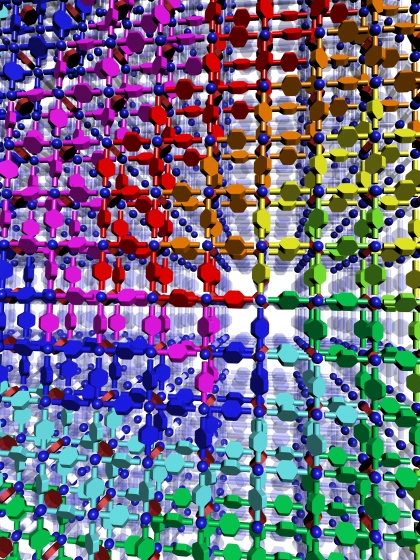 |
| Image of 3-D, synthetic DNA-like crystals created by Yaghi, Deng and colleagues. Credit: CNSI, UCLA–Department of Energy Institute of Genomics and Proteomics |
Abstract:
UCLA chemists report creating a synthetic "gene" that could capture heat-trapping carbon dioxide emissions, which contribute to global warming, rising sea levels and the increased acidity of oceans.
The research appears in the Feb. 12 issue of the journal Science.
UCLA chemists create synthetic 'gene-like' crystals for carbon dioxide capture
Los Angeles, CA | Posted on February 11th, 2010"We created three-dimensional, synthetic DNA-like crystals," said UCLA chemistry and biochemistry professor Omar M. Yaghi, who is a member of the California NanoSystems Institute (CNSI) at UCLA and the UCLA-Department of Energy Institute of Genomics and Proteomics. "We have taken organic and inorganic units and combined them into a synthetic crystal which codes information in a DNA-like manner. It is by no means as sophisticated as DNA, but it is certainly new in chemistry and materials science."
The discovery could lead to cleaner energy, including technology that factories and cars can use to capture carbon dioxide before it reaches the atmosphere.
"What we think this will be important for is potentially getting to a viable carbon dioxide-capture material with ultra-high selectivity," said Yaghi, who holds UCLA's Irving and Jean Stone Chair in Physical Sciences and is director of the CNSI's Center for Reticular Chemistry. "I am optimistic that is within our reach. Potentially, we could create a material that can convert carbon dioxide into a fuel, or a material that can separate carbon dioxide with greater efficiency."
The research was federally funded by the U.S. Department of Energy's Office of Basic Energy Sciences. The lead author is Hexiang "DJ" Deng, a UCLA graduate student of chemistry and biochemistry who works in Yaghi's laboratory.
"DNA is a beautiful molecule that has a way to code for information," Yaghi said. "How do you code information in a crystal in the same way that DNA does? DJ and I figured out a way to do this. The sequence of organic functionalities that decorates the pores of the crystals is most certainly a unique code.
"DJ has illustrated that one member of a series of materials he has made has 400 percent better performance in carbon dioxide capture than one that does not have the same code," he said.
In the early 1990s, Yaghi invented a class of materials called metal-organic frameworks (MOFs), sometimes described as crystal sponges, in which he can change the components nearly at will. MOFs have pores — openings on the nanoscale in which Yaghi and his colleagues can store gases that are usually difficult to store and transport. Molecules can go in and out of the pores unobstructed. Yaghi and his research team have made thousands of MOFs.
"We have created crystals of metal-organic frameworks in which the sequence of multiple functionalities of varying kind and ratios acts as a synthetic 'gene,'" Yaghi said. "With these multivariate MOFs, we have figured out a way to incorporate controlled complexity, which biology operates on, in a synthetic crystal — taking synthetic crystals to a new level of performance.
"This can be a boon for energy-related and other industrial applications, such as conversion of gases and liquids like carbon dioxide to fuel, or water to hydrogen, among many others," he said.
Yaghi has been collaborating with his former UCLA chemistry colleague and former CNSI director Sir J. Fraser Stoddart on how to take concepts from biology and incorporate them into a synthetic material.
"We hope the materials we are creating will introduce a new class of structures that have controlled complexity," Yaghi said. "Chemists and materials scientists are now able to ask new questions we have never asked before. Also, new tools for characterizing the sequences and deciphering the codes within the crystals will have to be developed."
Carbon dioxide is polluting Earth's atmosphere and damaging coral reefs and marine life — impacts that are irreversible in our lifetime, Yaghi said.
Co-authors on the study are Christian Doonan and Hiroyasu Furukawa, UCLA postdoctoral scholars in Yaghi's laboratory; Ricardo Ferreira, a UCLA visiting undergraduate; John Towne, a former UCLA undergraduate; Carolyn Knobler, a research associate in Yaghi's laboratory; and Bo Wang, a UCLA postdoctoral scholar in Yaghi's laboratory.
Try 100 times
A few years ago, Yaghi spoke at Shanghai's Fudan University, which is known for having one of the best chemistry departments in China. There, he met Deng, who at the time was an undergraduate student at the university. Deng and his colleagues had tried unsuccessfully to make new MOFs.
"DJ told me, 'Professor, we tried a slight variation to make new MOFs and it did not work,'" Yaghi recalled. "I asked, 'How many times did you try?' He said, 'Two or three times.' I said, 'How about 20 times, 30 times? How about 100 times? If it were that easy, why would it need a smart person like you to do it? Success and excellence do not come that easily.' I said, 'If you really want to learn how to do MOF chemistry, you better come and work with me.' I think that shocked him, but here he is."
How did Deng react to Yaghi's offer?
"Definitely," said Deng, who plans to become a chemistry professor. "And," he added, "the story ends with me trying enough times to get it right. It took me about a hundred more times."
"With MOF chemistry," Yaghi said, "it is not all design; there is a lot of trial and error because we are trying to learn what nature is telling us, and learning that code takes time.
"What is special about DJ and the other students who have worked in my laboratory is that no matter how much you raise the bar, they jump high enough to rise above it," Yaghi said. "It takes a special student to do that, but they are out there, and they need to be inspired. Working with students like DJ that I can challenge in this way is every professor's dream."
####
About UCLA
UCLA is California's largest university, with an enrollment of nearly 38,000 undergraduate and graduate students. The UCLA College of Letters and Science and the university's 11 professional schools feature renowned faculty and offer more than 323 degree programs and majors. UCLA is a national and international leader in the breadth and quality of its academic, research, health care, cultural, continuing education and athletic programs. Five alumni and five faculty have been awarded the Nobel Prize.
For more information, please click here
Contacts:
Media Contacts
Stuart Wolpert
310-206-0511
Copyright © UCLA
If you have a comment, please Contact us.Issuers of news releases, not 7th Wave, Inc. or Nanotechnology Now, are solely responsible for the accuracy of the content.
Bookmark:


| Related News Press |
News and information
 Simulating magnetization in a Heisenberg quantum spin chain April 5th, 2024
NRL charters Navy’s quantum inertial navigation path to reduce drift April 5th, 2024
Discovery points path to flash-like memory for storing qubits: Rice find could hasten development of nonvolatile quantum memory April 5th, 2024
Good as gold - improving infectious disease testing with gold nanoparticles April 5th, 2024
Synthetic Biology
New micromaterial releases nanoparticles that selectively destroy cancer cells April 5th, 2024
Rice University launches Rice Synthetic Biology Institute to improve lives January 12th, 2024
Govt.-Legislation/Regulation/Funding/Policy
NRL charters Navy’s quantum inertial navigation path to reduce drift April 5th, 2024
Discovery points path to flash-like memory for storing qubits: Rice find could hasten development of nonvolatile quantum memory April 5th, 2024
Chemical reactions can scramble quantum information as well as black holes April 5th, 2024
Possible Futures
Discovery points path to flash-like memory for storing qubits: Rice find could hasten development of nonvolatile quantum memory April 5th, 2024
With VECSELs towards the quantum internet Fraunhofer: IAF achieves record output power with VECSEL for quantum frequency converters April 5th, 2024
Announcements
NRL charters Navy’s quantum inertial navigation path to reduce drift April 5th, 2024
Discovery points path to flash-like memory for storing qubits: Rice find could hasten development of nonvolatile quantum memory April 5th, 2024
Environment
Billions of nanoplastics released when microwaving baby food containers: Exposure to plastic particles kills up to 75% of cultured kidney cells July 21st, 2023
Energy
Development of zinc oxide nanopagoda array photoelectrode: photoelectrochemical water-splitting hydrogen production January 12th, 2024
Shedding light on unique conduction mechanisms in a new type of perovskite oxide November 17th, 2023
Inverted perovskite solar cell breaks 25% efficiency record: Researchers improve cell efficiency using a combination of molecules to address different November 17th, 2023
The efficient perovskite cells with a structured anti-reflective layer – another step towards commercialization on a wider scale October 6th, 2023
Automotive/Transportation
Researchers’ approach may protect quantum computers from attacks March 8th, 2024
Tests find no free-standing nanotubes released from tire tread wear September 8th, 2023
Industrial
Boron nitride nanotube fibers get real: Rice lab creates first heat-tolerant, stable fibers from wet-spinning process June 24th, 2022
Nanotubes: a promising solution for advanced rubber cables with 60% less conductive filler June 1st, 2022
Protective equipment with graphene nanotubes meets the strictest ESD safety standards March 25th, 2022
OCSiAl receives the green light for Luxembourg graphene nanotube facility project to power the next generation of electric vehicles in Europe March 4th, 2022
 |
||
 |
||
| The latest news from around the world, FREE | ||
 |
||
|
|
||
| Premium Products | ||
 |
||
|
Only the news you want to read!
Learn More |
||
 |
||
|
Full-service, expert consulting
Learn More |
||
|
|
||