Home > Press > Composite nanomaterials show promise for solar hydrogen generation
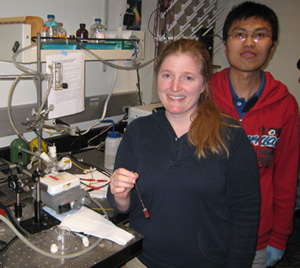 |
| Graduate students Jennifer Hensel and Gongming Wang tested the performance of composite nanomaterials in PEC cells for hydrogen production. Photo by Yat Li. |
Abstract:
A novel strategy for engineering semiconductor materials can boost the performance of water-splitting solar cells for hydrogen production, according to a new study by researchers at the University of California, Santa Cruz.
Composite nanomaterials show promise for solar hydrogen generation
Santa Cruz, CA | Posted on February 9th, 2010Using sunlight to split water into hydrogen and oxygen is potentially a clean and sustainable way to generate hydrogen for fuel-cell vehicles. Photovoltaic cells use solar energy to generate electricity, and electricity can be used to split water by electrolysis. But a more direct and efficient approach is provided by photoelectrochemical (PEC) cells, which use solar energy to generate hydrogen inside the cell itself.
The UCSC researchers focused on the semiconductor material used as a light-absorbing anode in the PEC cell. They combined two techniques--called elemental doping and quantum dot sensitization--that have been used to improve the performance of metal oxide semiconductors in solar cells. These techniques use nanotechnology to manipulate the structure of a material on the scale of billionths of a meter.
Previous work in the laboratory of Jin Zhang, professor of chemistry and biochemistry at UCSC, showed that this combination of techniques has a synergistic effect, markedly enhancing the performance of photovoltaic cells (see earlier story 1). In the new study, Zhang teamed up with Yat Li, assistant professor of chemistry and biochemistry, to test the same strategy in a PEC cell.
"Elemental doping and quantum dot sensitization are two different techniques that work well by themselves. We found that we can combine them to get a synergistic effect," Li said. "We not only extended this idea nicely to a photoelectrochemical cell for hydrogen generation, we also proposed a new model to explain the observed experimental data."
Zhang noted that more theoretical work is needed to fully understand the mechanisms involved. "Understanding the mechanisms will allow us to optimize the effects," he said. "The model we proposed in the first paper was very preliminary, but the new results have helped us refine our model."
The researchers reported their findings in the journal Nano Letters in a paper posted online on January 25. Lead authors of the paper (2) were Jennifer Hensel, a graduate student in Zhang's lab, and Gongming Wang, a graduate student in Li's lab.
The researchers synthesized thin films of titanium dioxide nanoparticles, as well as titanium dioxide nanowire arrays vertically aligned in a thin film on a substrate. The titanium dioxide films were doped with nitrogen, and cadmium selenide nanoparticles were used for quantum dot sensitization. The resulting nanostructured composite materials were then used as photoanodes in a PEC cell to compare their performance in carefully controlled experiments.
The results are an important demonstration of the potential to improve the performance of photoelectrochemical cells, as well as photovoltaic solar cells, using carefully designed materials, Zhang said. "The key is that combining different approaches in a rational manner can significantly boost performance," he said.
This research was supported by UCSC, the National Science Foundation, the U.S. Department of Energy, and the NSF of China.
1. press.ucsc.edu/text.asp?pid=1852
2. pubs.acs.org/doi/abs/10.1021/nl903217w
####
About University of California, Santa Cruz
UC Santa Cruz has a current enrollment of more than 16,000 students. Undergraduates pursue course work in more than 60 majors, and graduate students work toward master's degrees, doctoral degrees, and graduate certificates in more than 30 academic fields. Above: Students pass through the Science Hill area of the campus, a picturesque cluster of science buildings, including the award-winning Science & Engineering Library.
For more information, please click here
Contacts:
Tim Stephens
UCSC
(831) 459-2495
Copyright © University of California, Santa Cruz
If you have a comment, please Contact us.Issuers of news releases, not 7th Wave, Inc. or Nanotechnology Now, are solely responsible for the accuracy of the content.
Bookmark:


| Related News Press |
News and information
 Quantum computer improves AI predictions April 17th, 2026
Flexible sensor gains sensitivity under pressure April 17th, 2026
A reusable chip for particulate matter sensing April 17th, 2026
Detecting vibrational quantum beating in the predissociation dynamics of SF6 using time-resolved photoelectron spectroscopy April 17th, 2026
Govt.-Legislation/Regulation/Funding/Policy
Quantum computer improves AI predictions April 17th, 2026
Metasurfaces smooth light to boost magnetic sensing precision January 30th, 2026
New imaging approach transforms study of bacterial biofilms August 8th, 2025
Academic/Education
Rice University launches Rice Synthetic Biology Institute to improve lives January 12th, 2024
Multi-institution, $4.6 million NSF grant to fund nanotechnology training September 9th, 2022
Announcements
A fundamentally new therapeutic approach to cystic fibrosis: Nanobody repairs cellular defect April 17th, 2026
UC Irvine physicists discover method to reverse ‘quantum scrambling’ : The work addresses the problem of information loss in quantum computing system April 17th, 2026
Energy
Sensors innovations for smart lithium-based batteries: advancements, opportunities, and potential challenges August 8th, 2025
Simple algorithm paired with standard imaging tool could predict failure in lithium metal batteries August 8th, 2025
Quantum Dots/Rods
A new kind of magnetism November 17th, 2023
IOP Publishing celebrates World Quantum Day with the announcement of a special quantum collection and the winners of two prestigious quantum awards April 14th, 2023
Qubits on strong stimulants: Researchers find ways to improve the storage time of quantum information in a spin rich material January 27th, 2023
NIST’s grid of quantum islands could reveal secrets for powerful technologies November 18th, 2022
Solar/Photovoltaic
Spinel-type sulfide semiconductors to operate the next-generation LEDs and solar cells For solar-cell absorbers and green-LED source October 3rd, 2025
KAIST researchers introduce new and improved, next-generation perovskite solar cell November 8th, 2024
Groundbreaking precision in single-molecule optoelectronics August 16th, 2024
Development of zinc oxide nanopagoda array photoelectrode: photoelectrochemical water-splitting hydrogen production January 12th, 2024
 |
||
 |
||
| The latest news from around the world, FREE | ||
 |
||
|
|
||
| Premium Products | ||
 |
||
|
Only the news you want to read!
Learn More |
||
 |
||
|
Full-service, expert consulting
Learn More |
||
|
|
||