Home > Press > Energy from Light and Water
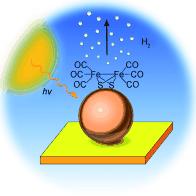 |
| Hitting water with a 2 iron: A novel nanophotocathode for hydrogen production that is based on a multilayer array of InP quantum dots activated with a synthetic diiron catalyst, which is related to the subsite of FeFe hydrogenase. |
Abstract:
New photocatalytic method for the clean production of hydrogen from water
Energy from Light and Water
Weinheim, Germany | Posted on February 9th, 2010Hydrogen-powered fuel cells and solar energy are the best hope for a more environmentally friendly and resource-sparing energy supply in the future. A combination of the two is considered to be particularly "clean": the production of hydrogen by splitting water with sunlight. Previous approaches to this have suffered from high costs and the limited lifetime of their catalytic systems. In the journal Angewandte Chemie, a team led by Thomas Nann and Christopher J. Pickett at the University of East Anglia (Norwich, UK) has now introduced an efficient, robust photoelectrode made of common, inexpensive materials.
The new system consists of a gold electrode that is covered with layers of indium phosphide (InP) nanoparticles. The researchers then introduce an iron-sulfur complex, [Fe2S2(CO)6], into the layered arrangement. When submerged in water and irradiated with light under a relatively small electric current, this photoelectrocatalytic system produces hydrogen with an efficiency of 60%. "This relatively high efficiency is a breakthrough," says Nann.
The researchers have proposed the following mechanism for the reaction: The incoming light particles are absorbed by the InP nanocrystals and excite electrons within the InP. In this excited state, the electrons can be transferred to the iron-sulfur complexes. In a catalytic reaction, the iron-sulfur complexes then pass their electrons on to hydrogen ions (H+) in the surrounding water, which are then released in the form of hydrogen (H2). The gold electrode supplies the necessary electrons to replenish the InP nanocrystals.
In contrast to current processes, the new system works without organic molecules. These must be converted into an excited state to react, which causes them to degrade over time. This problem limits the lifetime of systems with organic components. The new system is purely inorganic and lasts correspondingly longer. "Our newly developed photocatalytic electrode system is robust, efficient, inexpensive, and free of toxic heavy metals," according to Nann. "It may be a highly promising alternative for industrial hydrogen production."
Author: Thomas Nann, University of East Anglia, Norwich (UK), www.uea.ac.uk/che/people/faculty/nannt
Title: Water Splitting by Visible Light: A Nanophotocathode for Hydrogen Production
Angewandte Chemie International Edition, Permalink: dx.doi.org/10.1002/anie.200906262
####
About Wiley InterScience
Wiley InterScience (www.interscience.wiley.com) provides access to over 3 million articles across nearly 1500 journals and 7000 Online Books and major reference works. It also holds industry leading databases such as The Cochrane Library, chemistry databases and the acclaimed Current Protocols laboratory manuals.
Wiley InterScience is one of the world's premiere resources for study, teaching and advanced research.
For more information, please click here
Contacts:
Editorial office
Amy Molnar (US)
Jennifer Beal (UK)
Alina Boey (Asia)
Copyright © Wiley InterScience
If you have a comment, please Contact us.Issuers of news releases, not 7th Wave, Inc. or Nanotechnology Now, are solely responsible for the accuracy of the content.
Bookmark:


| Related News Press |
News and information
 Simulating magnetization in a Heisenberg quantum spin chain April 5th, 2024
NRL charters Navy’s quantum inertial navigation path to reduce drift April 5th, 2024
Discovery points path to flash-like memory for storing qubits: Rice find could hasten development of nonvolatile quantum memory April 5th, 2024
Announcements
NRL charters Navy’s quantum inertial navigation path to reduce drift April 5th, 2024
Discovery points path to flash-like memory for storing qubits: Rice find could hasten development of nonvolatile quantum memory April 5th, 2024
Energy
Development of zinc oxide nanopagoda array photoelectrode: photoelectrochemical water-splitting hydrogen production January 12th, 2024
Shedding light on unique conduction mechanisms in a new type of perovskite oxide November 17th, 2023
Inverted perovskite solar cell breaks 25% efficiency record: Researchers improve cell efficiency using a combination of molecules to address different November 17th, 2023
The efficient perovskite cells with a structured anti-reflective layer – another step towards commercialization on a wider scale October 6th, 2023
Fuel Cells
Current and Future Developments in Nanomaterials and Carbon Nanotubes: Applications of Nanomaterials in Energy Storage and Electronics October 28th, 2022
Quantum Dots/Rods
A new kind of magnetism November 17th, 2023
IOP Publishing celebrates World Quantum Day with the announcement of a special quantum collection and the winners of two prestigious quantum awards April 14th, 2023
Qubits on strong stimulants: Researchers find ways to improve the storage time of quantum information in a spin rich material January 27th, 2023
NIST’s grid of quantum islands could reveal secrets for powerful technologies November 18th, 2022
 |
||
 |
||
| The latest news from around the world, FREE | ||
 |
||
|
|
||
| Premium Products | ||
 |
||
|
Only the news you want to read!
Learn More |
||
 |
||
|
Full-service, expert consulting
Learn More |
||
|
|
||