Home > Press > Princeton scientist makes a leap in quantum computing
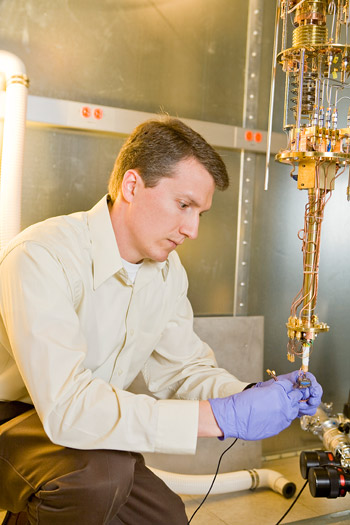 |
| Jason Petta, an assistant professor of physics, has found a way to alter the property of a lone electron without disturbing the trillions of electrons in its immediate surroundings. Such a feat is an important step toward developing future types of quantum computers. (Photos: Brian Wilson) |
Abstract:
A major hurdle in the ambitious quest to design and construct a radically new kind of quantum computer has been finding a way to manipulate the single electrons that very likely will constitute the new machines' processing components or "qubits."
Princeton scientist makes a leap in quantum computing
Princeton, NJ | Posted on February 7th, 2010Princeton University's Jason Petta has discovered how to do just that -- demonstrating a method that alters the properties of a lone electron without disturbing the trillions of electrons in its immediate surroundings. The feat is essential to the development of future varieties of superfast computers with near-limitless capacities for data.
Petta, an assistant professor of physics, has fashioned a new method of trapping one or two electrons in microscopic corrals created by applying voltages to minuscule electrodes. Writing in the Feb. 5 edition of Science, he describes how electrons trapped in these corrals form "spin qubits," quantum versions of classic computer information units known as bits. Other authors on the paper include Art Gossard and Hong Lu at the University of California-Santa Barbara.
Previous experiments used a technique in which electrons in a sample were exposed to microwave radiation. However, because it affected all the electrons uniformly, the technique could not be used to manipulate single electrons in spin qubits. It also was slow. Petta's method not only achieves control of single electrons, but it does so extremely rapidly -- in one-billionth of a second.
"If you can take a small enough object like a single electron and isolate it well enough from external perturbations, then it will behave quantum mechanically for a long period of time," said Petta. "All we want is for the electron to just sit there and do what we tell it to do. But the outside world is sort of poking at it, and that process of the outside world poking at it causes it to lose its quantum mechanical nature."
When the electrons in Petta's experiment are in what he calls their quantum state, they are "coherent," following rules that are radically different from the world seen by the naked eye. Living for fractions of a second in the realm of quantum physics before they are rattled by external forces, the electrons obey a unique set of physical laws that govern the behavior of ultra-small objects.
Scientists like Petta are working in a field known as quantum control where they are learning how to manipulate materials under the influence of quantum mechanics so they can exploit those properties to power advanced technologies like quantum computing. Quantum computers will be designed to take advantage of these characteristics to enrich their capacities in many ways.
In addition to electrical charge, electrons possess rotational properties. In the quantum world, objects can turn in ways that are at odds with common experience. The Austrian theoretical physicist Wolfgang Pauli, who won the Nobel Prize in Physics in 1945, proposed that an electron in a quantum state can assume one of two states -- "spin-up" or "spin-down." It can be imagined as behaving like a tiny bar magnet with spin-up corresponding to the north pole pointing up and spin-down corresponding to the north pole pointing down.
An electron in a quantum state can simultaneously be partially in the spin-up state and partially in the spin-down state or anywhere in between, a quantum mechanical property called "superposition of states." A qubit based on the spin of an electron could have nearly limitless potential because it can be neither strictly on nor strictly off.
New designs could take advantage of a rich set of possibilities offered by harnessing this property to enhance computing power. In the past decade, theorists and mathematicians have designed algorithms that exploit this mysterious superposition to perform intricate calculations at speeds unmatched by supercomputers today.
Petta's work is using electron spin to advantage.
"In the quest to build a quantum computer with electron spin qubits, nuclear spins are typically a nuisance," said Guido Burkard, a theoretical physicist at the University of Konstanz in Germany. "Petta and coworkers demonstrate a new method that utilizes the nuclear spins for performing fast quantum operations. For solid-state quantum computing, their result is a big step forward."
Petta's spin qubits, which he envisions as the core of future quantum logic elements, are cooled to temperatures near absolute zero and trapped in two tiny corrals known as quantum wells on the surface of a high-purity, gallium arsenide chip. The depth of each well is controlled by varying the voltage on tiny electrodes or gates. Like a juggler tossing two balls between his hands, Petta can move the electrons from one well to the other by selectively toggling the gate voltages.
Prior to this experiment, it was not clear how experimenters could manipulate the spin of one electron without disturbing the spin of another in a closely packed space, according to Phuan Ong, the Eugene Higgins Professor of Physics at Princeton and director of the Princeton Center for Complex Materials.
Other experts agree.
"They have managed to create a very exotic transient condition, in which the spin state of a pair of electrons is in that moment entangled with an almost macroscopic degree of freedom," said David DiVincenzo, a research staff member at the IBM Thomas J. Watson Research Center in Yorktown Heights, N.Y.
Petta's research also is part of the fledgling field of "spintronics" in which scientists are studying how to use an electron's spin to create new types of electronic devices. Most electrical devices today operate on the basis of another key property of the electron -- its charge.
There are many more challenges to face, Petta said.
"Our approach is really to look at the building blocks of the system, to think deeply about what the limitations are and what we can do to overcome them," Petta said. "But we are still at the level of just manipulating one or two quantum bits, and you really need hundreds to do something useful."
As excited as he is about present progress, long-term applications are still years away. "It's a one-day-at-a-time approach," Petta said.
Research at Princeton was supported by the Sloan Foundation, the Packard Foundation and the National Science Foundation. Work at the University of California-Santa Barbara was supported by the Defense Advanced Research Projects Agency and the NSF.
####
About Princeton University
Princeton University is a vibrant community of scholarship and learning that stands in the nation's service and in the service of all nations. Chartered in 1746, Princeton is the fourth-oldest college in the United States. Princeton is an independent, coeducational, nondenominational institution that provides undergraduate and graduate instruction in the humanities, social sciences, natural sciences and engineering.
As a world-renowned research university, Princeton seeks to achieve the highest levels of distinction in the discovery and transmission of knowledge and understanding. At the same time, Princeton is distinctive among research universities in its commitment to undergraduate teaching.
Today, more than 1,100 faculty members instruct approximately 5,000 undergraduate students and 2,500 graduate students. The University's generous financial aid program ensures that talented students from all economic backgrounds can afford a Princeton education.
For more information, please click here
Contacts:
Office of Communications
Princeton University
22 Chambers Street, Suite 201
Princeton, N.J. 08542
Tel (609) 258-3601
Fax (609) 258-1301
Primary Media Contact:
Cass Cliatt
Director of Media Relations
(609) 258-6108
Copyright © Princeton University
If you have a comment, please Contact us.Issuers of news releases, not 7th Wave, Inc. or Nanotechnology Now, are solely responsible for the accuracy of the content.
Bookmark:


| Related News Press |
News and information
 Quantum computer improves AI predictions April 17th, 2026
Flexible sensor gains sensitivity under pressure April 17th, 2026
A reusable chip for particulate matter sensing April 17th, 2026
Detecting vibrational quantum beating in the predissociation dynamics of SF6 using time-resolved photoelectron spectroscopy April 17th, 2026
Govt.-Legislation/Regulation/Funding/Policy
Quantum computer improves AI predictions April 17th, 2026
Metasurfaces smooth light to boost magnetic sensing precision January 30th, 2026
New imaging approach transforms study of bacterial biofilms August 8th, 2025
Possible Futures
A fundamentally new therapeutic approach to cystic fibrosis: Nanobody repairs cellular defect April 17th, 2026
UC Irvine physicists discover method to reverse ‘quantum scrambling’ : The work addresses the problem of information loss in quantum computing system April 17th, 2026
Spintronics
Quantum materials: Electron spin measured for the first time June 9th, 2023
Quantum Computing
Quantum computer improves AI predictions April 17th, 2026
UC Irvine physicists discover method to reverse ‘quantum scrambling’ : The work addresses the problem of information loss in quantum computing system April 17th, 2026
Researchers develop molecular qubits that communicate at telecom frequencies October 3rd, 2025
Announcements
A fundamentally new therapeutic approach to cystic fibrosis: Nanobody repairs cellular defect April 17th, 2026
UC Irvine physicists discover method to reverse ‘quantum scrambling’ : The work addresses the problem of information loss in quantum computing system April 17th, 2026
Alliances/Trade associations/Partnerships/Distributorships
Chicago Quantum Exchange welcomes six new partners highlighting quantum technology solutions, from Chicago and beyond September 23rd, 2022
University of Illinois Chicago joins Brookhaven Lab's Quantum Center June 10th, 2022
Quantum nanoscience
Beyond silicon: Electronics at the scale of a single molecule January 30th, 2026
MXene nanomaterials enter a new dimension Multilayer nanomaterial: MXene flakes created at Drexel University show new promise as 1D scrolls January 30th, 2026
ICFO researchers overcome long-standing bottleneck in single photon detection with twisted 2D materials August 8th, 2025
 |
||
 |
||
| The latest news from around the world, FREE | ||
 |
||
|
|
||
| Premium Products | ||
 |
||
|
Only the news you want to read!
Learn More |
||
 |
||
|
Full-service, expert consulting
Learn More |
||
|
|
||