Home > Press > Researchers show applied electric field can significantly improve hydrogen storage properties
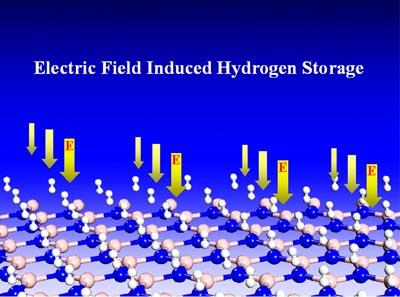 |
| This image illustrates that an applied electric field polarizes hydrogen molecules and the substrate, inducing hydrogen absorption with good thermodynamics and kinetics. Image courtesy of Qian Wang, Ph.D./VCU. |
Abstract:
An international team of researchers has identified a new theoretical approach that may one day make the synthesis of hydrogen fuel storage materials less complicated and improve the thermodynamics and reversibility of the system.
Researchers show applied electric field can significantly improve hydrogen storage properties
Richmond, VA | Posted on February 4th, 2010Many researchers have their sights set on hydrogen as an alternative energy source to fossil fuels such as oil, natural gas and coal that contain carbon, pollute the environment and contribute to global warming. Known to be the most abundant element in the universe, hydrogen is considered an ideal energy carrier - not to mention that it's clean, environmentally friendly and non-toxic. However, it has been difficult to find materials that can efficiently and safely store and release it with fast kinetics under ambient temperature and pressure.
The team of researchers from Virginia Commonwealth University, Peking University in Beijing, and the Chinese Academy of Science in Shanghai, have developed a process using an electric field that can significantly improve how hydrogen fuel is stored and released.
"Although tremendous efforts have been devoted to experimental and theoretical research in the past years, the biggest challenge is that all the existing methods do not meet the Department of Energy targets for hydrogen storage materials. The breakthrough can only be achieved by exploring new mechanisms and new principles for materials design," said Qiang Sun, Ph.D., research associate professor with the VCU team, who led the study.
"We have made such an attempt, and we have proposed a new principle for the design of hydrogen storage materials which involves materials with low-coordinated, non-metal anions that are highly polarizable in an applied electric field," he said.
"Using an external electric field as another variable in our search for such a material will bring a hydrogen economy closer to reality. This is a paradigm shift in the approach to store hydrogen. Thus far, the efforts have been on how to modify the composition of the storage material. Here we show that an applied electric field can do the same thing as doped metal ions," said Puru Jena, Ph.D., distinguished professor in the VCU Department of Physics.
"More importantly, it avoids many problems associated with doping metal ions such as clustering of metal atoms, poisoning of metal ions by other gases, and a complicated synthesis process. In addition, once the electric field is removed, hydrogen desorbs, making the process reversible with fast kinetics under ambient conditions," he said.
The team found that an external electric field can be used to store hydrogen just as an internal field can store hydrogen due to charge polarization caused by a metal ion.
"This work will help researchers create an entirely new way to store hydrogen and find materials that are most suitable. The challenge now is to find materials that are easily polarizable under an applied electric field. This will reduce the strength of the electric field needed for efficient hydrogen storage," said Jena.
The research is published online in the Early Edition of the Proceedings of the National Academy of Sciences and will be highlighted in the front section of the print edition, "In this Issue."
The research is based on a 1992 published polarization theory by Jena, the late B.K. Rao, a former professor of physics at VCU, and their student, J.Niu.
This work is supported by grants from the National Natural Science Foundation of China, the Foundation of National Laboratory for Infrared Physics, the National Grand Fundamental Research 973 Program of China, the U.S. National Science Foundation and the U.S. Department of Energy.
####
About Virginia Commonwealth University
Virginia Commonwealth University is a major, urban public research university with national and international rankings in sponsored research. Located on two downtown campuses in Richmond, VCU enrolls more than 32,000 students in 211 certificate and degree programs in the arts, sciences and humanities. Sixty-nine of the programs are unique in Virginia, many of them crossing the disciplines of VCU’s 13 schools and one college. MCV Hospitals and the health sciences schools of Virginia Commonwealth University compose the VCU Medical Center, one of the nation’s leading academic medical centers.
For more information, please click here
Contacts:
Sathya Achia Abraham
VCU Communications and Public Relations
(804) 827-0890
Copyright © Virginia Commonwealth University
If you have a comment, please Contact us.Issuers of news releases, not 7th Wave, Inc. or Nanotechnology Now, are solely responsible for the accuracy of the content.
Bookmark:


| Related News Press |
News and information
 Simulating magnetization in a Heisenberg quantum spin chain April 5th, 2024
NRL charters Navy’s quantum inertial navigation path to reduce drift April 5th, 2024
Discovery points path to flash-like memory for storing qubits: Rice find could hasten development of nonvolatile quantum memory April 5th, 2024
Academic/Education
Rice University launches Rice Synthetic Biology Institute to improve lives January 12th, 2024
Multi-institution, $4.6 million NSF grant to fund nanotechnology training September 9th, 2022
Announcements
NRL charters Navy’s quantum inertial navigation path to reduce drift April 5th, 2024
Discovery points path to flash-like memory for storing qubits: Rice find could hasten development of nonvolatile quantum memory April 5th, 2024
Environment
Billions of nanoplastics released when microwaving baby food containers: Exposure to plastic particles kills up to 75% of cultured kidney cells July 21st, 2023
Energy
Development of zinc oxide nanopagoda array photoelectrode: photoelectrochemical water-splitting hydrogen production January 12th, 2024
Shedding light on unique conduction mechanisms in a new type of perovskite oxide November 17th, 2023
Inverted perovskite solar cell breaks 25% efficiency record: Researchers improve cell efficiency using a combination of molecules to address different November 17th, 2023
The efficient perovskite cells with a structured anti-reflective layer – another step towards commercialization on a wider scale October 6th, 2023
Automotive/Transportation
Researchers’ approach may protect quantum computers from attacks March 8th, 2024
Tests find no free-standing nanotubes released from tire tread wear September 8th, 2023
Fuel Cells
Current and Future Developments in Nanomaterials and Carbon Nanotubes: Applications of Nanomaterials in Energy Storage and Electronics October 28th, 2022
Grants/Sponsored Research/Awards/Scholarships/Gifts/Contests/Honors/Records
Discovery points path to flash-like memory for storing qubits: Rice find could hasten development of nonvolatile quantum memory April 5th, 2024
Chemical reactions can scramble quantum information as well as black holes April 5th, 2024
 |
||
 |
||
| The latest news from around the world, FREE | ||
 |
||
|
|
||
| Premium Products | ||
 |
||
|
Only the news you want to read!
Learn More |
||
 |
||
|
Full-service, expert consulting
Learn More |
||
|
|
||