Home > Press > Nano for the senses
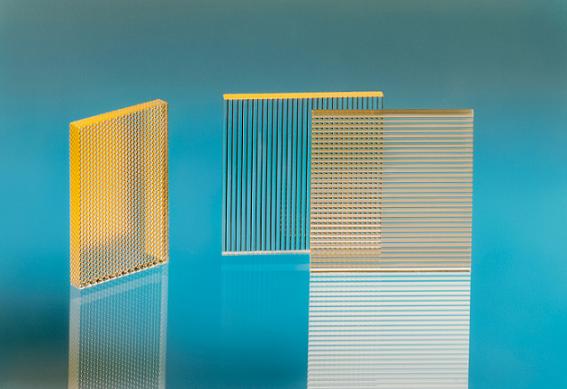 |
| Micro-optical elements bundle and homogenize the light. (© Fraunhofer IOF) |
Abstract:
Pin-sharp projections, light that's whiter than white, varnishes that make sounds if the temperature changes: at nano tech 2010 in Tokyo, Fraunhofer researchers present nanotechnology that is a veritable feast for the senses.
Nano for the senses
Germany | Posted on February 2nd, 2010A mystical glow emanates from the display case. A white light appears out of nowhere. And a light source is invisible - at least at first glance. Only upon close examination does the source of the apparently supernatural illumination become visible: a light diode, smaller than a pinhead, passes through thousands of infinitesimal lens structures measuring only a few hundred nanometers, et voilà: beaming white light.
"For a long time, producing white light with no peripheral color effects was an almost unsolvable technical problem," explains Dr. Michael Popall of the Fraunhofer Institute for Silicate Research ISC in Wurzburg. "White light is produced by mixing the complementary colors red, green and blue. Undesirable refraction occurs with conventional beamer technology, resulting in colored streaks on the periphery of the projection." This technology - which researchers will present from February 17 to 19 at nano tech 2010 in Tokyo, Hall 3.03 Booth F-14-1 - delivers not only brilliant color, but also pure white: "The tiniest of red, blue and green light diodes on the most condensed space produce the light, which is then bundled and homogenized by the nano-structured ORMOCER® optics," illustrates Popall, who was deeply involved in the development of the material.
"ORMOCER®s are an ideal material for the production of microoptics," concludes the researcher. "They are not only superior light conductors, but are also easy to process - not as brittle as glass, and not as pliant as polymers." In fact, ORMOCER®s are a hybrid of inorganic and organic components that are networked at the molecular level. This material makes it possible to realize things inconceivable even a couple of years ago: Ultra-flat and ultra-small optics for micro-cameras or beamers that fit into a pants pocket. The design of the new ORMOCER® optics, incidentally, was developed by experts at the Fraunhofer Institute for Applied Optics and Precision Engineering IOF in Jena. Popall: "Thanks to close collaboration among chemists at ISC and the physicists and engineers at IOF, we have succeeded in developing ORMOCER® tandem arrays with two-sided and symmetrically arranged micro-lens configurations, which allow the light from light diodes to be projected with pinpoint accuracy and without refraction errors." The new technology has meanwhile reached the verge of market introduction.
Nanotechnology not only puts an entirely new dimension before the eye, it also makes audible things that no ear could ever perceive before: like changes in temperature. A new varnish developed by researchers at the Fraunhofer Institute for Engineering and Automation IPA ensures that surfaces emit sound if they become warmer or cool off. The trick: carbon nano-tubes embedded in the varnish that conduct electricity: If a surface is coated with this varnish, then it can be heated up by application of an electric current. This change in temperature is audible because the warming up surface makes the air around it vibrate. "And this is only one of a myriad of conceivable innovative applications. The surface coating is likewise capable of heating large surfaces and surfaces of complex shape, and in the future, conceivably it can be used as a multifunctional coating for heating, or as a resistance sensor, or as a coating for color displays," says Ivica Kolaric, head of department at IPA.
"The interdisciplinary nature of Fraunhofer is its strength," concludes Popall. The 59 institutes that collaborate within the Fraunhofer Gesellschaft cover a truly broad spectrum - from materials to technology and design, through to processes and the resulting applications. At nano tech 2010 in Tokyo, ISC presents an array of optical materials, ranging from glasses to ORMOCER®s and their nanotechnology, to plastics. IOF contributes high-precision optical design and microtechnology, the Fraunhofer Institute for Electron Beam and Plasma Technology FEP has physical coating technologies. The Fraunhofer Institute for Ceramic Technologies and Systems IKTS in Dresden will additionally display manufacturing processes, such as pressing glass optics or coating with the use of nanolithography. Lastly, IPA will exhibit its prowess with carbon nano-tubes.
####
About Fraunhofer-Gesellschaft
60 years ago, on March 26, 1949, the Fraunhofer-Gesellschaft was founded in the large conference hall of the Bavarian Ministry of the Economy. At the time, the idea was to develop new structures for research after the war's destruction, and to spur reconstruction of the economy.
For more information, please click here
Contacts:
Franz Miller
Head of Press and Public Relations
Headquarters of the Fraunhofer-Gesellschaft
Hansastraße 27c
80686 Munich, Germany
franz.miller(at)zv.fraunhofer.de
Phone +49 89 1205-1300
Fax +49 89 1205-7515
Copyright © Fraunhofer-Gesellschaft
If you have a comment, please Contact us.Issuers of news releases, not 7th Wave, Inc. or Nanotechnology Now, are solely responsible for the accuracy of the content.
Bookmark:


| Related News Press |
News and information
 Quantum computer improves AI predictions April 17th, 2026
Flexible sensor gains sensitivity under pressure April 17th, 2026
A reusable chip for particulate matter sensing April 17th, 2026
Detecting vibrational quantum beating in the predissociation dynamics of SF6 using time-resolved photoelectron spectroscopy April 17th, 2026
Chemistry
Projecting light to dispense liquids: A new route to ultra-precise microdroplets January 30th, 2026
From sensors to smart systems: the rise of AI-driven photonic noses January 30th, 2026
"Nanoreactor" cage uses visible light for catalytic and ultra-selective cross-cycloadditions October 3rd, 2025
Cambridge chemists discover simple way to build bigger molecules – one carbon at a time June 6th, 2025
Single-atom catalysts change spin state when boosted by a magnetic field June 4th, 2025
Display technology/LEDs/SS Lighting/OLEDs
Spinel-type sulfide semiconductors to operate the next-generation LEDs and solar cells For solar-cell absorbers and green-LED source October 3rd, 2025
Nanotubes/Buckyballs/Fullerenes/Nanorods/Nanostrings/Nanosheets
Tiny nanosheets, big leap: A new sensor detects ethanol at ultra-low levels January 30th, 2026
Enhancing power factor of p- and n-type single-walled carbon nanotubes April 25th, 2025
Chainmail-like material could be the future of armor: First 2D mechanically interlocked polymer exhibits exceptional flexibility and strength January 17th, 2025
Innovative biomimetic superhydrophobic coating combines repair and buffering properties for superior anti-erosion December 13th, 2024
Announcements
A fundamentally new therapeutic approach to cystic fibrosis: Nanobody repairs cellular defect April 17th, 2026
UC Irvine physicists discover method to reverse ‘quantum scrambling’ : The work addresses the problem of information loss in quantum computing system April 17th, 2026
Events/Classes
Institute for Nanoscience hosts annual proposal planning meeting May 16th, 2025
A New Blue: Mysterious origin of the ribbontail ray’s electric blue spots revealed July 5th, 2024
Researchers demonstrate co-propagation of quantum and classical signals: Study shows that quantum encryption can be implemented in existing fiber networks January 20th, 2023
Alliances/Trade associations/Partnerships/Distributorships
Chicago Quantum Exchange welcomes six new partners highlighting quantum technology solutions, from Chicago and beyond September 23rd, 2022
University of Illinois Chicago joins Brookhaven Lab's Quantum Center June 10th, 2022
 |
||
 |
||
| The latest news from around the world, FREE | ||
 |
||
|
|
||
| Premium Products | ||
 |
||
|
Only the news you want to read!
Learn More |
||
 |
||
|
Full-service, expert consulting
Learn More |
||
|
|
||