Home > Press > Self-healing polymer “starfish” prolong lifetime of automotive oils
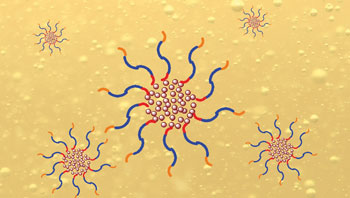 |
| Star-shaped polymers can repair their arms using a Diels-Alder reaction. RSC Publishing. |
Abstract:
Researchers have created self-healing polymers that could extend the lifetime of automotive oils.
Self-healing polymer “starfish” prolong lifetime of automotive oils
UK | Posted on January 30th, 2010These polymers are suitable to add to lubricants and could maintain the physical properties of engine oils for longer, they claim helping engine efficiency. Biological materials, such as skin, self heal following damage giving inspiration for these new materials.
Polymers are often added to automotive oils to control important physical properties such as viscosity but mechanical and thermal stress can break the polymers decreasing the efficiency and how they affect the oils properties. The research team, led by Professor David Haddleton, of the University of Warwick have now designed a self-healing, star-shaped polymer for use as a viscosity modifier.
The methacrylate polymer has vulnerable long arms which be broken off if stressed reducing performance. The research team found they could add a particular chemical combination to the polymer's backbone which, almost like a starfish, which allow broken arms to reform via a "Diels Alder cycloaddition reaction" in a self healing reaction.
The research team now plan to 'optimise the chemistry before passing it on to our industrial collaborators, Lubrizol, for development in automotive lubricant applications,' says Professor Haddleton.
The research paper "Self-healing polymers prepared via living radical polymerisation" by
Jay A. Syrett, Giuseppe Mantovani, William R. S. Barton, David Price and David M. Haddleton, has just been published in Polymer Chemistry. DOI: 10.1039/b9py00316a Journal at:
www.rsc.org/Publishing/Journals/PY/index.asp
The RSC story with graphic at:
www.rsc.org/Publishing/ChemScience/Volume/2010/02/Self-healing_polymer.asp
####
About University of Warwick
Warwick is one of the UK’s leading universities, with an acknowledged reputation for excellence in research and teaching, for innovation, and for links with business and industry. By 2015 Warwick will be in the top 50 world Universities.
For more information, please click here
Contacts:
Professor Dave Haddleton
Department of Chemistry
University of Warwick
024 76523256
Peter Dunn
Head of Communications
University of Warwick
024 76 523708
07767 655860
Copyright © University of Warwick
If you have a comment, please Contact us.Issuers of news releases, not 7th Wave, Inc. or Nanotechnology Now, are solely responsible for the accuracy of the content.
Bookmark:


| Related News Press |
News and information
 Simulating magnetization in a Heisenberg quantum spin chain April 5th, 2024
NRL charters Navy’s quantum inertial navigation path to reduce drift April 5th, 2024
Discovery points path to flash-like memory for storing qubits: Rice find could hasten development of nonvolatile quantum memory April 5th, 2024
Possible Futures
Discovery points path to flash-like memory for storing qubits: Rice find could hasten development of nonvolatile quantum memory April 5th, 2024
With VECSELs towards the quantum internet Fraunhofer: IAF achieves record output power with VECSEL for quantum frequency converters April 5th, 2024
Announcements
NRL charters Navy’s quantum inertial navigation path to reduce drift April 5th, 2024
Discovery points path to flash-like memory for storing qubits: Rice find could hasten development of nonvolatile quantum memory April 5th, 2024
Automotive/Transportation
Researchers’ approach may protect quantum computers from attacks March 8th, 2024
Tests find no free-standing nanotubes released from tire tread wear September 8th, 2023
 |
||
 |
||
| The latest news from around the world, FREE | ||
 |
||
|
|
||
| Premium Products | ||
 |
||
|
Only the news you want to read!
Learn More |
||
 |
||
|
Full-service, expert consulting
Learn More |
||
|
|
||