Home > Press > Using Nanotechnology to Boost the Lifespan of Medical Implants
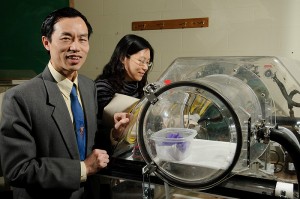 |
| Professor Leon Shaw with a graduate student in his lab at the Institute of Materials Science. Photo by Peter Morenus |
Abstract:
His work in the red-hot area of nanotechnology has sparked three NSF-funded research awards for Leon Shaw, a professor in the Department of Chemical, Materials, & Biomolecular Engineering.
Using Nanotechnology to Boost the Lifespan of Medical Implants
Storrs, CT | Posted on January 9th, 2010Of the three, one marries nano-materials with biomedical engineering. Together with Yong Wang, an assistant professor of chemical, materials, and biomolecular engineering, Shaw will work on developing a titanium/hydroxyapatite orthopedic implant designed to improve implant longevity and reduce the need for revision surgery, thus reducing long-term health care costs and patient stress.
Over 10 million Americans currently carry at least one major implanted medical device in their bodies. Due to their excellent corrosion resistance, superior strength, and biocompatibility, titanium and stainless steel alloys are the principal materials used in most medical implants. Despite their advantages, these alloys also carry major disadvantages: in many cases, their life expectancy is shorter than those of their wearers, prompting additional replacement implant surgeries.
In addition, titanium and steel alloys are unlikely to have the stability or fit of the original tissue, leading to rejection of the implant. While currently available implants may alleviate pain and allow patients to live active lives, there are often complications getting bone to attach to the metal devices. Small gaps between natural bone and the implant can expand over time, requiring additional surgery to replace the implant. Researchers are increasingly turning to nanotechnology for solutions.
To overcome the problems associated with metallic implants, many research organizations and commercial companies have tried to develop orthopedic implants that have a bioactive surface to promote cellular adhesion and bony in-growth. Efforts have been made to create a stable fit that more closely resembles the original tissue, thus eliminating the need for additional surgery to repair the damage or gaps.
The two most widely used methods involve the application of either hydroxyapatite or porous titanium coatings to implant surfaces. The problem is that titanium is not bioactive, whereas hydroxyapatite coatings could delaminate during use. With this in mind, Shaw and Wang have geared their project toward the development of a new family of functionally graded, porous implant materials with a hierarchy of engineered microstructures. This new family of orthopedic implants will address the issues by applying either hydroxyapatite or porous titanium coatings and will be fabricated through a novel solid freeform fabrication method developed in Shaw's laboratory. This type of orthopedic implants is the first of its kind to pair a titanium-rich core and a hydroxyapatite-rich surface with a controlled level of micro- and macro-porosity never produced previously.
Shaw's other NSF grants are also collaborative efforts. Shaw will be teaming with Kennametal Inc., a global leader in hard metal technology. This project is aimed at the development of innovative manufacturing methods that can produce novel materials with superior mechanical properties derived from nanocrystalline powder. The collaboration will ensure that the research is relevant to the hard metal industry and that the results will be disseminated to end users.
The third research project is in collaboration with Mahmoud Zawrah, a researcher from the National Research Center in Cairo, Egypt. Together, they are looking at the processing and fabrication of nano-Si3N4 and SiC composites using the waste material silica fume as the starting material. If successful, this project will lead to advancements in the production of large quantities of high purity nano-composite powders and sintered (or densified) Si3N4/SiC components from silica fume in a reproducible, precise, and economical fashion.
####
About University of Connecticut
Perennially ranked the top public university in New England, the University of Connecticut now stands among the best public institutions in the nation. UConn’s main campus in Storrs is admitting the highest-achieving freshmen in University history. Student diversity continues to increase, as does the number of honors students, valedictorians and salutatorians who consistently make UConn their top choice.
For more information, please click here
Copyright © University of Connecticut
If you have a comment, please Contact us.Issuers of news releases, not 7th Wave, Inc. or Nanotechnology Now, are solely responsible for the accuracy of the content.
Bookmark:


| Related News Press |
News and information
 Simulating magnetization in a Heisenberg quantum spin chain April 5th, 2024
NRL charters Navy’s quantum inertial navigation path to reduce drift April 5th, 2024
Discovery points path to flash-like memory for storing qubits: Rice find could hasten development of nonvolatile quantum memory April 5th, 2024
Govt.-Legislation/Regulation/Funding/Policy
NRL charters Navy’s quantum inertial navigation path to reduce drift April 5th, 2024
Discovery points path to flash-like memory for storing qubits: Rice find could hasten development of nonvolatile quantum memory April 5th, 2024
Chemical reactions can scramble quantum information as well as black holes April 5th, 2024
Nanomedicine
New micromaterial releases nanoparticles that selectively destroy cancer cells April 5th, 2024
Good as gold - improving infectious disease testing with gold nanoparticles April 5th, 2024
Researchers develop artificial building blocks of life March 8th, 2024
Announcements
NRL charters Navy’s quantum inertial navigation path to reduce drift April 5th, 2024
Discovery points path to flash-like memory for storing qubits: Rice find could hasten development of nonvolatile quantum memory April 5th, 2024
Nanobiotechnology
New micromaterial releases nanoparticles that selectively destroy cancer cells April 5th, 2024
Good as gold - improving infectious disease testing with gold nanoparticles April 5th, 2024
Researchers develop artificial building blocks of life March 8th, 2024
Alliances/Trade associations/Partnerships/Distributorships
Chicago Quantum Exchange welcomes six new partners highlighting quantum technology solutions, from Chicago and beyond September 23rd, 2022
University of Illinois Chicago joins Brookhaven Lab's Quantum Center June 10th, 2022
 |
||
 |
||
| The latest news from around the world, FREE | ||
 |
||
|
|
||
| Premium Products | ||
 |
||
|
Only the news you want to read!
Learn More |
||
 |
||
|
Full-service, expert consulting
Learn More |
||
|
|
||