Home > Press > The Cell Whisperers
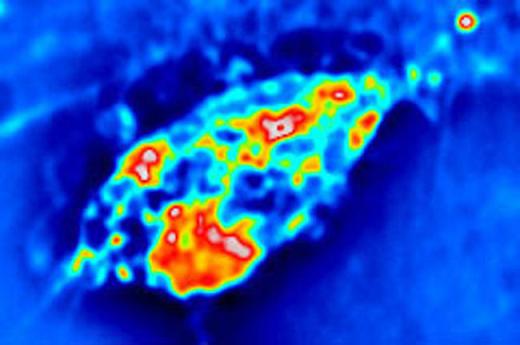 |
| Hippocampal neuron imaged by Spatial Light Interference Microscopy (SLIM) developed at the QLI Lab (light.ece.uiuc.edu/) |
Abstract:
Gabriel Popescu and his Quantitative Light Imaging Lab Take New Approach to Measuring Cell Dynamics and Structure
The Cell Whisperers
Urbana, IL | Posted on January 8th, 2010Beckman Institute researcher Gabriel Popescu doesn't just want to know how cells communicate - he wants in on the conversation. To accomplish that, Popescu takes advantage of the properties of light through truly original approaches to measuring cellular structure and dynamics.
Light scattering techniques, interferometry (bringing two waves together), and microscopy are combined in his research to address tissue interactions and make-up, both for basic science research and for applications. When asked about his research, Popescu says his approach is a form of eavesdropping.
"One way," he said, "to describe our cell imaging work is that we're trying to listen to cells as opposed to just seeing them, which microscopy has been doing for centuries. Now we are actually accurately measuring their motion at the nanoscale. So that in many ways, with all of these vibrations, is very close to listening to something."
Popescu's grand vision for his research line, however, goes beyond just listening to those cells. "What we really want to do in the end is to be cell whisperers, to talk back to them, and understand their language."
For Popescu and the students and postdocs in his lab, their work to quantify the structure and dynamics of cells and tissues has three components: research that serves both basic and translational purposes and that is highly collaborative.
"We cannot solve the problems by ourselves," Popescu said. "At the same time we think that the cell biology labs cannot do certain things without our help. This is the trend in the whole biomedical field, to apply understanding from non-living science back to cells, via collaborations across disciplines."
Popescu is an Assistant Professor in the Department of Electrical and Computer Engineering at Illinois and a full-time faculty member in the Bioimaging Science and Technology group. His Quantitative Light Imaging (QLI) Laboratory at Beckman works, as stated on their Web site, to develop "novel optical methods based on light scattering, interferometry and microscopy to quantify structure and dynamics of cells and tissues" toward performing "highly interdisciplinary research at the interface between technology development, basic biological studies and clinical applications."
The group includes students from physics, electrical engineering, and mechanical engineering, with collaborations that touch on topics in fields such as medicine, neuroscience, computer science, and biochemistry. Technology development using their optical methods is central to their efforts, especially for the technology's potential use in the biomedical field. When asked about their research, Popescu and members of his lab say potential applications of the work are just as important as the science behind those applications.
"We're not only toolmakers but we also use them to do our own science while we hope to impact other research," Popescu said. "At this stage we are exploring many of the applications of our technology.
"I usually separate them into structures, saying we are imaging the structures and then the dynamics. Both of these parts of the research are basic; we are trying to understand phenomena in cells, and how light interacts with tissues. But we also have a component that goes all the way to clinical applications. In that we are looking mainly at blood screening and cancer detection."
Huafeng Ding, a postdoctoral researcher in the lab who works on issues such as Fourier transport and light scattering in cells and tissues, says their work seeks results that are useful in real-world settings.
"We want to apply this system in a clinic to detect cancer," he said. "It will save time and labor and it will also be easy to use and allow for early diagnosis."
Mustafa Mir is a graduate student who has been with the lab for two years. He is working on a blood screening project that uses interferometry to characterize blood cells for medical diagnosis applications.
"That's basically what a pathologist is doing when they are looking at a slide: with the help of the stains they are looking at the shapes of these cells," Mir said. "We developed a way to do this automatically, and to reduce the amount of time a pathologist needs to spend on a case and to provide more accurate information for a diagnosis."
The lab is collaborating on projects with Provena Hospital in Urbana to develop methods for clinical settings.
"What we are seeing in the biomedical field is more of an engineering and physics approach to cell functioning," Popescu said. "What's missing are the proper tools to measure all these signals in live cells. How do you measure interactions between cells, these small vibrations that are always there, but very hard to measure. I think we're contributing to that with the tools."
Popescu sees those tools and their approach as offering a new way to understand cellular structure and dynamics.
"If you want a quantitative measurement of this, then you have to apply some engineering tools to understand the signal," he said. "So, treat the cell like it's a radio, treat a network of neurons as if they were a network of wires communicating with one another. You have all the signals. Now what you are trying to do is come up with the proper models to understand them."
Popescu said that cell growth is a poorly understood phenomenon, but having the proper tools to measure and understand that process could mean a breakthrough.
"Then you can modulate them, you can make cells grow differently," Popescu said. "That's where we have our own unique place because there are so many physicists and engineering people coming into the field nowadays like us. The fact that we have these ultrasensitive, quantitative methods, I hope, will make an impact in basic science, in research labs, but also we are trying to push it to the clinic, where the requirements are sometimes totally different.
"We're learning that as we go. Having this collaboration with Provena helps us because we see how they run things in their medical lab."
That type of end-product vision is a big motivator for the lab's researchers. Zhou Wang came to the group as an electrical engineering student with little background in biology.
"It's very exciting for me because I had never imaged things before," Wang said. "I had looked at things under a microscope but that was just for class. Here we are developing new microscopy and imaging cell to cell in 3-D. With imaging you really see it and feel it. I'm still an engineer but I'm excited to provide useful tools for biologists and to collaborate with them."
Ru Wang's major is in mechanical engineering but in the lab she is developing methods for understanding the mechanics of cells. In one project, she uses microscopy to study the deformation of red blood cells (an important issue for understanding cellular oxygen transport), while another is aimed at developing a low-coherence optical spectroscopy method for extremely fast detection of the microrheology of complex fluids, including biological structures.
"We try to understand how these materials store and dissipate mechanical energy," Wang said. "I'm very happy that my work has some applications in these two important areas. What I enjoy most is that our lab has developed some very unique technologies."
Popescu's background includes degrees in Physics from the University of Bucharest in his native country and a Ph.D. in Optics in 2002 from CREOL, the University of Central Florida. He worked as a postdoctoral research associate at MIT before coming to the University of Illinois and Beckman in 2007.
Popescu's approach combines his thesis work on light scattering, and his postdoctoral research involving imaging. He says applying optical methods toward understanding tissue dynamics and structure offers several advantages over other techniques.
"Light in general has the advantage of being non-invasive," Popescu said. "The typical optical experiment in biomedicine is to send light through the tissue and then read what comes back through scattering, or read what's missing through absorption measuring."
Popescu said their methods are expanding measurement capabilities by getting additional information on both structure and dynamics at the nanoscale.
"In our case we push that further in terms of sensitivity, adding interferometry," he added. "In other words, we are using two beams instead of just one - one that interacts with the sample and the second that is kept as a reference. By comparing these two beams we actually get to the nanoscale structure and motion in live cells and tissue.
"So that is fairly unique. Commercial microscopes don't do that. All this information is quantitative. In a way this is combining holography with microscopy. It's a new but very dynamic field that we are contributing to."
For those interested in this line of research, Popescu will be teaching a new course on Modern Light Microscopy where current, cutting-edge topics in microscopy will be introduced.
Popescu and his lab members say that their leading-edge research makes coming to the lab a fun experience.
"I think that is the most important part, the fact that we talk to one another basically every day, and the new surprising things that keep happening," Popescu said. "We come to work every morning and we don't know what we are going to discover. So we talk to one another, go back and forth; I think that is the greatest part of the whole thing.
"I think when you are excited about what's going on in the lab it doesn't feel like work. Nobody can work effectively for 12 hours a day but everybody can have fun for 12 hours a day."
####
About Beckman Institute for Advanced Science and Technology
The Beckman Institute for Advanced Science and Technology at the University of Illinois at Urbana-Champaign is an interdisciplinary research institute devoted to leading-edge research in the physical sciences, computation, engineering, biology, behavior, cognition, and neuroscience.
The Institute's primary mission is to foster interdisciplinary work of the highest quality, transcending many of the limitations inherent in traditional university organizations and structures. The Institute was founded on the premise that reducing the barriers between traditional scientific and technological disciplines can yield research advances that more conventional approaches cannot.
For more information, please click here
Copyright © Beckman Institute for Advanced Science and Technology
If you have a comment, please Contact us.Issuers of news releases, not 7th Wave, Inc. or Nanotechnology Now, are solely responsible for the accuracy of the content.
Bookmark:


| Related News Press |
News and information
 Simulating magnetization in a Heisenberg quantum spin chain April 5th, 2024
NRL charters Navy’s quantum inertial navigation path to reduce drift April 5th, 2024
Discovery points path to flash-like memory for storing qubits: Rice find could hasten development of nonvolatile quantum memory April 5th, 2024
Possible Futures
Discovery points path to flash-like memory for storing qubits: Rice find could hasten development of nonvolatile quantum memory April 5th, 2024
With VECSELs towards the quantum internet Fraunhofer: IAF achieves record output power with VECSEL for quantum frequency converters April 5th, 2024
Academic/Education
Rice University launches Rice Synthetic Biology Institute to improve lives January 12th, 2024
Multi-institution, $4.6 million NSF grant to fund nanotechnology training September 9th, 2022
Nanomedicine
New micromaterial releases nanoparticles that selectively destroy cancer cells April 5th, 2024
Good as gold - improving infectious disease testing with gold nanoparticles April 5th, 2024
Researchers develop artificial building blocks of life March 8th, 2024
Announcements
NRL charters Navy’s quantum inertial navigation path to reduce drift April 5th, 2024
Discovery points path to flash-like memory for storing qubits: Rice find could hasten development of nonvolatile quantum memory April 5th, 2024
Nanobiotechnology
New micromaterial releases nanoparticles that selectively destroy cancer cells April 5th, 2024
Good as gold - improving infectious disease testing with gold nanoparticles April 5th, 2024
Researchers develop artificial building blocks of life March 8th, 2024
Alliances/Trade associations/Partnerships/Distributorships
Chicago Quantum Exchange welcomes six new partners highlighting quantum technology solutions, from Chicago and beyond September 23rd, 2022
University of Illinois Chicago joins Brookhaven Lab's Quantum Center June 10th, 2022
 |
||
 |
||
| The latest news from around the world, FREE | ||
 |
||
|
|
||
| Premium Products | ||
 |
||
|
Only the news you want to read!
Learn More |
||
 |
||
|
Full-service, expert consulting
Learn More |
||
|
|
||