Home > Press > UCSB Researchers Develop Drug Delivery System Using Nanoparticles and Lasers
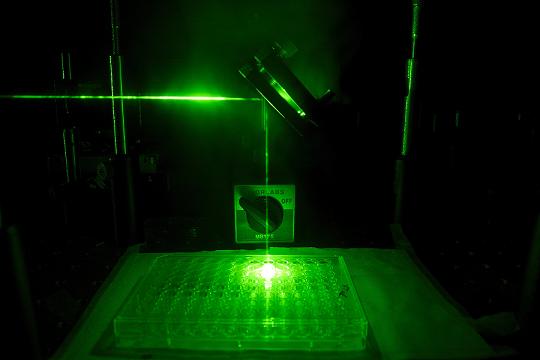 |
| The near-infrared laser pathway into the cell culture plate, traced by visible laser for photo. photo credit: Rod Rolle |
Abstract:
Researchers at UC Santa Barbara have developed a new way to deliver drugs into cancer cells by exposing them briefly to a non-harmful laser. Their results are published in a recent article in ACS NANO, a journal of the American Chemical Society.
UCSB Researchers Develop Drug Delivery System Using Nanoparticles and Lasers
Santa Barbara, CA | Posted on December 28th, 2009"This entirely novel tool will allow biologists to investigate how genes function by providing them with temporal and spatial control over when a gene is turned on or off," explained Norbert Reich, senior author and a professor in the Department of Chemistry and Biochemistry at UCSB. "In a nutshell, what we describe is the ability to control genes in cells -- and we are working on doing this in animals -- simply by briefly exposing them to a non-harmful laser."
The scientists used cancer cells from mice, and grew them in culture. They then introduced gold nanoshells, with a peptide-lipid coating, that encapsulated "silencing ribonucleic acid" (siRNA), which was the drug that was taken up by the cells. Next, they exposed the cells to a non-harmful infrared laser.
"A major technical hurdle is how to combine multiple biochemical components into a compact nanoparticle which may be taken up by cells and exist stably until the release is desired," said Gary Braun, first author and a graduate student in UCSB's Department of Chemistry and Biochemistry. "Laser-controlled release is a convenient and powerful tool, allowing precise dosing of particular cells within a group. The use of biologically friendly tissue penetration with near-infrared light is the ideal for extending this capability into larger biological systems such as tissues and animals."
The authors demonstrated, for the first time, the delivery of a potent siRNA cargo inside mammalian cancer cells, released by exposing the internalized nanoparticles for several seconds to a pulsed near-infrared laser tuned for peak absorption with a specific spatial pattern. The technique can be expanded to deliver numerous drug molecules against diverse biological targets.
The additional collaborating authors on the paper are Alessia Pallaoro, also of UCSB's Department of Chemistry and Biochemistry; Guohui Wu and Joseph A. Zasadzinski, of UCSB's Department of Chemical Engineering; Dimitris Missirlis, of UCSB's College of Engineering, and Matthew Tirrell, former dean of UCSB's College of Engineering and now at UC Berkeley.
####
About UCSB
UCSB is one of only 62 institutions elected to membership in the prestigious Association of American Universities. And the Newsweek guide to America's best colleges has named UCSB one of the country's "hottest colleges" twice in the past five years.
For more information, please click here
Contacts:
Gail Gallessich
805-893-7220
George Foulsham
805-893-3071
Copyright © UCSB
If you have a comment, please Contact us.Issuers of news releases, not 7th Wave, Inc. or Nanotechnology Now, are solely responsible for the accuracy of the content.
Bookmark:


| Related News Press |
News and information
 Quantum computer improves AI predictions April 17th, 2026
Flexible sensor gains sensitivity under pressure April 17th, 2026
A reusable chip for particulate matter sensing April 17th, 2026
Detecting vibrational quantum beating in the predissociation dynamics of SF6 using time-resolved photoelectron spectroscopy April 17th, 2026
Possible Futures
A fundamentally new therapeutic approach to cystic fibrosis: Nanobody repairs cellular defect April 17th, 2026
UC Irvine physicists discover method to reverse ‘quantum scrambling’ : The work addresses the problem of information loss in quantum computing system April 17th, 2026
Nanomedicine
A fundamentally new therapeutic approach to cystic fibrosis: Nanobody repairs cellular defect April 17th, 2026
New molecular technology targets tumors and simultaneously silences two ‘undruggable’ cancer genes August 8th, 2025
New imaging approach transforms study of bacterial biofilms August 8th, 2025
Electrifying results shed light on graphene foam as a potential material for lab grown cartilage June 6th, 2025
Nanobiotechnology
A fundamentally new therapeutic approach to cystic fibrosis: Nanobody repairs cellular defect April 17th, 2026
New molecular technology targets tumors and simultaneously silences two ‘undruggable’ cancer genes August 8th, 2025
New imaging approach transforms study of bacterial biofilms August 8th, 2025
Electrifying results shed light on graphene foam as a potential material for lab grown cartilage June 6th, 2025
Alliances/Trade associations/Partnerships/Distributorships
Chicago Quantum Exchange welcomes six new partners highlighting quantum technology solutions, from Chicago and beyond September 23rd, 2022
University of Illinois Chicago joins Brookhaven Lab's Quantum Center June 10th, 2022
 |
||
 |
||
| The latest news from around the world, FREE | ||
 |
||
|
|
||
| Premium Products | ||
 |
||
|
Only the news you want to read!
Learn More |
||
 |
||
|
Full-service, expert consulting
Learn More |
||
|
|
||