Home > Press > New insight in nerve cell communication
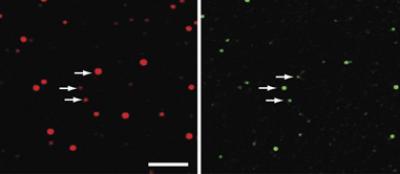 |
| Right: Brain-lipid vesicles. Smaller "dots" indicate smaller vesicles. Left: BAR domain protein. The intensity of the dot indicates the amount of BAR bound to the vesicle. The smaller the vesicle, the more curved membrane, and the more binding of BAR. Credit: Dimitrios Stamou |
Abstract:
Communication between nerve cells is vital for our bodies to function. Part of this communication happens through vesicles containing signalling molecules called neurotransmitters. The vesicle fuses with the nerve cell membrane; the neurotransmitters are released and quickly recorded by the next nerve cell. It is crucial that new vesicles constantly are produced for the nerve cell communication continuously to take place. If parts of this communication do not work, it leads to nerve pain like phantom pain following amputation.
New insight in nerve cell communication
Copenhagen | Posted on December 22nd, 2009New discoveries on a nanoscale
- In patients with nerve pain, part of the pathological picture is a defect in a protein domain we call BAR. We have studied how BAR binds to small membrane vesicles of different size. We expect that the new knowledge can be used to combat nerve pain in the future, explains Associate Professor Dimitrios Stamou, Bio-Nanotechnology Laboratory, Nano-Science Center and the Department of Neuroscience and Pharmacology. Dimitrios Stamou has led the work.
- We have used nanotechnology techniques, which give us the unique opportunity to study the binding of proteins to individual vesicles. Earlier studies have been performed in solutions where you measure a large number of vesicles and proteins at a time. This gives an average value of binding and "masks out" a large number of important information that we can retrieve by measurements on single vesicles, says Dimitrios Stamou.
Error in communication
More and more studies - this study included, show that the curvature of the membrane is absolutely central to the binding of proteins to cell membranes - the greater the curvature, the greater the binding. This also applies to nerve cells in the brain. It therefore provides an important insight for the overall understanding of how nerve cells communicate with each other and for treating diseases where the communication has failed.
- To our great surprise we find that BAR binds to the membrane vesicles via small cracks in the vesicle membrane. We had expected that BAR bound to the small round membrane vesicles both because of its banana shaped structure, which fits with the shape of the vesicle, and by means of an attraction between "the banana's" positive surface and vesicle's negative surface. But instead, it is the hydrophobic part of BAR that is involved in binding, explains Dimitrios Stamou.
####
About University of Copenhagen
With over 37,000 students and more than 7,000 employees, the University of Copenhagen is the largest institution of research and education in Denmark.
For more information, please click here
Contacts:
Dimitrios Stamou
454-116-0468
Communication Officer
Gitte Frandsen
Tel.: +45 28 75 04 58
Copyright © University of Copenhagen
If you have a comment, please Contact us.Issuers of news releases, not 7th Wave, Inc. or Nanotechnology Now, are solely responsible for the accuracy of the content.
Bookmark:


| Related News Press |
News and information
 Quantum computer improves AI predictions April 17th, 2026
Flexible sensor gains sensitivity under pressure April 17th, 2026
A reusable chip for particulate matter sensing April 17th, 2026
Detecting vibrational quantum beating in the predissociation dynamics of SF6 using time-resolved photoelectron spectroscopy April 17th, 2026
Possible Futures
A fundamentally new therapeutic approach to cystic fibrosis: Nanobody repairs cellular defect April 17th, 2026
UC Irvine physicists discover method to reverse ‘quantum scrambling’ : The work addresses the problem of information loss in quantum computing system April 17th, 2026
Nanomedicine
A fundamentally new therapeutic approach to cystic fibrosis: Nanobody repairs cellular defect April 17th, 2026
New molecular technology targets tumors and simultaneously silences two ‘undruggable’ cancer genes August 8th, 2025
New imaging approach transforms study of bacterial biofilms August 8th, 2025
Electrifying results shed light on graphene foam as a potential material for lab grown cartilage June 6th, 2025
Announcements
A fundamentally new therapeutic approach to cystic fibrosis: Nanobody repairs cellular defect April 17th, 2026
UC Irvine physicists discover method to reverse ‘quantum scrambling’ : The work addresses the problem of information loss in quantum computing system April 17th, 2026
Nanobiotechnology
A fundamentally new therapeutic approach to cystic fibrosis: Nanobody repairs cellular defect April 17th, 2026
New molecular technology targets tumors and simultaneously silences two ‘undruggable’ cancer genes August 8th, 2025
New imaging approach transforms study of bacterial biofilms August 8th, 2025
Electrifying results shed light on graphene foam as a potential material for lab grown cartilage June 6th, 2025
 |
||
 |
||
| The latest news from around the world, FREE | ||
 |
||
|
|
||
| Premium Products | ||
 |
||
|
Only the news you want to read!
Learn More |
||
 |
||
|
Full-service, expert consulting
Learn More |
||
|
|
||