Home > Press > NETL Researchers Develop Promising New Photocatalyst for CO2 Reuse
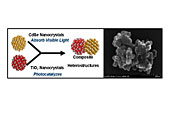 |
| (Left panel) Schematic diagram of the new photocatalytic technology for converting CO2 into fuels. (Right panel) SEM image of a heterostructured CdSe/Pt/TiO2 photocatalyst synthesized and tested by the NETL team (scale bar 100 nm). |
Abstract:
Researchers at the National Energy Technology Laboratory have developed a new, heterostructured photocatalyst capable of using the low-energy, visible-light portion of the electromagnetic spectrum for converting CO2 and H2O into methane, methanol, and other value-added chemicals.
NETL Researchers Develop Promising New Photocatalyst for CO2 Reuse
Pittsburgh, PA | Posted on December 22nd, 2009In this system, CdSe nanocrystals absorb visible light photons, creating excited electrons which are injected into TiO2 to reduce CO2. The photoactivity of this system can be systematically tuned to utilize different regions of the electromagnetic spectrum just by changing the size of the CdSe nanocrystal photosensitizer. This catalyst is believed to be the first developed that is capable of using the low-energy, visible-light portion of the electromagnetic spectrum for this process, and it represents a significant advance in the development of new technologies for CO2 capture and reuse. A manuscript detailing this new photocatalyst has been published in the Journal of Physical Chemistry Letters, and a provisional patent has also been filed on the technology.
####
About National Energy Technology Laboratory
The National Energy Technology Laboratory (NETL), part of DOE’s national laboratory system, is owned and operated by the U.S. Department of Energy (DOE). NETL supports DOE’s mission to advance the national, economic, and energy security of the United States.
For more information, please click here
Contacts:
Customer Service Line:
(800) 553-7681
Copyright © National Energy Technology Laboratory
If you have a comment, please Contact us.Issuers of news releases, not 7th Wave, Inc. or Nanotechnology Now, are solely responsible for the accuracy of the content.
Bookmark:


| Related News Press |
News and information
 Quantum computer improves AI predictions April 17th, 2026
Flexible sensor gains sensitivity under pressure April 17th, 2026
A reusable chip for particulate matter sensing April 17th, 2026
Detecting vibrational quantum beating in the predissociation dynamics of SF6 using time-resolved photoelectron spectroscopy April 17th, 2026
Chemistry
Projecting light to dispense liquids: A new route to ultra-precise microdroplets January 30th, 2026
From sensors to smart systems: the rise of AI-driven photonic noses January 30th, 2026
"Nanoreactor" cage uses visible light for catalytic and ultra-selective cross-cycloadditions October 3rd, 2025
Cambridge chemists discover simple way to build bigger molecules – one carbon at a time June 6th, 2025
Possible Futures
A fundamentally new therapeutic approach to cystic fibrosis: Nanobody repairs cellular defect April 17th, 2026
UC Irvine physicists discover method to reverse ‘quantum scrambling’ : The work addresses the problem of information loss in quantum computing system April 17th, 2026
Announcements
A fundamentally new therapeutic approach to cystic fibrosis: Nanobody repairs cellular defect April 17th, 2026
UC Irvine physicists discover method to reverse ‘quantum scrambling’ : The work addresses the problem of information loss in quantum computing system April 17th, 2026
 |
||
 |
||
| The latest news from around the world, FREE | ||
 |
||
|
|
||
| Premium Products | ||
 |
||
|
Only the news you want to read!
Learn More |
||
 |
||
|
Full-service, expert consulting
Learn More |
||
|
|
||