Home > Press > At Stanford, nanotubes + ink + paper = instant battery
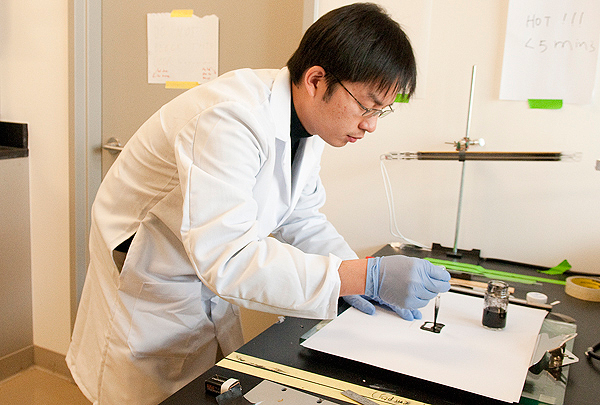 |
| Bing Hu, a post-doctoral fellow, prepares a small square of ordinary paper to with an ink that will deposit nanotubes on the surface that can then be charged with energy to create a battery. |
Abstract:
Dip an ordinary piece of paper into ink infused with carbon nanotubes and silver nanowires, and it turns into a battery or supercapacitor. Crumple the piece of paper, and it still works. Stanford researcher Yi Cui sees many uses for this new way of storing electricity.
At Stanford, nanotubes + ink + paper = instant battery
Stanford, CA | Posted on December 9th, 2009Stanford scientists are harnessing nanotechnology to quickly produce ultra-lightweight, bendable batteries and supercapacitors in the form of everyday paper.
Simply coating a sheet of paper with ink made of carbon nanotubes and silver nanowires makes a highly conductive storage device, said Yi Cui, assistant professor of materials science and engineering.
"Society really needs a low-cost, high-performance energy storage device, such as batteries and simple supercapacitors," he said.
Like batteries, capacitors hold an electric charge, but for a shorter period of time. However, capacitors can store and discharge electricity much more rapidly than a battery.
Cui's work is reported in the paper "Highly Conductive Paper for Energy Storage Devices," published online this week in the Proceedings of the National Academy of Sciences.
"These nanomaterials are special," Cui said. "They're a one-dimensional structure with very small diameters." The small diameter helps the nanomaterial ink stick strongly to the fibrous paper, making the battery and supercapacitor very durable. The paper supercapacitor may last through 40,000 charge-discharge cycles - at least an order of magnitude more than lithium batteries. The nanomaterials also make ideal conductors because they move electricity along much more efficiently than ordinary conductors, Cui said.
Cui had previously created nanomaterial energy storage devices using plastics. His new research shows that a paper battery is more durable because the ink adheres more strongly to paper (answering the question, "Paper or plastic?"). What's more, you can crumple or fold the paper battery, or even soak it in acidic or basic solutions, and the performance does not degrade. "We just haven't tested what happens when you burn it," he said.
The flexibility of paper allows for many clever applications. "If I want to paint my wall with a conducting energy storage device," Cui said, "I can use a brush." In his lab, he demonstrated the battery to a visitor by connecting it to an LED (light-emitting diode), which glowed brightly.
A paper supercapacitor may be especially useful for applications like electric or hybrid cars, which depend on the quick transfer of electricity. The paper supercapacitor's high surface-to-volume ratio gives it an advantage.
"This technology has potential to be commercialized within a short time," said Peidong Yang, professor of chemistry at the University of California-Berkeley. "I don't think it will be limited to just energy storage devices," he said. "This is potentially a very nice, low-cost, flexible electrode for any electrical device."
Cui predicts the biggest impact may be in large-scale storage of electricity on the distribution grid. Excess electricity generated at night, for example, could be saved for peak-use periods during the day. Wind farms and solar energy systems also may require storage.
"The most important part of this paper is how a simple thing in daily life - paper - can be used as a substrate to make functional conductive electrodes by a simple process," Yang said. "It's nanotechnology related to daily life, essentially."
Cui's research team includes postdoctoral scholars Liangbing Hu and JangWook Choi, and graduate student Yuan Yang.
Janelle Weaver is a science-writing intern at the Stanford News Service.
(see full release for video and more pictures)
####
About Stanford
Located between San Francisco and San Jose in the heart of Silicon Valley, Stanford University is recognized as one of the world's leading research and teaching institutions.
Leland and Jane Stanford founded the University to "promote the public welfare by exercising an influence on behalf of humanity and civilization." Stanford opened its doors in 1891, and more than a century later, it remains dedicated to finding solutions to the great challenges of the day and to preparing our students for leadership in today's complex world.
For more information, please click here
Contacts:
Dan Stober
Stanford News Service
(650) 721-6965
Copyright © Stanford
If you have a comment, please Contact us.Issuers of news releases, not 7th Wave, Inc. or Nanotechnology Now, are solely responsible for the accuracy of the content.
Bookmark:


| Related News Press |
News and information
 Quantum computer improves AI predictions April 17th, 2026
Flexible sensor gains sensitivity under pressure April 17th, 2026
A reusable chip for particulate matter sensing April 17th, 2026
Detecting vibrational quantum beating in the predissociation dynamics of SF6 using time-resolved photoelectron spectroscopy April 17th, 2026
Possible Futures
A fundamentally new therapeutic approach to cystic fibrosis: Nanobody repairs cellular defect April 17th, 2026
UC Irvine physicists discover method to reverse ‘quantum scrambling’ : The work addresses the problem of information loss in quantum computing system April 17th, 2026
Nanotubes/Buckyballs/Fullerenes/Nanorods/Nanostrings/Nanosheets
Tiny nanosheets, big leap: A new sensor detects ethanol at ultra-low levels January 30th, 2026
Enhancing power factor of p- and n-type single-walled carbon nanotubes April 25th, 2025
Chainmail-like material could be the future of armor: First 2D mechanically interlocked polymer exhibits exceptional flexibility and strength January 17th, 2025
Innovative biomimetic superhydrophobic coating combines repair and buffering properties for superior anti-erosion December 13th, 2024
Announcements
A fundamentally new therapeutic approach to cystic fibrosis: Nanobody repairs cellular defect April 17th, 2026
UC Irvine physicists discover method to reverse ‘quantum scrambling’ : The work addresses the problem of information loss in quantum computing system April 17th, 2026
Energy
Sensors innovations for smart lithium-based batteries: advancements, opportunities, and potential challenges August 8th, 2025
Simple algorithm paired with standard imaging tool could predict failure in lithium metal batteries August 8th, 2025
Battery Technology/Capacitors/Generators/Piezoelectrics/Thermoelectrics/Energy storage
Decoding hydrogen‑bond network of electrolyte for cryogenic durable aqueous zinc‑ion batteries January 30th, 2026
COF scaffold membrane with gate‑lane nanostructure for efficient Li+/Mg2+ separation January 30th, 2026
MXene nanomaterials enter a new dimension Multilayer nanomaterial: MXene flakes created at Drexel University show new promise as 1D scrolls January 30th, 2026
 |
||
 |
||
| The latest news from around the world, FREE | ||
 |
||
|
|
||
| Premium Products | ||
 |
||
|
Only the news you want to read!
Learn More |
||
 |
||
|
Full-service, expert consulting
Learn More |
||
|
|
||