Home > Press > New imaging technique to change the way we see disease
 |
Abstract:
New nano-technology being developed by physicists at Macquarie University could help medical professionals better understand and more effectively treat cancer and other diseases.
New imaging technique to change the way we see disease
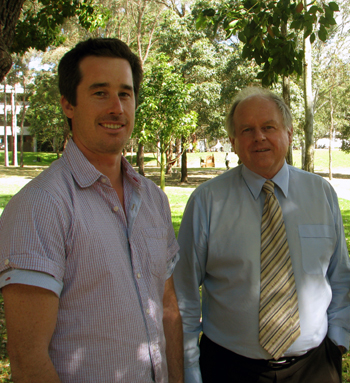
Sydney, Australia | Posted on December 7th, 2009Senior Lecturer at Macquarie University, Associate Professor James Rabeau, is using nano-diamonds to develop a new imaging technique that may allow scientists to image the finest details of a single cell, including those infected with cancer or other life threatening diseases.
Rabeau said his work could aid in the development of drugs to fight illness while, at the same time, help researchers better understand complex diseases.
"There's so much information in single molecules and proteins and they are so important to the many functions of life. The point of my project is to use nano-diamonds which are sensitive to magnetic fields placed on probe tips as an imaging device," he said.
"If we can actually zoom in even further than the current limits of microscopy and actually look at small components and even beyond that, that's rich ground for new discoveries.
"It could potentially help scientists look at cancer cells in the level of detail that would allow them to understand how disease spreads and what gives rise to it."
Nano-diamonds are made up of tiny particles of carbon, but some have impurities present such as nitrogen atoms which make them susceptible to magnetic fields. Rabeau is exploiting these impurities in the hopes of creating ‘super microscopes'.
"That is the big dream - to build a nano-diamond probe that biologists can use to take a picture of a single molecule. From that you would look at engineering it into a real and practical device and eventually benefit people in the medical field or in drug therapy," he said.
Rabeau said it's likely to take a long time to reach his goal, which involves relying on many local and international collaborations.
"I guess the key for me is to try to find a stream that is unique. The progress we've made over time is phenomenal but there's even further to go."
Rabeau was recently named a Future Fellow by the Australian Research Council for his proposal: Room temperature quantum microscopy for advanced nanoscale imaging. The prestigious scheme recognises talented mid-career researchers.
####
About Macquarie University
Macquarie University is on track to becoming one of Australia's leading research universities. It's our goal that by 2014 – our 50th anniversary – Macquarie will be among the top eight research universities in Australia and one of the top 200 in the world.
Macquarie has continued its rise up the Shanghai Jiao Tong University Academic Rankings of World Universities, moving up 17 places from 286th in the world in 2007 to 269th this year. Macquarie is currently ranked 9th in Australia.
To reach our goal we are investing heavily in research, learning and teaching, new buildings, new teaching facilities and in developing mutually beneficial relationships with industry.
We are busy employing top class research academic staff at the rate of more than 40 each year in order to build our capabilities in our 17 Concentrations of Research Excellence. These concentrations cover a diverse range of fields from Ancient History to Climate Change.
For more information, please click here
Contacts:
Any enquiries from the media should be directed to:
Samantha Norris
phone:(02) 9850 9658
Copyright © Macquarie University
If you have a comment, please Contact us.Issuers of news releases, not 7th Wave, Inc. or Nanotechnology Now, are solely responsible for the accuracy of the content.
Bookmark:


| Related News Press |
News and information
 Quantum computer improves AI predictions April 17th, 2026
Flexible sensor gains sensitivity under pressure April 17th, 2026
A reusable chip for particulate matter sensing April 17th, 2026
Detecting vibrational quantum beating in the predissociation dynamics of SF6 using time-resolved photoelectron spectroscopy April 17th, 2026
Physics
UC Irvine physicists discover method to reverse ‘quantum scrambling’ : The work addresses the problem of information loss in quantum computing system April 17th, 2026
Quantum computers simulate fundamental physics: shedding light on the building blocks of nature June 6th, 2025
Possible Futures
A fundamentally new therapeutic approach to cystic fibrosis: Nanobody repairs cellular defect April 17th, 2026
UC Irvine physicists discover method to reverse ‘quantum scrambling’ : The work addresses the problem of information loss in quantum computing system April 17th, 2026
Nanomedicine
A fundamentally new therapeutic approach to cystic fibrosis: Nanobody repairs cellular defect April 17th, 2026
New molecular technology targets tumors and simultaneously silences two ‘undruggable’ cancer genes August 8th, 2025
New imaging approach transforms study of bacterial biofilms August 8th, 2025
Electrifying results shed light on graphene foam as a potential material for lab grown cartilage June 6th, 2025
Discoveries
Quantum computer improves AI predictions April 17th, 2026
Flexible sensor gains sensitivity under pressure April 17th, 2026
A reusable chip for particulate matter sensing April 17th, 2026
Detecting vibrational quantum beating in the predissociation dynamics of SF6 using time-resolved photoelectron spectroscopy April 17th, 2026
Announcements
A fundamentally new therapeutic approach to cystic fibrosis: Nanobody repairs cellular defect April 17th, 2026
UC Irvine physicists discover method to reverse ‘quantum scrambling’ : The work addresses the problem of information loss in quantum computing system April 17th, 2026
Tools
Metasurfaces smooth light to boost magnetic sensing precision January 30th, 2026
From sensors to smart systems: the rise of AI-driven photonic noses January 30th, 2026
Japan launches fully domestically produced quantum computer: Expo visitors to experience quantum computing firsthand August 8th, 2025
Nanobiotechnology
A fundamentally new therapeutic approach to cystic fibrosis: Nanobody repairs cellular defect April 17th, 2026
New molecular technology targets tumors and simultaneously silences two ‘undruggable’ cancer genes August 8th, 2025
New imaging approach transforms study of bacterial biofilms August 8th, 2025
Electrifying results shed light on graphene foam as a potential material for lab grown cartilage June 6th, 2025
 |
||
 |
||
| The latest news from around the world, FREE | ||
 |
||
|
|
||
| Premium Products | ||
 |
||
|
Only the news you want to read!
Learn More |
||
 |
||
|
Full-service, expert consulting
Learn More |
||
|
|
||