Home > Press > Synthetic magnetism achieved by optical methods
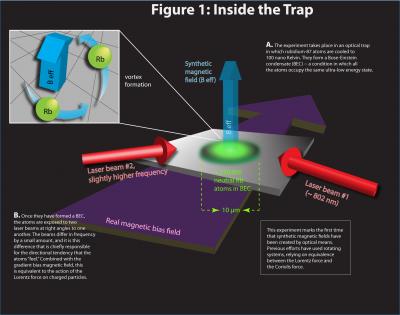 |
| This is the first figure to accompany the Joint Quantum Institute press release about synthetic magnetism. Credit: JQI |
Abstract:
Technique enables unprecedented insights
Synthetic magnetism achieved by optical methods
College Park, MD | Posted on December 4th, 2009For the first time, physicists have used laser light to create "synthetic magnetism," an exotic condition in which neutral atoms suddenly begin to behave as if they were charged particles interacting with a magnetic field -- even though no such field is present and the atoms have no charge. The achievement provides unprecedented insights into fundamental physics and the behavior of quantum objects, and opens up entirely new ways to study the nature of condensed-matter systems that were barely imaginable before.
There are many phenomena of urgent interest to physicists, such as the action of electrons restrained in two dimensions in a magnetic field, that are difficult to investigate in conventional materials such as semiconductors. Not only is it hard to control the numerous variables involved, but there are always defects and irregularities in the experimental samples. Nonetheless, such research is important both to basic quantum mechanics and to applied fields such as quantum computing and information science. Synthetic magnetism provides a way to model and examine such quantum systems while exercising precision control over the parameters.
"The creation of synthetic magnetic fields for ultracold neutral atoms enables previously impossible experiments in these most quintessential of quantum mechanical systems," says research group leader Ian Spielman, a Fellow of the Joint Quantum Institute and physicist at the National Institute of Standards and Technology (NIST). Spielman and colleagues describe the work in a paper published in the Dec. 3 issue of Nature.
The team began by taking a population of rubidium-87 atoms, decelerating them with a Zeeman slower and then confining them in a magneto-optical trap. The atoms then underwent evaporative cooling in a magnetic trap and then an optical-dipole trap until approximately 250,000 remained at a temperature of about 100 nano Kelvin. Under those ultracold, low-energy conditions, the atoms formed a Bose-Einstein condensate (BEC) ¡V a strange state of matter in which most of the atoms in a group occupy the same minimum-energy quantum state, somewhat as if they collectively constituted a single "super atom."
A small, spatially varying, magnetic bias field was applied across the BEC, producing a gradient that affected the atoms differently depending on their position along one axis of the trap. [See Figure 1.] Then two near-infrared (wavelength, Ć=801.7 nm) laser beams, oriented at 90 degree angles to each other, were aimed into the atoms. The scientists adjusted the beams to have very slightly different frequencies. The cumulative effect of the gradient field and the two laser beams altered the properties of the atoms (in particular, their momentum along one axis) in a way that depended on their location in the trap and their interaction with the beams.
Those differences, the researchers found, could be tuned by making slight changes in the frequencies of the laser beams, in effect conferring a "charge" on sub-populations of the neutral atoms and creating a synthetic magnetic field to which they reacted.
By varying the beams and the gradient, and thus controlling the position-dependent momentum potentials of the atoms, the team observed that ¡V as predicted in a theory paper Spielman had authored earlier this year ¡V atoms at specific points in the trap began to move in a way mathematically equivalent to the way a charged particle would revolve in a magnetic field. The effect caused small quantized vortices of atoms to enter the BEC.
To confirm and measure the magnitude of the phenomenon, the team took pictures of the BEC approximately 25 milliseconds after shutting off all fields and beams in the trap. Images of the expanding atomic cloud clearly showed that when the synthetic magnetism was not present, the atoms in the BEC had the customary distribution. But when the synthetic field was activated, vortices were plainly visible ¡V a clear indication that an optically induced synthetic magnetic field had been created for the first time.
The results are expected to have a substantial impact on various fields of inquiry in quantum science, especially the behavior of electrons confined in different geometries, as they are in real materials. In particular, it will allow researchers to explore how the energy spectrum of electrons in a crystal lattice varies with the magnetic field applied to the system. (This subject produced the now-famous theoretical plot of energy levels called "Hofstadter's butterfly" because of its elegant, wing-like curves.)
In addition, synthetic magnetism should prove valuable in characterizing aspects of the quantum Hall effect, a phenomenon observed in two-dimensional systems of electrons in a magnetic field. In that situation, the electrons naturally tend to follow circular ("cyclotron") orbits; and the energy levels of those orbits are quantized. The National Institute of Standards and Technology uses the quantum Hall effect to define the international standard of resistance.
Further improvements on the synthetic magnetism work, Spielman says, should allow new ways to investigate these and other phenomena.
"By adding an optical lattice potential to our synthetic magnetic field," he says, "we have the opportunity to create both long anticipated systems such as the Hofstadter butterfly -- an iconic pattern of energy levels for non-interacting particles -- and potentially to realize totally new states of matter such as quantum Hall states of bosons."
The research was partially supported by the Office of Naval Research, the Office of the Director of National Intelligence, the Army Research Office and the National Science Foundation through the NSF Physics Frontier Center at the Joint Quantum Institute.
####
About Joint Quantum Institute, University of Maryland
The Joint Quantum Institute (JQI) is a research partnership between University of Maryland (UMD) and the National Institute of Standards and Technology, with the support and participation of the Laboratory for Physical Sciences.
Created in 2006 to pursue theoretical and experimental studies of quantum physics in the context of information science and technology, JQI is located on UMD's College Park campus. For further information, see jqi.umd.edu.
For more information, please click here
Contacts:
Dr. Ian Spielman
301-975-8664
University of Maryland
Copyright © Eurekalert
If you have a comment, please Contact us.Issuers of news releases, not 7th Wave, Inc. or Nanotechnology Now, are solely responsible for the accuracy of the content.
Bookmark:


| Related News Press |
News and information
 Quantum computer improves AI predictions April 17th, 2026
Flexible sensor gains sensitivity under pressure April 17th, 2026
A reusable chip for particulate matter sensing April 17th, 2026
Detecting vibrational quantum beating in the predissociation dynamics of SF6 using time-resolved photoelectron spectroscopy April 17th, 2026
Physics
UC Irvine physicists discover method to reverse ‘quantum scrambling’ : The work addresses the problem of information loss in quantum computing system April 17th, 2026
Quantum computers simulate fundamental physics: shedding light on the building blocks of nature June 6th, 2025
Govt.-Legislation/Regulation/Funding/Policy
Quantum computer improves AI predictions April 17th, 2026
Metasurfaces smooth light to boost magnetic sensing precision January 30th, 2026
New imaging approach transforms study of bacterial biofilms August 8th, 2025
Possible Futures
A fundamentally new therapeutic approach to cystic fibrosis: Nanobody repairs cellular defect April 17th, 2026
UC Irvine physicists discover method to reverse ‘quantum scrambling’ : The work addresses the problem of information loss in quantum computing system April 17th, 2026
Announcements
A fundamentally new therapeutic approach to cystic fibrosis: Nanobody repairs cellular defect April 17th, 2026
UC Irvine physicists discover method to reverse ‘quantum scrambling’ : The work addresses the problem of information loss in quantum computing system April 17th, 2026
Alliances/Trade associations/Partnerships/Distributorships
Chicago Quantum Exchange welcomes six new partners highlighting quantum technology solutions, from Chicago and beyond September 23rd, 2022
University of Illinois Chicago joins Brookhaven Lab's Quantum Center June 10th, 2022
Quantum nanoscience
Beyond silicon: Electronics at the scale of a single molecule January 30th, 2026
MXene nanomaterials enter a new dimension Multilayer nanomaterial: MXene flakes created at Drexel University show new promise as 1D scrolls January 30th, 2026
ICFO researchers overcome long-standing bottleneck in single photon detection with twisted 2D materials August 8th, 2025
 |
||
 |
||
| The latest news from around the world, FREE | ||
 |
||
|
|
||
| Premium Products | ||
 |
||
|
Only the news you want to read!
Learn More |
||
 |
||
|
Full-service, expert consulting
Learn More |
||
|
|
||