Home > Press > UCF Secures $7.5 Million Research Grant to Improve Hybrid Photovoltaic Solar Cells
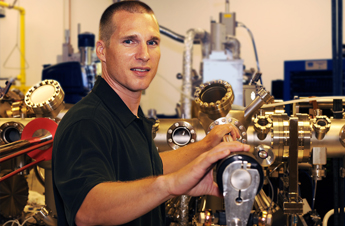 |
| Photo: Jacque Brund Winston Schoenfeld, a professor in CREOL, the College of Optics and Photonics at UCF, will lead the research. |
Abstract:
The University of Central Florida has been awarded a $7.5 million research grant to study ways to make photovoltaic solar cells more efficient in capturing and converting solar energy into electricity and less costly to manufacture.
UCF Secures $7.5 Million Research Grant to Improve Hybrid Photovoltaic Solar Cells
Orlando, FL | Posted on October 29th, 2009The research can lead to ways to produce highly flexible solar panels, which could be manufactured in larger quantities and used to support a variety of solar products, spanning from solar roof shingles to portable energy.
The grant, from New York-based Prime Source Initiative, Inc., will be awarded in $1.5 million allotments per year for five years.
The research will be led by Winston Schoenfeld, a professor in CREOL, The College of Optics and Photonics at UCF. He will work on methods to increase the efficiency between the organic material that harvests the sun's energy and the inorganic semiconductor nanostructures within a hybrid photovoltaic solar cell.
"All-organic solar cells are effective at absorbing light and collecting energy from the sun, but they aren't efficient at converting this into electricity," Schoenfeld explained.
Hybrid solar cells use an inorganic semiconductor (such as silicon) to increase electric output. But how to efficiently and economically integrate the organic and the inorganic components of the hybrid solar cell is a challenge and hasn't been widely studied.
Schoenfeld will develop the inorganic, nanostructured semiconductor backbone of the solar cell. The project's co-researcher, Andre Gesquiere, a professor in UCF's Nanotechnology Science Center and the Chemistry Department, will lead the organic, polymer research components of the project.
"Once the light is absorbed in the polymer, excitons are created that must be separated. If you don't separate them, they'll just recombine and you lose that energy," Schoenfeld said. "So we are using inorganic nanostructures that act as 'transport highways' to allow an efficient way for excitons to be separated and transferred into electricity."
The research will seek to answer questions such as how close together and how long the nanostructures should be made within the solar cell. Researchers also will attempt to increase the absorption capability of the organic material so that more of the solar spectrum can be harvested.
Schoenfeld cautioned that while the research goal is to identify efficient solar devices in the laboratory, the discoveries have to meet the demands of deployment into the marketplace.
"We have to think of the constraints of the end product. Will it be expensive to manufacture? Will the end-product be able to capture the aesthetic properties that will actually sell? Is there enough demand in other geographic areas? These are all factors that drive what products can eventually emerge from the laboratory."
Schoenfeld said this research project will emphasize collaboration with other researchers.
"A large grant can spawn three or four researchers to come together and go after challenging multi-disciplinary ideas, bringing vision into reality," Schoenfeld said. "The real value in this grant will be the ability to create these new collaborative connections, putting UCF in a unique position to make significant progress in the area of photovoltaic research."
Prime Source Initiative is based in New York with a real estate affiliation in Florida. Established in 1974, the supply chain company has expanded into humanitarian efforts to include this first-of-its kind research grant to fund photovoltaic research in hopes of creating more energy efficient communities.
####
About University of Central Florida
UCF Stands for Opportunity: The University of Central Florida is a metropolitan research university that ranks as the 3rd largest in the nation with more than 53,500 students. UCF's first classes were offered in 1968. The university offers impressive academic and research environments that power the region's economic development. UCF's culture of opportunity is driven by our diversity, Orlando environment, history of entrepreneurship and our youth, relevance and energy.
For more information, please click here
Contacts:
Kimberly Lewis
News & Information
407-823-1637
Copyright © University of Central Florida
If you have a comment, please Contact us.Issuers of news releases, not 7th Wave, Inc. or Nanotechnology Now, are solely responsible for the accuracy of the content.
Bookmark:


| Related News Press |
News and information
 Decoding hydrogen‑bond network of electrolyte for cryogenic durable aqueous zinc‑ion batteries January 30th, 2026
COF scaffold membrane with gate‑lane nanostructure for efficient Li+/Mg2+ separation January 30th, 2026
Announcements
Decoding hydrogen‑bond network of electrolyte for cryogenic durable aqueous zinc‑ion batteries January 30th, 2026
COF scaffold membrane with gate‑lane nanostructure for efficient Li+/Mg2+ separation January 30th, 2026
Energy
Sensors innovations for smart lithium-based batteries: advancements, opportunities, and potential challenges August 8th, 2025
Simple algorithm paired with standard imaging tool could predict failure in lithium metal batteries August 8th, 2025
Grants/Sponsored Research/Awards/Scholarships/Gifts/Contests/Honors/Records
Metasurfaces smooth light to boost magnetic sensing precision January 30th, 2026
Researchers tackle the memory bottleneck stalling quantum computing October 3rd, 2025
New discovery aims to improve the design of microelectronic devices September 13th, 2024
Alliances/Trade associations/Partnerships/Distributorships
Chicago Quantum Exchange welcomes six new partners highlighting quantum technology solutions, from Chicago and beyond September 23rd, 2022
University of Illinois Chicago joins Brookhaven Lab's Quantum Center June 10th, 2022
Solar/Photovoltaic
Spinel-type sulfide semiconductors to operate the next-generation LEDs and solar cells For solar-cell absorbers and green-LED source October 3rd, 2025
KAIST researchers introduce new and improved, next-generation perovskite solar cell November 8th, 2024
Groundbreaking precision in single-molecule optoelectronics August 16th, 2024
Development of zinc oxide nanopagoda array photoelectrode: photoelectrochemical water-splitting hydrogen production January 12th, 2024
 |
||
 |
||
| The latest news from around the world, FREE | ||
 |
||
|
|
||
| Premium Products | ||
 |
||
|
Only the news you want to read!
Learn More |
||
 |
||
|
Full-service, expert consulting
Learn More |
||
|
|
||