Home > Press > The Battery of the Future: New storage material improves energy density of lithium-ion battery
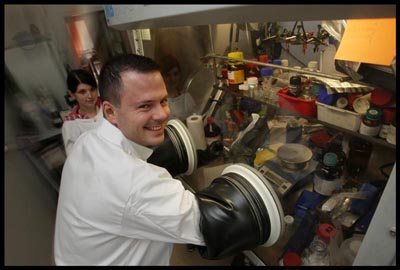 |
| Researcher at work: Stefan Koller from the Institute for Chemistry and Technology of Materials TU Graz/Lunghammer |
Abstract:
High-performance energy storage technologies for the automotive industry or mobile phone batteries and notebooks providing long battery times - these visions of the future are being brought one step nearer to the present by scientists from Graz University of Technology. Researchers at the Institute for Chemistry and Technology of Materials have developed a new method that utilises silicon for lithium-ion batteries.
The Battery of the Future: New storage material improves energy density of lithium-ion battery
Graz, Austria | Posted on October 28th, 2009Its storage capacity is ten times higher than the graphite substrate which has been used up to now, and promises considerable improvements for users. The new findings - which came to light in the "NanoPoliBat" EU project - have been recently submitted to the patent office by researchers together with their co-operation partner Varta Microbattery.
Modern electronic devices need more energy and even the automotive industry is hankering after increasingly powerful energy storage systems. The technological development of battery research has been inadequate for some time now. "A real revolution is needed for the development of the next generation. We need new storage materials for lithium-ion batteries", explains battery researcher Stefan Koller, who is familiar with the topic from his doctoral thesis. Together with colleagues from science and industry, he has managed to develop such a substrate material for electrochemical reactions at a low price.
Silicon gel on graphite
In the newly developed process, researchers utilise a silicon-containing gel and apply it to the graphite substrate material. "In this way the graphite works as a buffer, cushioning the big changes in volume of the silicon during the uptake and transfer of lithium ions", explains Koller. Silicon has a lithium-ion storage capacity some ten times higher than the up-to-now commercially used graphite. The new material can thus store more than double the quantity of lithium ions without changes to the battery lifetime. This method is far cheaper than the previous ones in which silicon is separated in the gas phase. The challenge lies in the poor storage density of materials in the counter electrode in the whole battery, something which we have been doing intensive research on," says Koller.
####
About Technische Universität Graz
Today engineers have more responsibility than ever for the quality of life of generations to come. Just as technological progress is shaping our lives more and more, universities of technology are becoming more important in the education and training of scientists, research and development, and as partners with business, industry and politics. This awareness and a modern understanding of technology are the guiding principles of the students, teaching staff and researchers of Graz University of Technology. Its location in the midst of the economic region Graz makes Graz University of Technology a focal point for teaching and research in technical sciences in the South of Austria.
For more information, please click here
Contacts:
Dr. Stefan Koller
Institute for Chemistry and Technology of Materials
Tel.: +43 (0) 316 873 8763
Mobile: +43 (0) 664 39 49 547
Copyright © TU Graz
If you have a comment, please Contact us.Issuers of news releases, not 7th Wave, Inc. or Nanotechnology Now, are solely responsible for the accuracy of the content.
Bookmark:


| Related News Press |
Chemistry
 Projecting light to dispense liquids: A new route to ultra-precise microdroplets January 30th, 2026
From sensors to smart systems: the rise of AI-driven photonic noses January 30th, 2026
"Nanoreactor" cage uses visible light for catalytic and ultra-selective cross-cycloadditions October 3rd, 2025
Cambridge chemists discover simple way to build bigger molecules – one carbon at a time June 6th, 2025
Announcements
A fundamentally new therapeutic approach to cystic fibrosis: Nanobody repairs cellular defect April 17th, 2026
UC Irvine physicists discover method to reverse ‘quantum scrambling’ : The work addresses the problem of information loss in quantum computing system April 17th, 2026
Energy
Sensors innovations for smart lithium-based batteries: advancements, opportunities, and potential challenges August 8th, 2025
Simple algorithm paired with standard imaging tool could predict failure in lithium metal batteries August 8th, 2025
Automotive/Transportation
Decoding hydrogen‑bond network of electrolyte for cryogenic durable aqueous zinc‑ion batteries January 30th, 2026
Sensors innovations for smart lithium-based batteries: advancements, opportunities, and potential challenges August 8th, 2025
Simple algorithm paired with standard imaging tool could predict failure in lithium metal batteries August 8th, 2025
Battery Technology/Capacitors/Generators/Piezoelectrics/Thermoelectrics/Energy storage
Decoding hydrogen‑bond network of electrolyte for cryogenic durable aqueous zinc‑ion batteries January 30th, 2026
COF scaffold membrane with gate‑lane nanostructure for efficient Li+/Mg2+ separation January 30th, 2026
MXene nanomaterials enter a new dimension Multilayer nanomaterial: MXene flakes created at Drexel University show new promise as 1D scrolls January 30th, 2026
 |
||
 |
||
| The latest news from around the world, FREE | ||
 |
||
|
|
||
| Premium Products | ||
 |
||
|
Only the news you want to read!
Learn More |
||
 |
||
|
Full-service, expert consulting
Learn More |
||
|
|
||