Home > Press > UCF Team Developing Tool Kit to Help Diagnose Dementia
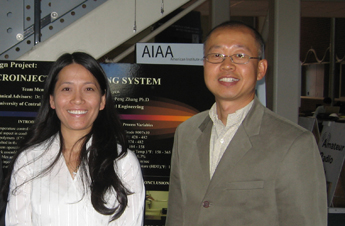 |
| Associate Professor Hyoung Jin Cho (right) partnered with UCF colleague Sudipta Seal (not pictured). |
Abstract:
With the risk of developing dementia growing at an alarming pace, a University of Central Florida research team is working with the Boston University School of Medicine to develop a miniature diagnostic toolkit in the hopes of stimulating earlier detection and treatment.
UCF Team Developing Tool Kit to Help Diagnose Dementia
Orlando, FL | Posted on October 1st, 2009The collaborative research project, funded by the National Science Foundation for up to $600,000 over three years, will use nanoparticles on a chip about the size of a credit card to detect damaging levels of oxygen byproducts in the central nervous system.
The byproducts, known as reactive oxygen species (ROS), are major contributors to serious neurodegenerative diseases, including Alzheimer's and Parkinson's.
The development of new analytical tools for speeding up diagnosis and treatment of these disorders is critical if we hope to slow their growth, said lead researcher Hyoung Jin Cho, an associate professor of Mechanical, Materials and Aerospace Engineering at the University of Central Florida and a researcher at UCF's NanoScience Technology Center.
The number of people with dementia, which is the primary precursor to Alzheimer's, will almost double every 20 years, reaching 65.7 million in 2030 and 115.4 million in 2050, according to the 2009 World Alzheimer Report from Alzheimer's Disease International. The report, issued last week in recognition of World Alzheimer's Day, calls for making the fight against the disease a national and global priority.
"This research shows significant potential for better understanding the role of ROS in neurodegenerative diseases," said Cho. "Once we have a clearer understanding of the role of ROS, we may be able to address more effective treatments."
Existing tests have several drawbacks. They are only able to detect limited numbers of significant byproducts at a time; they require time-consuming and labor-intensive processing; and they don't work quickly enough to keep up with the short lifespan of most of the byproducts.
Cho has previously developed a microfluidic mixer and a miniaturized electrochemical sensor for "lab on a chip" applications that would allow scientists to perform multiple analyses on one miniaturized chip. He said the ROS assessment tool will be developed on a similar platform.
What will make the ROS detector unique is the use of nanoparticles to help detect the high oxidative stress that has been identified as one of the earliest indicators of Alzheimer's and Parkinson's diseases.
Cho partnered with Sudipta Seal, director of UCF's NanoScience Technology and Advanced Materials Processing and Analysis centers, who has studied rare earth cerium oxide nanoparticles for years. Seal has found them to be effective at everything from treating glaucoma to cleansing fly ash from smokestacks.
Because the nanoparticles behave like an antioxidant, protecting cells from oxidative stress, they can effectively serve as an indicator of ROS, Seal said.
Together with Diego Diaz, a NanoScience Technology Center and Department of Chemistry faculty member, the researchers are collaborating with a group led by Lee Goldstein, an associate professor at the Boston University School of Medicine.
UCF's share of the NSF funding is $346,000.
####
About University of Central Florida
UCF Stands For Opportunity --The University of Central Florida is a metropolitan research university that ranks as the 5th largest in the nation with more than 52,000 students. UCF's first classes were offered in 1968. The university offers impressive academic and research environments that power the region's economic development. UCF's culture of opportunity is driven by our diversity, Orlando environment, history of entrepreneurship and our youth, relevance and energy.
For more information, please click here
Contacts:
Zenaida Gonzalez Kotala
News & Information
407-823-6120
Copyright © University of Central Florida
If you have a comment, please Contact us.Issuers of news releases, not 7th Wave, Inc. or Nanotechnology Now, are solely responsible for the accuracy of the content.
Bookmark:


| Related News Press |
News and information
 Quantum computer improves AI predictions April 17th, 2026
Flexible sensor gains sensitivity under pressure April 17th, 2026
A reusable chip for particulate matter sensing April 17th, 2026
Detecting vibrational quantum beating in the predissociation dynamics of SF6 using time-resolved photoelectron spectroscopy April 17th, 2026
Govt.-Legislation/Regulation/Funding/Policy
Quantum computer improves AI predictions April 17th, 2026
Metasurfaces smooth light to boost magnetic sensing precision January 30th, 2026
New imaging approach transforms study of bacterial biofilms August 8th, 2025
Possible Futures
A fundamentally new therapeutic approach to cystic fibrosis: Nanobody repairs cellular defect April 17th, 2026
UC Irvine physicists discover method to reverse ‘quantum scrambling’ : The work addresses the problem of information loss in quantum computing system April 17th, 2026
Nanomedicine
A fundamentally new therapeutic approach to cystic fibrosis: Nanobody repairs cellular defect April 17th, 2026
New molecular technology targets tumors and simultaneously silences two ‘undruggable’ cancer genes August 8th, 2025
New imaging approach transforms study of bacterial biofilms August 8th, 2025
Electrifying results shed light on graphene foam as a potential material for lab grown cartilage June 6th, 2025
Sensors
Flexible sensor gains sensitivity under pressure April 17th, 2026
Tiny nanosheets, big leap: A new sensor detects ethanol at ultra-low levels January 30th, 2026
From sensors to smart systems: the rise of AI-driven photonic noses January 30th, 2026
Sensors innovations for smart lithium-based batteries: advancements, opportunities, and potential challenges August 8th, 2025
Announcements
A fundamentally new therapeutic approach to cystic fibrosis: Nanobody repairs cellular defect April 17th, 2026
UC Irvine physicists discover method to reverse ‘quantum scrambling’ : The work addresses the problem of information loss in quantum computing system April 17th, 2026
Nanobiotechnology
A fundamentally new therapeutic approach to cystic fibrosis: Nanobody repairs cellular defect April 17th, 2026
New molecular technology targets tumors and simultaneously silences two ‘undruggable’ cancer genes August 8th, 2025
New imaging approach transforms study of bacterial biofilms August 8th, 2025
Electrifying results shed light on graphene foam as a potential material for lab grown cartilage June 6th, 2025
 |
||
 |
||
| The latest news from around the world, FREE | ||
 |
||
|
|
||
| Premium Products | ||
 |
||
|
Only the news you want to read!
Learn More |
||
 |
||
|
Full-service, expert consulting
Learn More |
||
|
|
||