Home > Press > First-ever calculation performed on optical quantum computer chip
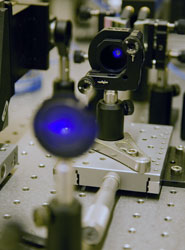 |
| A quantum photonic experiment Photo by Carmel King |
Abstract:
A primitive quantum computer that uses single particles of light (photons) whizzing through a silicon chip has performed its first mathematical calculation. This is the first time a calculation has been performed on a photonic chip and it is major step forward in the quest to realise a super-powerful quantum computer.
First-ever calculation performed on optical quantum computer chip
Bristol, UK | Posted on September 4th, 2009The chip takes four photons that carry the input for the calculation, it then implements a quantum programme (Shor's algorithm) to find the prime factors of 15, and outputs the answer - 3 and 5. The results are reported by a team of physicists and engineers from the University of Bristol in today's issue of Science.
"This task could be done much faster by any school kid," said PhD student, Alberto Politi, who, together with fellow PhD student Jonathan Matthews performed the experiment, "but this is a really important proof-of-principle demonstration."
Finding prime factors may seem like a mathematical abstraction, but it lies at the heart of modern encryption schemes, including those used for secure internet communication. The ability of quantum computers to simulate quantum systems may also prove to be a powerful tool in the development of new materials or pharmaceuticals.
The team from the University of Bristol's newly established Centre for Nanoscience and Quantum Information have spent several years developing devices where photons propagate in silica waveguides — much like in optical fibres — micro-fabricated on a silicon chip.
"This approach results in miniature, high-performance and scalable devices," said Professor Jeremy O'Brien, Director of the Centre for Quantum Photonics, who led the research. "The realisation of a quantum algorithm on a chip is an extremely important step towards an all-optical quantum computer"
"Despite recent advances, the ability to perform even small-scale quantum algorithms has largely been missing," said Matthews. "For the last few years, researchers at the Centre for Quantum Photonics have been working towards building fully functional quantum circuits on a chip to solve this issue," added O'Brien.
The team coupled four photons into and out of the chip using optical fibres. On the chip the photons traveled through silica waveguides that were brought together to form a sequence of quantum logic gates. The output was determined by which waveguides the photons exited the chip in. By detecting the photons at the output of the device they confirmed high-performance operation of the quantum algorithm.
"As well as quantum computing and quantum metrology, ‘on-chip' photonic quantum circuits could have important applications in quantum communication, since they can be easily integrated with optical fibres to send photons between remote locations," said Politi.
O'Brien concurred and added: "The really exciting thing about this result is that it will enable the development of large scale quantum circuits for photons. This opens up all kinds of possibilities".
####
For more information, please click here
Contacts:
Cherry Lewis
Copyright © University of Bristol
If you have a comment, please Contact us.Issuers of news releases, not 7th Wave, Inc. or Nanotechnology Now, are solely responsible for the accuracy of the content.
Bookmark:


| Related News Press |
News and information
 Quantum computer improves AI predictions April 17th, 2026
Flexible sensor gains sensitivity under pressure April 17th, 2026
A reusable chip for particulate matter sensing April 17th, 2026
Detecting vibrational quantum beating in the predissociation dynamics of SF6 using time-resolved photoelectron spectroscopy April 17th, 2026
Possible Futures
A fundamentally new therapeutic approach to cystic fibrosis: Nanobody repairs cellular defect April 17th, 2026
UC Irvine physicists discover method to reverse ‘quantum scrambling’ : The work addresses the problem of information loss in quantum computing system April 17th, 2026
Quantum Computing
Quantum computer improves AI predictions April 17th, 2026
UC Irvine physicists discover method to reverse ‘quantum scrambling’ : The work addresses the problem of information loss in quantum computing system April 17th, 2026
Researchers develop molecular qubits that communicate at telecom frequencies October 3rd, 2025
Announcements
A fundamentally new therapeutic approach to cystic fibrosis: Nanobody repairs cellular defect April 17th, 2026
UC Irvine physicists discover method to reverse ‘quantum scrambling’ : The work addresses the problem of information loss in quantum computing system April 17th, 2026
 |
||
 |
||
| The latest news from around the world, FREE | ||
 |
||
|
|
||
| Premium Products | ||
 |
||
|
Only the news you want to read!
Learn More |
||
 |
||
|
Full-service, expert consulting
Learn More |
||
|
|
||