Home > Press > UCF Research Finds Nanoparticles Prevent Cell Damage
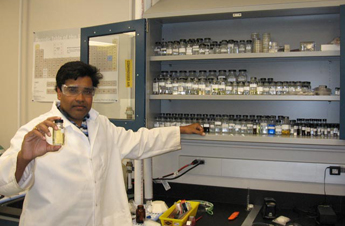 |
| Dr. Sudipta Seal in his lab at the University of Central Florida. |
Abstract:
University of Central Florida Professor Sudipta Seal and his team have engineered a nanoparticle that appears to prevent cell damage.
UCF Research Finds Nanoparticles Prevent Cell Damage
Orlando, FL | Posted on June 29th, 2009Seal and his team engineered nanoparticles of cerium oxide (called nanoceria), a material long used in ceramics and fuel cells. In its nanocrystalline form it is non-toxic and appears to work as an antioxidant working to protect cells. Seal's work is recognized by the National Science Foundation this month, which featured him in a Behind the Scenes article at LiveScience.com.
Nanoceria show promise and may protect healthy cells from the damaging effects of radiation given as cancer treatments, and it shows promise for treating arthritis, wound healing, spinal cord injuries and neurodegenerative diseases. In collaboration with researchers at Imperial College London, Seal and his colleagues are also incorporating these nanostructures into bio-scaffolds for tissue engineering.
"It is very exciting," Seal said. "We have found that the nanoceria behave like antioxidants, protecting cells from oxidative stress and they can be fine tuned to potentially deliver medical treatments directly into the cells."
Oxidative stress has been implicated as a cause of arthritis, heart disease and even aging. It also plays a role in several incurable eye diseases, such as diabetic retinopathy, age-related macular degeneration, and retinal degeneration.
Oxidative stress occurs when too many reactive oxygen species (ROS) are present. These powerful molecules are generated by exposure to ionizing radiation and by commonplace reduction-oxidation reactions within cells. (Peroxide and free radicals are two examples of ROS.)
Usually, enzymes known as antioxidants protect cells from oxidative stress by disarming ROS and minimizing their toxic effects. But sometimes, the number of ROS overwhelms a biological system, causing damage to proteins, DNA and other cellular materials.
In the nanocrystalline form Seal and his team engineered, the nanoceria act as powerful antioxidant because its latticework crystal structure can capture oxygen and the material has a large surface area reducing the effects of ROS.
Nanoceria are also able to regenerate their antioxidant abilities, so repeated doses like taking antioxidant vitamins daily, may not be needed, Seal said.
Seal's NSF funded NIRT team includes UCF's Associate Professor William Self, UCF theoretical chemist Asterm Masunov from UCF's Nanoscience and Technology Center, and vision scientist James McGinnis, from the University of Oklahoma Health Sciences Center.
His team's previous work found that nanoceria could also deliver medicine to the retinas of mice with glaucoma.
So far the team has obtained two patents related to the promising nanoceria, and McGinnis has launched a new company to develop medical applications. Meanwhile, Seal and his colleagues continue to investigate the chemical properties of cerium oxide and other rare earth metals and oxides, identifying and investigating various forms with potential applications in medicine and energy. Findings from the ongoing research have been published in several journals including ACS Nano.
Because of its catalytic nature, cerium oxide nanoparticles and their hybrids could also be used efficiently in methanol-ethanol conversion, in the production of hydrogen from sugar cane, for pollution control and as an electrolyte in fuel cells. More research is needed in these areas.
"We have just scratched the surface of what nanoceria can do," he says. "There are endless possibilities."
Along with National Science Foundation award, the National Institutes of Health contributed funding toward this research.
The National Academy of Engineering (NAE) also this month named Seal as one the country's brightest young engineers and will participate in the 15th annual Frontiers of Engineering Symposium in September. He is one of 88 honored and his colleagues include professors and researchers at MIT, Cornell, Microsoft, NASA, Ford Motor Company and John Hopkins.
####
About University of Central Florida
The University of Central Florida is a metropolitan research university that ranks as the 5th largest in the nation with more than 50,000 students. UCF's first classes were offered in 1968. The university offers impressive academic and research environments that power the region's economic development. UCF's culture of opportunity is driven by our diversity, Orlando environment, history of entrepreneurship and our youth, relevance and energy.
For more information, please click here
Contacts:
UCF Professor Seal Sudpita
407-823-5277
Copyright © University of Central Florida
If you have a comment, please Contact us.Issuers of news releases, not 7th Wave, Inc. or Nanotechnology Now, are solely responsible for the accuracy of the content.
Bookmark:


| Related News Press |
News and information
 Quantum computer improves AI predictions April 17th, 2026
Flexible sensor gains sensitivity under pressure April 17th, 2026
A reusable chip for particulate matter sensing April 17th, 2026
Detecting vibrational quantum beating in the predissociation dynamics of SF6 using time-resolved photoelectron spectroscopy April 17th, 2026
Possible Futures
A fundamentally new therapeutic approach to cystic fibrosis: Nanobody repairs cellular defect April 17th, 2026
UC Irvine physicists discover method to reverse ‘quantum scrambling’ : The work addresses the problem of information loss in quantum computing system April 17th, 2026
Nanomedicine
A fundamentally new therapeutic approach to cystic fibrosis: Nanobody repairs cellular defect April 17th, 2026
New molecular technology targets tumors and simultaneously silences two ‘undruggable’ cancer genes August 8th, 2025
New imaging approach transforms study of bacterial biofilms August 8th, 2025
Electrifying results shed light on graphene foam as a potential material for lab grown cartilage June 6th, 2025
Announcements
A fundamentally new therapeutic approach to cystic fibrosis: Nanobody repairs cellular defect April 17th, 2026
UC Irvine physicists discover method to reverse ‘quantum scrambling’ : The work addresses the problem of information loss in quantum computing system April 17th, 2026
Environment
A reusable chip for particulate matter sensing April 17th, 2026
Researchers unveil a groundbreaking clay-based solution to capture carbon dioxide and combat climate change June 6th, 2025
Energy
Sensors innovations for smart lithium-based batteries: advancements, opportunities, and potential challenges August 8th, 2025
Simple algorithm paired with standard imaging tool could predict failure in lithium metal batteries August 8th, 2025
Fuel Cells
Deciphering local microstrain-induced optimization of asymmetric Fe single atomic sites for efficient oxygen reduction August 8th, 2025
Current and Future Developments in Nanomaterials and Carbon Nanotubes: Applications of Nanomaterials in Energy Storage and Electronics October 28th, 2022
Nanobiotechnology
A fundamentally new therapeutic approach to cystic fibrosis: Nanobody repairs cellular defect April 17th, 2026
New molecular technology targets tumors and simultaneously silences two ‘undruggable’ cancer genes August 8th, 2025
New imaging approach transforms study of bacterial biofilms August 8th, 2025
Electrifying results shed light on graphene foam as a potential material for lab grown cartilage June 6th, 2025
 |
||
 |
||
| The latest news from around the world, FREE | ||
 |
||
|
|
||
| Premium Products | ||
 |
||
|
Only the news you want to read!
Learn More |
||
 |
||
|
Full-service, expert consulting
Learn More |
||
|
|
||