Home > Press > Scientists Create First Electronic Quantum Processor
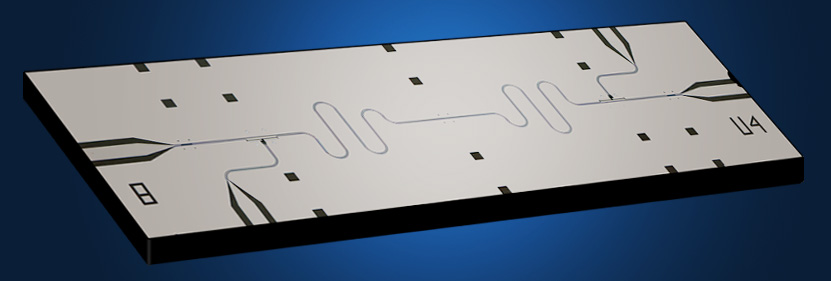 |
| The two-qubit processor is the first solid-state quantum processor that resembles a conventional computer chip and is able to run simple algorithms. (Photo: Blake Johnson/Yale University) |
Abstract:
A team led by Yale University researchers has created the first rudimentary solid-state quantum processor, taking another step toward the ultimate dream of building a quantum computer.
Scientists Create First Electronic Quantum Processor
New Haven, CT | Posted on June 29th, 2009They also used the two-qubit superconducting chip to successfully run elementary algorithms, such as a simple search, demonstrating quantum information processing with a solid-state device for the first time. Their findings will appear in Nature's advanced online publication June 28.
"Our processor can perform only a few very simple quantum tasks, which have been demonstrated before with single nuclei, atoms and photons," said Robert Schoelkopf, the William A. Norton Professor of Applied Physics & Physics at Yale. "But this is the first time they've been possible in an all-electronic device that looks and feels much more like a regular microprocessor."
Working with a group of theoretical physicists led by Steven Girvin, the Eugene Higgins Professor of Physics & Applied Physics, the team manufactured two artificial atoms, or qubits ("quantum bits"). While each qubit is actually made up of a billion aluminum atoms, it acts like a single atom that can occupy two different energy states. These states are akin to the "1" and "0" or "on" and "off" states of regular bits employed by conventional computers. Because of the counterintuitive laws of quantum mechanics, however, scientists can effectively place qubits in a "superposition" of multiple states at the same time, allowing for greater information storage and processing power.
For example, imagine having four phone numbers, including one for a friend, but not knowing which number belonged to that friend. You would typically have to try two to three numbers before you dialed the right one. A quantum processor, on the other hand, can find the right number in only one try.
"Instead of having to place a phone call to one number, then another number, you use quantum mechanics to speed up the process," Schoelkopf said. "It's like being able to place one phone call that simultaneously tests all four numbers, but only goes through to the right one."
These sorts of computations, though simple, have not been possible using solid-state qubits until now in part because scientists could not get the qubits to last long enough. While the first qubits of a decade ago were able to maintain specific quantum states for about a nanosecond, Schoelkopf and his team are now able to maintain theirs for a microsecond—a thousand times longer, which is enough to run the simple algorithms. To perform their operations, the qubits communicate with one another using a "quantum bus"—photons that transmit information through wires connecting the qubits—previously developed by the Yale group.
The key that made the two-qubit processor possible was getting the qubits to switch "on" and "off" abruptly, so that they exchanged information quickly and only when the researchers wanted them to, said Leonardo DiCarlo, a postdoctoral associate in applied physics at Yale's School of Engineering & Applied Science and lead author of the paper.
Next, the team will work to increase the amount of time the qubits maintain their quantum states so they can run more complex algorithms. They will also work to connect more qubits to the quantum bus. The processing power increases exponentially with each qubit added, Schoelkopf said, so the potential for more advanced quantum computing is enormous. But he cautions it will still be some time before quantum computers are being used to solve complex problems.
"We're still far away from building a practical quantum computer, but this is a major step forward."
Authors of the paper include Leonardo DiCarlo, Jerry M. Chow, Lev S. Bishop, Blake Johnson, David Schuster, Luigi Frunzio, Steven Girvin and Robert Schoelkopf (all of Yale University), Jay M. Gambetta (University of Waterloo), Johannes Majer (Atominstitut der Österreichischen Universitäten) and Alexandre Blais (Université de Sherbrooke).
####
About Yale University
Yale University comprises three major academic components: Yale College (the undergraduate program), the Graduate School of Arts and Sciences, and the professional schools. In addition, Yale encompasses a wide array of centers and programs, libraries, museums, and administrative support offices. Approximately 11,250 students attend Yale.
For more information, please click here
Contacts:
PRESS CONTACT:
Suzanne Taylor Muzzin
203-432-8555
Copyright © Yale University
If you have a comment, please Contact us.Issuers of news releases, not 7th Wave, Inc. or Nanotechnology Now, are solely responsible for the accuracy of the content.
Bookmark:


| Related News Press |
News and information
 Quantum computer improves AI predictions April 17th, 2026
Flexible sensor gains sensitivity under pressure April 17th, 2026
A reusable chip for particulate matter sensing April 17th, 2026
Detecting vibrational quantum beating in the predissociation dynamics of SF6 using time-resolved photoelectron spectroscopy April 17th, 2026
Possible Futures
A fundamentally new therapeutic approach to cystic fibrosis: Nanobody repairs cellular defect April 17th, 2026
UC Irvine physicists discover method to reverse ‘quantum scrambling’ : The work addresses the problem of information loss in quantum computing system April 17th, 2026
Quantum Computing
Quantum computer improves AI predictions April 17th, 2026
UC Irvine physicists discover method to reverse ‘quantum scrambling’ : The work addresses the problem of information loss in quantum computing system April 17th, 2026
Researchers develop molecular qubits that communicate at telecom frequencies October 3rd, 2025
Announcements
A fundamentally new therapeutic approach to cystic fibrosis: Nanobody repairs cellular defect April 17th, 2026
UC Irvine physicists discover method to reverse ‘quantum scrambling’ : The work addresses the problem of information loss in quantum computing system April 17th, 2026
 |
||
 |
||
| The latest news from around the world, FREE | ||
 |
||
|
|
||
| Premium Products | ||
 |
||
|
Only the news you want to read!
Learn More |
||
 |
||
|
Full-service, expert consulting
Learn More |
||
|
|
||