Home > Press > Nanofarming algae for biofuel oil
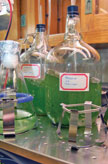 |
| Two strains of algae are being grown in the laboratory for testing the nanofarming technology. |
Abstract:
Researchers at DOE's Ames Laboratory and Iowa State University have developed groundbreaking "nanofarming" technology that safely harvests oil from the algae so the pond-based "crop" can keep on producing. The so-called "nanofarming" technology uses sponge-like nanoparticles to extract oil from the algae. The process doesn't harm the algae like other methods being developed, which helps reduce both production costs and the production cycle. Once the algal oil is extracted, a separate solid catalyst from Catilin, a nano-technology-based company that specializes in biofuel production, will be used to produce certified biodiesel. The three-year project is being funded with $885,000 from DOE Office of Energy Efficiency and Renewable Energy's Industrial Technology Program as part of the 2008 Nanomanufacturing for Energy Efficiency program, $216,000 from Catilin and $16,000 from Iowa State University in matching funds.
Nanofarming algae for biofuel oil
IA | Posted on June 8th, 2009####
For more information, please click here
Contacts:
Kerry Gibson
515.294.1405
Copyright © DOE
If you have a comment, please Contact us.Issuers of news releases, not 7th Wave, Inc. or Nanotechnology Now, are solely responsible for the accuracy of the content.
Bookmark:


| Related News Press |
News and information
 Quantum computer improves AI predictions April 17th, 2026
Flexible sensor gains sensitivity under pressure April 17th, 2026
A reusable chip for particulate matter sensing April 17th, 2026
Detecting vibrational quantum beating in the predissociation dynamics of SF6 using time-resolved photoelectron spectroscopy April 17th, 2026
Laboratories
Researchers develop molecular qubits that communicate at telecom frequencies October 3rd, 2025
A battery’s hopping ions remember where they’ve been: Seen in atomic detail, the seemingly smooth flow of ions through a battery’s electrolyte is surprisingly complicated February 16th, 2024
Discoveries
Quantum computer improves AI predictions April 17th, 2026
Flexible sensor gains sensitivity under pressure April 17th, 2026
A reusable chip for particulate matter sensing April 17th, 2026
Detecting vibrational quantum beating in the predissociation dynamics of SF6 using time-resolved photoelectron spectroscopy April 17th, 2026
Announcements
A fundamentally new therapeutic approach to cystic fibrosis: Nanobody repairs cellular defect April 17th, 2026
UC Irvine physicists discover method to reverse ‘quantum scrambling’ : The work addresses the problem of information loss in quantum computing system April 17th, 2026
Energy
Sensors innovations for smart lithium-based batteries: advancements, opportunities, and potential challenges August 8th, 2025
Simple algorithm paired with standard imaging tool could predict failure in lithium metal batteries August 8th, 2025
 |
||
 |
||
| The latest news from around the world, FREE | ||
 |
||
|
|
||
| Premium Products | ||
 |
||
|
Only the news you want to read!
Learn More |
||
 |
||
|
Full-service, expert consulting
Learn More |
||
|
|
||