Home > Press > Finding how carbon nanotubes work as catalysts could lead to cleaner fuels
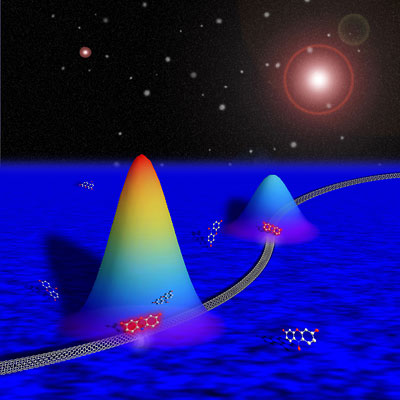 |
| Graphic by Aleksandr Kalininskiy Graphic depiction of reactions occurring along a single-walled carbon nanotube converting a nonfluorescent molecule into a fluorescent one. An optical microscope will see fluorescent events as if they were coming from various points around the reaction site -- the upper part of the image shows how this looks through the microscope. But variations in brightness (shown here as different colors) allow researchers to pinpoint the reaction site to within as little as 20 nanometers. |
Abstract:
Among their many other interesting properties, carbon nanotubes have been found to act as catalysts for some important chemical reactions, including some that could be used to make cleaner fuels. But many unanswered questions remain about how this process works.
Finding how carbon nanotubes work as catalysts could lead to cleaner fuels
Ithaca, NY | Posted on April 16th, 2009Cornell researchers have answered an important one by pinpointing unique sites where the reactions take place on single-walled nanotubes. But directly observing these sites has been challenging, but now, the researchers have shown that the reactions do not occur all along the tubes, but at the ends of the tubes or at defects along the tubes.
The research by Peng Chen, Cornell assistant professor of chemistry and chemical biology, and his research group was reported April 14 in the online edition of the journal Nano Letters and will appear in a forthcoming print edition.
Carbon nanotubes are microscopic cylinders with walls made of carbon atoms arranged in connected hexagons, somewhat like a rolled up tube of chicken wire. A typical nanotube is a few nanometers (nm) in diameter and several microns long. (A nanometer is one-billionth of a meter, about as long as three atoms in a row. A micron is one-millionth of a meter, or about three times the diameter of a human hair.) Chen's observations have located catalytic reaction sites to within about 20 nm.
Nanotubes act as catalysts when an electric current is passed through them. This enables them to donate electrons to molecules that come in contact with the reaction sites. The reaction is similar to what happens in fuel cells, Chen said, so further research may help in making better fuel cells.
Other researchers at Cornell and elsewhere have shown that carbon nanotubes can be made into transistors. Thus, one long-range goal, Chen added, is to make them into photoelectrochemical cells that would use sunlight directly to make hydrogen.
"We want to use photons to make electrons, then use the electrons in a water-splitting reaction to make hydrogen," he explained, noting that this would help deal with the storage and transportation problems that have hindered the use of solar energy.
Fortuitously, another reaction that carbon nanotubes can catalyze changes a chemical called resazurin into another, resorufin, that is fluorescent. Under a microscope, tiny flashes of light reveal when and where the fluorescent molecules have been created.
Chen's research group trapped an array of nanotubes between transparent conductors in a solution of resazurin and made a "movie" with an exposure every 100 milliseconds over tens of minutes after applying a voltage to start the catalytic reaction. A scattering of bright dots in each frame shows that the reactions are not happening all along the tubes.
Each dot is made up of thousands of photons, and because a light microscope typically cannot resolve features smaller than the wavelength of the light used -- in this case about 400 nm -- they appear scattered. So the researchers used an ingenious mathematical trick, plotting the rise and fall of brightness across each fuzzy dot to pinpoint the center. Think of finding the center aiming point of a shotgun by measuring the distribution of the pellets. Finally they superimposed the centers from all the frames of the movie and repeated the process to refine the locations to within 20 nanometers or less.
"The question now is what are the chemical natures of the reaction sites," Chen said. "Can we see how the electron transfer works?" Now that the sites can be located, he said, it will be possible to use high-resolution scanning tunneling microscopy to observe their atomic structure and relate their structure to electron transfer properties.
The research is supported by a Petroleum Research Foundation grant and by the Cornell Center for Materials Research, which is funded by the National Science Foundation.
####
For more information, please click here
Contacts:
Blaine Friedlander
(607) 254-8093
Cornell Chronicle:
Bill Steele
(607) 255-7164
Copyright © Cornell University
If you have a comment, please Contact us.Issuers of news releases, not 7th Wave, Inc. or Nanotechnology Now, are solely responsible for the accuracy of the content.
Bookmark:


| Related News Press |
News and information
 Quantum computer improves AI predictions April 17th, 2026
Flexible sensor gains sensitivity under pressure April 17th, 2026
A reusable chip for particulate matter sensing April 17th, 2026
Detecting vibrational quantum beating in the predissociation dynamics of SF6 using time-resolved photoelectron spectroscopy April 17th, 2026
Chemistry
Projecting light to dispense liquids: A new route to ultra-precise microdroplets January 30th, 2026
From sensors to smart systems: the rise of AI-driven photonic noses January 30th, 2026
"Nanoreactor" cage uses visible light for catalytic and ultra-selective cross-cycloadditions October 3rd, 2025
Cambridge chemists discover simple way to build bigger molecules – one carbon at a time June 6th, 2025
Govt.-Legislation/Regulation/Funding/Policy
Quantum computer improves AI predictions April 17th, 2026
Metasurfaces smooth light to boost magnetic sensing precision January 30th, 2026
New imaging approach transforms study of bacterial biofilms August 8th, 2025
Possible Futures
A fundamentally new therapeutic approach to cystic fibrosis: Nanobody repairs cellular defect April 17th, 2026
UC Irvine physicists discover method to reverse ‘quantum scrambling’ : The work addresses the problem of information loss in quantum computing system April 17th, 2026
Nanotubes/Buckyballs/Fullerenes/Nanorods/Nanostrings/Nanosheets
Tiny nanosheets, big leap: A new sensor detects ethanol at ultra-low levels January 30th, 2026
Enhancing power factor of p- and n-type single-walled carbon nanotubes April 25th, 2025
Chainmail-like material could be the future of armor: First 2D mechanically interlocked polymer exhibits exceptional flexibility and strength January 17th, 2025
Innovative biomimetic superhydrophobic coating combines repair and buffering properties for superior anti-erosion December 13th, 2024
Announcements
A fundamentally new therapeutic approach to cystic fibrosis: Nanobody repairs cellular defect April 17th, 2026
UC Irvine physicists discover method to reverse ‘quantum scrambling’ : The work addresses the problem of information loss in quantum computing system April 17th, 2026
Environment
A reusable chip for particulate matter sensing April 17th, 2026
Researchers unveil a groundbreaking clay-based solution to capture carbon dioxide and combat climate change June 6th, 2025
Energy
Sensors innovations for smart lithium-based batteries: advancements, opportunities, and potential challenges August 8th, 2025
Simple algorithm paired with standard imaging tool could predict failure in lithium metal batteries August 8th, 2025
 |
||
 |
||
| The latest news from around the world, FREE | ||
 |
||
|
|
||
| Premium Products | ||
 |
||
|
Only the news you want to read!
Learn More |
||
 |
||
|
Full-service, expert consulting
Learn More |
||
|
|
||