Home > Press > Beating the back-up blues
 |
Abstract:
That sinking feeling when your hard disk starts screeching and you haven't backed up your holiday photos is a step closer to becoming a thing of the past thanks to research into a new kind of computer memory.
Beating the back-up blues
Leeds, England | Posted on April 6th, 2009Physicists at the University of Leeds and scientists at IBM Research's Zurich lab have made new advances in researching a new kind of memory, called ‘racetrack' memory, which could become the standard method of storing information on home computers.
Your hard drive is a metal disc made up of millions of tiny spaces, called domains, in which all the atoms are magnetised in one direction or the other to represent binary data. Much like a record player, the disc spins around until the ‘head' finds and reads the information.
Racetrack memory, a concept invented by Stuart Parkin at IBM Research's Almaden Lab, has no moving parts - instead it is the information which moves. Using a kind of physics called spin transfer, scientists use electrons (in the form of electrical current) to switch the magnetism of the domains, pushing them to a different location along a nanowire.
Recently published in Physical Review Letters, the new research holds up a magnifying glass to how tiny magnetic devices behave. Using a special electron microscope that can ‘see' magnetism, scientists imaged a wall between two domains that lies in a notch in the side of the wire. This site, called a pinning centre, is where information starts and stops on its journey along the wire.
The researchers were then able to measure the current that was needed to blow the wall out of differently shaped notches.
The aim is to be able to reduce the current, and hence power, needed to move the information along the wire.
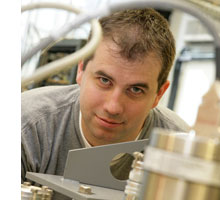
"The reason why the hard disk on your computer is likely to break is because it has moving parts which eventually wear out, but the racetrack method of storing information is much more reliable as all the parts are static," says Dr Chris Marrows, reader in condensed matter physics at the University of Leeds.
Compared with flash memory - the kind of solid state memory you find in flash drives and iPods - racetrack memory's huge advantage is on price. It is estimated that a racetrack memory in a computer would be 100 times cheaper per bit than flash.
"Magnetic racetrack memory is designed to replace the hard disk, and it's estimated that it could compete on price since it's very dense - it can store lots of bits of data on a small area of chip, as the information is stored in vertical towers," says Dr Marrows.
As well as being more reliable than hard disks, racetrack memory is also faster. There are no ‘seek' times when the head has to search the disk for information, so computers would be able to boot up almost instantly.
The next stage for the team is to develop better materials from which to make the racetrack components. A fully working race track memory is anticipated to be available within 10 years.
This research has been funded by the European Science Foundation and the Engineering and Physical Sciences Research Council in the UK, and has been published in the April issue of Physical Review Letters.
Notes to editors
Dr Christopher Marrows is a reader in condensed matter physics in the School of Physics and Astronomy, University of Leeds.
An animation demonstrating how racetrack memory works has been produced by IBM and is available as a youtube video, here www.youtube.com/watch?v=zIjK1dMdTGY
For more information about IBM Research, please visit www.research.ibm.com
####
About University of Leeds
The University of Leeds is one of the largest higher education institutions in the UK with more than 30,000 students from 130 countries and a turnover of £450m. The University is a member of the Russell Group of research-intensive universities and the 2008 Research Assessment Exercise showed it to be the UK’s eighth biggest research powerhouse. The University’s vision is to secure a place among the world’s top 50 by 2015. www.leeds.ac.uk
The School of Physics and Astronomy has a long and distinguished history dating back before the University's inception, over 100 years ago. It has over 30 members of academic staff including 10 professors, around 40 other postdoctoral staff and around 120 postgraduate students. There are typically 300 undergraduates on its degree programmes at any one time.
For more information, please click here
Contacts:
Further Information
Dr Christopher Marrows,
email:
tel: +44 (0)113 343 3780
Clare Ryan, University of Leeds press office,
tel: +44 (0)113 343 8059,
Out of hours: +44 (0)7976 929 746
Nicole Herfuth, Communications, IBM Research GmbH, Zurich Research Laboratory,
Tel: +41 44 724 8445
Copyright © University of Leeds
If you have a comment, please Contact us.Issuers of news releases, not 7th Wave, Inc. or Nanotechnology Now, are solely responsible for the accuracy of the content.
Bookmark:


| Related News Press |
News and information
 Quantum computer improves AI predictions April 17th, 2026
Flexible sensor gains sensitivity under pressure April 17th, 2026
A reusable chip for particulate matter sensing April 17th, 2026
Detecting vibrational quantum beating in the predissociation dynamics of SF6 using time-resolved photoelectron spectroscopy April 17th, 2026
Possible Futures
A fundamentally new therapeutic approach to cystic fibrosis: Nanobody repairs cellular defect April 17th, 2026
UC Irvine physicists discover method to reverse ‘quantum scrambling’ : The work addresses the problem of information loss in quantum computing system April 17th, 2026
Spintronics
Quantum materials: Electron spin measured for the first time June 9th, 2023
Memory Technology
Researchers tackle the memory bottleneck stalling quantum computing October 3rd, 2025
First real-time observation of two-dimensional melting process: Researchers at Mainz University unveil new insights into magnetic vortex structures August 8th, 2025
Utilizing palladium for addressing contact issues of buried oxide thin film transistors April 5th, 2024
Announcements
A fundamentally new therapeutic approach to cystic fibrosis: Nanobody repairs cellular defect April 17th, 2026
UC Irvine physicists discover method to reverse ‘quantum scrambling’ : The work addresses the problem of information loss in quantum computing system April 17th, 2026
 |
||
 |
||
| The latest news from around the world, FREE | ||
 |
||
|
|
||
| Premium Products | ||
 |
||
|
Only the news you want to read!
Learn More |
||
 |
||
|
Full-service, expert consulting
Learn More |
||
|
|
||