Home > Press > Bird Feathers Produce Color Through Structure Similar to Beer Foam
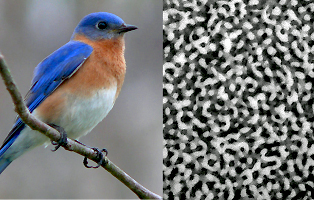 |
| Prum and Dufresne discovered that the nanostructures that produce some birds’ brightly colored plumage, such as the blue feathers of the male Eastern Bluebird, have a sponge-like structure. (Photo: Ken Thomas) |
Abstract:
Some of the brightest colors in nature are created by tiny nanostructures with a structure similar to beer foam or a sponge, according to Yale University researchers.
Bird Feathers Produce Color Through Structure Similar to Beer Foam
New Haven, CT | Posted on April 4th, 2009Most colors in nature—from the color of our skin to the green of trees—are produced by pigments. But the bright blue feathers found in many birds, such as Bluebirds and Blue Jays, are instead produced by nanostructures. Under an electron microscope, these structures look like sponges with air bubbles.
Now an interdisciplinary team of Yale engineers, physicists and evolutionary biologists has taken a step toward uncovering how these structures form. They compared the nanostructures to examples of materials undergoing phase separation, in which mixtures of different substances become unstable and separate from one another, such as the carbon-dioxide bubbles that form when the top is popped off a bubbly drink. They found that the color-producing structures in feathers appear to self-assemble in much the same manner. Bubbles of water form in a protein-rich soup inside the living cell and are replaced with air as the feather grows.
The research, which appears online in the journal Soft Matter, provides new insight into how organisms use self-assembly to produce color, and has important implications for the role color plays in birds' plumage, as the color produced depends entirely on the precise size and shape of these nanostructures.
"Many biologists think that plumage color can encode information about quality - basically, that a bluer male is a better mate," said Richard Prum, chair of the Department of Ecology and Evolutionary Biology and one of the paper's authors. "Such information would have to be encoded in the feather as the bubbles grow. I think our hypothesis that phase separation is involved provides less opportunity for encoding information about quality than most biologists thought. At the same time, it's exciting to think about other ways birds might be using phase separation."
Eric Dufresne, lead author of the paper, is also interested in the potential technological applications of the finding. "We have found that nature elegantly self assembles intricate optical structures in bird feathers. We are now mimicking this approach to make a new generation of optical materials in the lab," said Dufresne, assistant professor of mechanical engineering, chemical engineering and physics.
Prum believes it was the interdisciplinary approach the team took that led to their success - a result he plans on celebrating "with another practical application of phase separation: champagne!"
Other authors of the paper include Heeso Noh, Vinodkumar Saranathan, Simon Mochrie Hui Cao (all of Yale University).
####
About Yale
Yale University comprises three major academic components: Yale College (the undergraduate program), the Graduate School of Arts and Sciences, and the professional schools. In addition, Yale encompasses a wide array of centers and programs, libraries, museums, and administrative support offices. Approximately 11,250 students attend Yale.
For more information, please click here
Contacts:
Suzanne Taylor Muzzin
203-432-8555
Copyright © Yale University
If you have a comment, please Contact us.Issuers of news releases, not 7th Wave, Inc. or Nanotechnology Now, are solely responsible for the accuracy of the content.
Bookmark:


| Related News Press |
News and information
 Quantum computer improves AI predictions April 17th, 2026
Flexible sensor gains sensitivity under pressure April 17th, 2026
A reusable chip for particulate matter sensing April 17th, 2026
Detecting vibrational quantum beating in the predissociation dynamics of SF6 using time-resolved photoelectron spectroscopy April 17th, 2026
Possible Futures
A fundamentally new therapeutic approach to cystic fibrosis: Nanobody repairs cellular defect April 17th, 2026
UC Irvine physicists discover method to reverse ‘quantum scrambling’ : The work addresses the problem of information loss in quantum computing system April 17th, 2026
Self Assembly
Diamond glitter: A play of colors with artificial DNA crystals May 17th, 2024
Liquid crystal templated chiral nanomaterials October 14th, 2022
Nanoclusters self-organize into centimeter-scale hierarchical assemblies April 22nd, 2022
Atom by atom: building precise smaller nanoparticles with templates March 4th, 2022
Photonics/Optics/Lasers
Metasurfaces smooth light to boost magnetic sensing precision January 30th, 2026
From sensors to smart systems: the rise of AI-driven photonic noses January 30th, 2026
 |
||
 |
||
| The latest news from around the world, FREE | ||
 |
||
|
|
||
| Premium Products | ||
 |
||
|
Only the news you want to read!
Learn More |
||
 |
||
|
Full-service, expert consulting
Learn More |
||
|
|
||