Home > Press > UTSA Receives $1.2M Gift from Kleberg Foundation
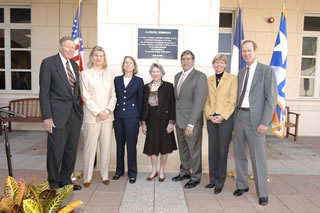 |
| (On March 11, 2008, UTSA dedicated the Robert J. Kleberg, Jr. and Helen C. Kleberg Commons in honor of the Foundation’s ongoing commitment to support UTSA research.) |
Abstract:
Officials with The University of Texas at San Antonio (UTSA) today announced receipt of a $1.2 million gift from the Robert J. Kleberg, Jr. and Helen C. Kleberg Foundation that will be used to purchase a second generation aberration corrected electron microscope. The instrument, one of only two worldwide, will help nanotechnology researchers develop new cancer therapies and treatments that combat a variety of human diseases. The microscope is not just for UTSA. It will be available to scientists across the globe and across many disciplines to advance research in their respective fields.
UTSA Receives $1.2M Gift from Kleberg Foundation
San Antonio, TX | Posted on January 22nd, 2009"We are extraordinarily grateful to the Kleberg Foundation for its support of UTSA," said Ricardo Romo, UTSA's president. "This gift will put UTSA and nanotechnology research on the map at a time when UTSA hopes to become a Top-100 research university."
"The board of the Richard J. Kleberg, Jr. and Helen C. Kleberg Foundation is very happy to be a contributor to UTSA and the progress that is going forward at the university, progress that will be a benefit to the community, state, country and the world at large," said Helen K. Groves, foundation president.
UTSA will house its new microscope, manufactured by industry leader JEOL USA, in its Advanced Microscopy Laboratory under the supervision of world-renowned researcher Miguel Yacaman, chair of the College of Sciences' Department of Physics and Astronomy. There, it will support first-class research in nanotechnology, materials science, medicine, biology, chemistry and engineering, allowing scientists to view images at a resolution of less than one Angstrom (10 -10 meters).
"Our global team understands the significance of UTSA's broad vision, and we are committed to providing JEOL's premier technology and applications support to help them achieve their goals," said Pete Genovese, JEOL's vice president and general manager, sales and marketing.
Tom Isabell, JEOL's TEM product manager, materials science, added, "The selection of this new, extraordinary microscope will provide collaborating research scientists with a unique gateway to study and share their experiences and knowledge about atomic properties - in action - at the nanoscale."
"This microscope will open up the world of science to researchers at the atomic level much the same way that telescopes such as the Hubble opened up the universe to astronomers," said Yacaman.
UTSA's microscope is slated for installation in October 2009. The instrument takes six months to fabricate and three months to install. Once up and running, researchers from across the world can send samples to UTSA, then through remote access, conduct experiments without leaving their home laboratories.
####
For more information, please click here
Contacts:
The University of Texas at San Antonio.
(210) 458-4011
One UTSA Circle
San Antonio, TX 78249-1644
Copyright © The University of Texas at San Antonio
If you have a comment, please Contact us.Issuers of news releases, not 7th Wave, Inc. or Nanotechnology Now, are solely responsible for the accuracy of the content.
Bookmark:


| Related News Press |
News and information
 Quantum computer improves AI predictions April 17th, 2026
Flexible sensor gains sensitivity under pressure April 17th, 2026
A reusable chip for particulate matter sensing April 17th, 2026
Detecting vibrational quantum beating in the predissociation dynamics of SF6 using time-resolved photoelectron spectroscopy April 17th, 2026
Imaging
Simple algorithm paired with standard imaging tool could predict failure in lithium metal batteries August 8th, 2025
Academic/Education
Rice University launches Rice Synthetic Biology Institute to improve lives January 12th, 2024
Multi-institution, $4.6 million NSF grant to fund nanotechnology training September 9th, 2022
Announcements
A fundamentally new therapeutic approach to cystic fibrosis: Nanobody repairs cellular defect April 17th, 2026
UC Irvine physicists discover method to reverse ‘quantum scrambling’ : The work addresses the problem of information loss in quantum computing system April 17th, 2026
Tools
Metasurfaces smooth light to boost magnetic sensing precision January 30th, 2026
From sensors to smart systems: the rise of AI-driven photonic noses January 30th, 2026
Japan launches fully domestically produced quantum computer: Expo visitors to experience quantum computing firsthand August 8th, 2025
Grants/Sponsored Research/Awards/Scholarships/Gifts/Contests/Honors/Records
Quantum computer improves AI predictions April 17th, 2026
Detecting vibrational quantum beating in the predissociation dynamics of SF6 using time-resolved photoelectron spectroscopy April 17th, 2026
Metasurfaces smooth light to boost magnetic sensing precision January 30th, 2026
 |
||
 |
||
| The latest news from around the world, FREE | ||
 |
||
|
|
||
| Premium Products | ||
 |
||
|
Only the news you want to read!
Learn More |
||
 |
||
|
Full-service, expert consulting
Learn More |
||
|
|
||