Home > Press > U of T physicists are first to 'squeeze' light to quantum limit
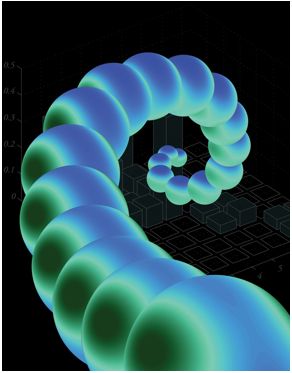 |
| A progression of squeezed triphoton states spiraling outwards. The quantum uncertainty in the triphotons can be represented as a blob on a sphere that becomes progressively "squeezed". Image Credit: Victoria Feistner |
Abstract:
A team of University of Toronto physicists have demonstrated a new technique to squeeze light to the fundamental quantum limit, a finding that has potential applications for high-precision measurement, next-generation atomic clocks, novel quantum computing and our most fundamental understanding of the universe.
U of T physicists are first to 'squeeze' light to quantum limit
TORONTO, ON, Canada | Posted on January 3rd, 2009Krister Shalm, Rob Adamson and Aephraim Steinberg of U of T´s Department of Physics and Centre for Quantum Information and Quantum Control, publish their findings in the January 1 issue of the prestigious international journal Nature.
"Precise measurement lies at the heart of all experimental science: the more accurately we can measure something the more information we can obtain. In the quantum world, where things get ever-smaller, accuracy of measurement becomes more and more elusive," explains PhD graduate student Krister Shalm.
Light is one of the most precise measuring tools in physics and has been used to probe fundamental questions in science ranging from special relativity to questions concerning quantum gravity. But light has its limits in the world of modern quantum technology.
The smallest particle of light is a photon and it is so small that an ordinary light bulb emits billions of photons in a trillionth of a second.. "Despite the unimaginably effervescent nature of these tiny particles, modern quantum technologies rely on single photons to store and manipulate information. But uncertainty, also known as quantum noise, gets in the way of the information," explains Professor Aephraim Steinberg.
Squeezing is a way to increase certainty in one quantity such as position or speed but it does so at a cost. "If you squeeze the certainty of one property that is of particular interest, the uncertainty of another complementary property inevitably grows," he says.
In the U of T experiment, the physicists combined three separate photons of light together inside an optical fibre, to create a triphoton. "A strange feature of quantum physics is that when several identical photons are combined, as they are in optical fibres such as those used to carry the internet to our homes, they undergo an "identity crisis" and one can no longer tell what an individual photon is doing," Steinberg says. The authors then squeezed the triphotonic state to glean the quantum information that was encoded in the triphoton´s polarization. (Polarization is a property of light which is at the basis of 3D movies, glare-reducing sunglasses, and a coming wave of advanced technologies such as quantum cryptography.)
In all previous work, it was assumed that one could squeeze indefinitely, simply tolerating the growth of uncertainty in the uninteresting direction. "But the world of polarization, like the Earth, is not flat," says Steinberg.
"A state of polarization can be thought of as a small continent floating on a sphere. When we squeezed our triphoton continent, at first all proceeded as in earlier experiments. But when we squeezed sufficiently hard, the continent lengthened so much that it began to "wrap around" the surface of the sphere," he says.
"To take the metaphor further, all previous experiments were confined to such small areas that the sphere, like your home town, looked as though it was flat. This work needed to map the triphoton on a globe, which we represented on a sphere providing an intuitive and easily applicable visualization. In so doing, we showed for the first time that the spherical nature of polarization creates qualitatively different states and places a limit on how much squeezing is possible," says Steinberg.
"Creating this special combined state allows the limits to squeezing to be properly studied," says Rob Adamson. "For the first time, we have demonstrated a technique for generating any desired triphoton state and shown that the spherical nature of polarization states of light has unavoidable consequences. Simply put: to properly visualize quantum states of light, one should draw them on a sphere."
####
For more information, please click here
Contacts:
Aephraim Steinberg
Note: Prof. Steinberg is reachable only by email until January 2.
Rob Adamson
Tel:807-345-7073 (December 28 - January 4)
All of the above scientists are with
the Department of Physics and The
Centre for Quantum Information &
Quantum Control University of Toronto
Kim Luke
Communications Faculty
Arts & Science
Tel: 416-978-4352
Copyright © University of Toronto
If you have a comment, please Contact us.Issuers of news releases, not 7th Wave, Inc. or Nanotechnology Now, are solely responsible for the accuracy of the content.
Bookmark:


| Related News Press |
News and information
 Quantum computer improves AI predictions April 17th, 2026
Flexible sensor gains sensitivity under pressure April 17th, 2026
A reusable chip for particulate matter sensing April 17th, 2026
Detecting vibrational quantum beating in the predissociation dynamics of SF6 using time-resolved photoelectron spectroscopy April 17th, 2026
Physics
UC Irvine physicists discover method to reverse ‘quantum scrambling’ : The work addresses the problem of information loss in quantum computing system April 17th, 2026
Quantum computers simulate fundamental physics: shedding light on the building blocks of nature June 6th, 2025
Quantum Computing
Quantum computer improves AI predictions April 17th, 2026
UC Irvine physicists discover method to reverse ‘quantum scrambling’ : The work addresses the problem of information loss in quantum computing system April 17th, 2026
Researchers develop molecular qubits that communicate at telecom frequencies October 3rd, 2025
Discoveries
Quantum computer improves AI predictions April 17th, 2026
Flexible sensor gains sensitivity under pressure April 17th, 2026
A reusable chip for particulate matter sensing April 17th, 2026
Detecting vibrational quantum beating in the predissociation dynamics of SF6 using time-resolved photoelectron spectroscopy April 17th, 2026
Announcements
A fundamentally new therapeutic approach to cystic fibrosis: Nanobody repairs cellular defect April 17th, 2026
UC Irvine physicists discover method to reverse ‘quantum scrambling’ : The work addresses the problem of information loss in quantum computing system April 17th, 2026
Quantum nanoscience
Beyond silicon: Electronics at the scale of a single molecule January 30th, 2026
MXene nanomaterials enter a new dimension Multilayer nanomaterial: MXene flakes created at Drexel University show new promise as 1D scrolls January 30th, 2026
ICFO researchers overcome long-standing bottleneck in single photon detection with twisted 2D materials August 8th, 2025
 |
||
 |
||
| The latest news from around the world, FREE | ||
 |
||
|
|
||
| Premium Products | ||
 |
||
|
Only the news you want to read!
Learn More |
||
 |
||
|
Full-service, expert consulting
Learn More |
||
|
|
||