Home > Press > Argonne scientists awarded presidential award for advancement of science
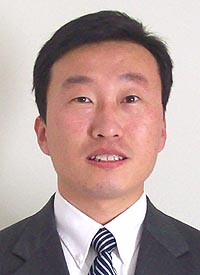 |
| Yugang Sun of the U.S. Department of Energy's Argonne National Laboratory received the Presidential Early Career Award for Scientists and Engineers (PECASE) to recognize his contributions to the advancement of science. |
Abstract:
Assistant chemist Yugang Sun and physicist Robin Santra of the U.S. Department of Energy's Argonne National Laboratory today received the Presidential Early Career Award for Scientists and Engineers (PECASE) to recognize their contribution to the advancement of science.
Argonne scientists awarded presidential award for advancement of science
ARGONNE, IL | Posted on December 22nd, 2008The Presidential Awards are intended to recognize and nurture some of the finest scientists and engineers who, while early in their research careers, show exceptional potential for leadership at the frontiers of scientific knowledge during the 21st century. The Presidential Award is the highest honor bestowed by the U.S. government on outstanding scientists and engineers who are beginning their independent careers.
"These awards recognize some of the outstanding people affiliated with the Department of Energy whose extraordinary talents are discovering the solutions to power and secure America 's future," said Secretary of Energy Samuel W. Bodman. "Each honoree has made a unique contribution to fulfilling the department's mission and to enhancing scientific knowledge at large. I am proud of the awardees and appreciative of their efforts."
Santra was recognized for theoretical contributions to the field of atomic, molecular and optical science in the areas of high-order harmonic generation and strong-field absorption and ionization; and for scientific mentoring of students and the public.
Santra received his Ph.D. in theoretical chemical physics from the University of Heidelberg in 2001. As a postdoctoral researcher, he worked at JILA, which is jointly operated by the University of Colorado and the National Institute of Standards and Technology, and at the Institute for Theoretical Atomic, Molecular and Optical Physics at the Harvard-Smithsonian Center for Astrophysics. Santra joined Argonne National Laboratory in 2005. In 2007, he was awarded by the International Union of Pure and Applied Physics the Young Scientist Prize in Atomic, Molecular and Optical Physics. He has published more than 60 peer-reviewed articles and has given 59 invited presentations.
Sun was recognized for developing ground-breaking techniques for chemical synthesis and nanofabrication of metal and semiconductor nanomaterials; and for educational activities for the community.
Sun received a B.S. and Ph.D. degrees in chemistry from the University of Science and Technology of China in 1996 and 2001, respectively. Before joining Argonne in 2006, he was a post-doctoral research associate at the University of Washington and the University of Illinois at Urbana-Champaign, where his research led to more than 10 patents.
He has published more than 80 peer-reviewed articles in high-profile journals including Science, Nature Nanotechnology, Nano Letters Advanced Materials, and the Journal of American Chemical Society. The total number of citations to his work is more than 7,400, and he has 16 papers that have been cited individually more than 100 times. He has delivered more than 20 invited presentations at major international conferences and universities.
The winning scientists are among 68 researchers supported by nine federal departments and agencies who received the award. In addition to a citation and a plaque, each PECASE winner receives up to five years of funding from their agency to advance his or her research. John Marburger, Science Advisor to the President and Director of the Office of Science and Technology Policy, presented the awards.
####
About Argonne National Laboratory
Argonne National Laboratory seeks solutions to pressing national problems in science and technology. The nation's first national laboratory, Argonne conducts leading-edge basic and applied scientific research in virtually every scientific discipline. Argonne researchers work closely with researchers from hundreds of companies, universities, and federal, state and municipal agencies to help them solve their specific problems, advance America 's scientific leadership and prepare the nation for a better future. With employees from more than 60 nations, Argonne is managed by UChicago Argonne, LLC for the U.S. Department of Energy's Office of Science.
Follow Argonne on Twitter at twitter.com/argonne.
For more information, please click here
Contacts:
Brock Cooper
630/252-5565
Copyright © Argonne National Laboratory
If you have a comment, please Contact us.Issuers of news releases, not 7th Wave, Inc. or Nanotechnology Now, are solely responsible for the accuracy of the content.
Bookmark:


| Related News Press |
News and information
 Simulating magnetization in a Heisenberg quantum spin chain April 5th, 2024
NRL charters Navy’s quantum inertial navigation path to reduce drift April 5th, 2024
Discovery points path to flash-like memory for storing qubits: Rice find could hasten development of nonvolatile quantum memory April 5th, 2024
Laboratories
A battery’s hopping ions remember where they’ve been: Seen in atomic detail, the seemingly smooth flow of ions through a battery’s electrolyte is surprisingly complicated February 16th, 2024
NRL discovers two-dimensional waveguides February 16th, 2024
Three-pronged approach discerns qualities of quantum spin liquids November 17th, 2023
Govt.-Legislation/Regulation/Funding/Policy
NRL charters Navy’s quantum inertial navigation path to reduce drift April 5th, 2024
Discovery points path to flash-like memory for storing qubits: Rice find could hasten development of nonvolatile quantum memory April 5th, 2024
Chemical reactions can scramble quantum information as well as black holes April 5th, 2024
Announcements
NRL charters Navy’s quantum inertial navigation path to reduce drift April 5th, 2024
Discovery points path to flash-like memory for storing qubits: Rice find could hasten development of nonvolatile quantum memory April 5th, 2024
Grants/Sponsored Research/Awards/Scholarships/Gifts/Contests/Honors/Records
Discovery points path to flash-like memory for storing qubits: Rice find could hasten development of nonvolatile quantum memory April 5th, 2024
Chemical reactions can scramble quantum information as well as black holes April 5th, 2024
 |
||
 |
||
| The latest news from around the world, FREE | ||
 |
||
|
|
||
| Premium Products | ||
 |
||
|
Only the news you want to read!
Learn More |
||
 |
||
|
Full-service, expert consulting
Learn More |
||
|
|
||