Home > Press > Jumbo 'nanotube' existence confirmed at Sandia/LANL nanotech center
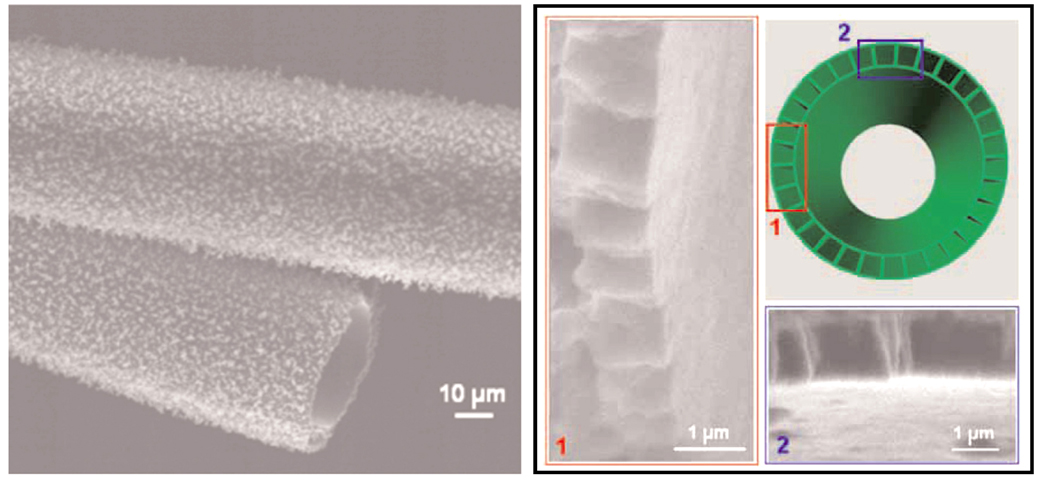 |
| JUMBO TUBES -- a scanning electron microscope image (left) of a huge carbon tube. Images at right depict cross-sectional view of the tube, with rectangular pore tunnels visible in its wall. (photo by Sandi/LANL Center for Integrated Nanotechnologies) |
Abstract:
A jumbo nanotube, like a jumbo shrimp, sounds contradictory.
A giant lightweight carbon nanotube with good strength and electrical properties is desirable, all right. A micron-sized carbon tube is easier to exploit commercially than any (so to speak) littler nanocousin.
Jumbo 'nanotube' existence confirmed at Sandia/LANL nanotech center
ALBUQUERQUE, NM | Posted on December 18th, 2008But is it still a nanotube?
Jianyu Huang at the joint Sandia and Los Alamos national laboratories Center for Integrated Nanotechnologies (CINT), with colleagues elsewhere, got around this problem by naming their new creation "colossal carbon tubes" in a paper published in a recent issue of Physical Review Letters.
"The structures are remarkable because they are very light, possess good electrical conductivity, and mechanical properties similar to carbon fibers," Huang says.
Among possibilities of use are so-called textile electronics and body armor.
Because of their strange, surprising sponginess — walls of graphite-like carbon kept apart by hollow, rectangular compartments — the colossal fibrous tubes are 20 times less dense than carbon fibers, yet about the same length — in the centimeter range. And they appear to be slightly stronger — a very desirable, and until now unheard-of property in large carbon tubes.
The new form of carbon surprised leading nanotechnology researchers. MIT's carbon technology specialist Mildred Dresselhaus was quoted in an online news article in the journal Nature: "This is a new form of carbon that was unexpected to me."
Huang, who did the microstructure analysis confirming that the walls of such tubes consist of graphitic structure, describes the new creation as "a porous, giant, carbon fiber-like tubular structure" of diameters ranging from 40 to 100 microns. Conventional carbon nanotubes are about 10 nanometer diameter.
The material was made at Los Alamos National Laboratory. Researchers there led by Yuntian Zhu and Huisheng Peng found that heating ethylene and paraffin oil produced a carbon vapor that condensed into tubes of pure carbon tens of microns wide and up to several centimeters long. Zhu now is at North Carolina State University, and Huisheng Peng is at Tongji University in Shanghai.
####
About Sandia National Laboratories
Sandia is a multiprogram laboratory operated by Sandia Corporation, a Lockheed Martin company, for the U.S. Department of Energy’s National Nuclear Security Administration. With main facilities in Albuquerque, N.M., and Livermore, Calif., Sandia has major R&D responsibilities in national security, energy and environmental technologies, and economic competitiveness.
For more information, please click here
Contacts:
Neal Singer
(505) 845-7078
Copyright © Sandia National Laboratories
If you have a comment, please Contact us.Issuers of news releases, not 7th Wave, Inc. or Nanotechnology Now, are solely responsible for the accuracy of the content.
Bookmark:


| Related News Press |
News and information
 Quantum computer improves AI predictions April 17th, 2026
Flexible sensor gains sensitivity under pressure April 17th, 2026
A reusable chip for particulate matter sensing April 17th, 2026
Detecting vibrational quantum beating in the predissociation dynamics of SF6 using time-resolved photoelectron spectroscopy April 17th, 2026
Nanotubes/Buckyballs/Fullerenes/Nanorods/Nanostrings/Nanosheets
Tiny nanosheets, big leap: A new sensor detects ethanol at ultra-low levels January 30th, 2026
Enhancing power factor of p- and n-type single-walled carbon nanotubes April 25th, 2025
Chainmail-like material could be the future of armor: First 2D mechanically interlocked polymer exhibits exceptional flexibility and strength January 17th, 2025
Innovative biomimetic superhydrophobic coating combines repair and buffering properties for superior anti-erosion December 13th, 2024
Discoveries
Quantum computer improves AI predictions April 17th, 2026
Flexible sensor gains sensitivity under pressure April 17th, 2026
A reusable chip for particulate matter sensing April 17th, 2026
Detecting vibrational quantum beating in the predissociation dynamics of SF6 using time-resolved photoelectron spectroscopy April 17th, 2026
Announcements
A fundamentally new therapeutic approach to cystic fibrosis: Nanobody repairs cellular defect April 17th, 2026
UC Irvine physicists discover method to reverse ‘quantum scrambling’ : The work addresses the problem of information loss in quantum computing system April 17th, 2026
 |
||
 |
||
| The latest news from around the world, FREE | ||
 |
||
|
|
||
| Premium Products | ||
 |
||
|
Only the news you want to read!
Learn More |
||
 |
||
|
Full-service, expert consulting
Learn More |
||
|
|
||