Home > Press > Research group applies nanocoating technology to a 'living interface' between implants and bone
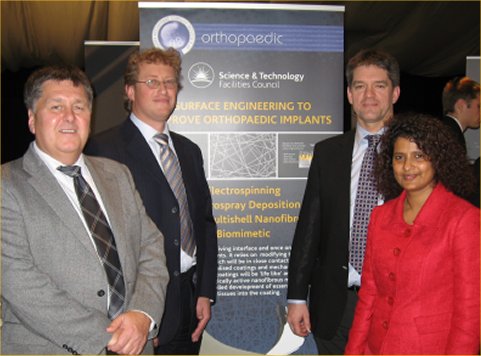 |
| Alternative Text for image (if uploaded): Mr Mansel Williams (Micro and Nanotechnology Centre), Mr Julian Fairman (Symmetry Medical), Dr Robert Stevens (The Electrospinning Technology Company, Ltd) and Dr Rajshree Mootanah (Anglia Ruskin University). |
Abstract:
New multi-layer coating containing biological substances improves the reliability and durability of surgical implants.
Research group applies nanocoating technology to a 'living interface' between implants and bone
UK | Posted on December 15th, 2008A Medical Engineering Research Group, based in the East of England, has won a Translational Research Award in Orthopaedics from the Medical Futures Innovation Awards 2008 (MFIA2008).
A strategic collaboration between the Medical Engineering Research Group of Anglia Ruskin University, the Micro and Nanotechnology Centre of the Science and Technology Facilities Council, the Electrospinning Company Ltd and Symmetry Medical led to the prestigious MFIA2008 award.
The technology involves a unique surface engineering process that is being developed at the Micro and Nanotechnology Centre at the Science and Technology Facilities Council. This brand new process, adds micro and nano sized hair like structures to the surface which creates a ‘living interface' between artificial implants and bone. The addition of a multilayer coating containing biological substances, such as growth factors and antibiotics, could improve bony integration, arterial and venous proliferation and reduce infection. This space-age technology could revolutionise the reliability and durability of surgical implants, such as hip and knee replacements.
Hundreds of applications were made for the MFIA08 in a number of therapy areas including cancer, cardiovascular disease, dentistry, ENT, ophthalmology and orthopaedics and only 20 were awards were given.
A Medical Futures Innovation Award is one of the UK's most sought after healthcare and business accolades, rewarding ground-breaking innovation from front line clinicians and scientists and ideas that have the potential to transform peoples' lives and demonstrate the UK's position as a world leader. The judging is performed by a panel of the most distinguished doctors and business leaders in the country.
Dr Robert Stevens (the Electrospinning Company Ltd), Dr Rajshree Mootanah (Anglia Ruskin University), Mr Mansel Williams (the Micro and Nanotechnology Centre) and Mr Julian Fairman (Symmetry Medical) received recognition for the medical and commercial potential of their technology at the MFIA08 awards ceremony on 2 December 2008.
Dr Rajshree Mootanah, Director of the Medical Engineering Research Group said, ‘This groundbreaking technology could result in wide-scale clinical applications and improve quality of life. We are very pleased to be a recipient of the MFIA08 award and are committed to work on this exciting research project.'
This strategic collaboration was initiated at the 4th Medical Engineering Research Conference in September 2008 at Anglia Ruskin University. The concept developed was to transfer technology of the nano surface engineering process to orthopaedic implants, using computer simulations (finite element methods) to predict the effectiveness of the coated prostheses.
Photo: Mr Mansel Williams (Micro and Nanotechnology Centre), Mr Julian Fairman (Symmetry Medical), Dr Robert Stevens (The Electrospinning Technology Company, Ltd) and Dr Rajshree Mootanah (Anglia Ruskin University).
The Medical Engineering Research Conference
The Medical Engineering Research Conference is a biennial event, organised by the Medical Engineering Research Group at Anglia Ruskin University. The aim of this conference is to initiate and strengthen research collaborations among medical engineering research groups, companies and hospitals to apply engineering principles to help overcome the social, economic and health-related problems through collaborative research. The Medical Engineering Research Conference has led to a number of collaborations and external funding in the past, including: (1) Kirton Healthcare Group, which led to a Knowledge Transfer Partnership and two KEEP awards and (2) the Vascular Department of Mid-Essex Hospitals Trust (MEHT), which led to two awards, the MEHT research and development fund and the Chelmsford Medical Education and Research Trust grant.
This year, the 4th Medical Engineering Research Conference was held jointly with the Postgraduate Medical Institute. The keynote speaker was Prof Howard J Hillstrom, Director of the Leon Root Motion Analysis Laboratory from the Hospital of Special Surgery (HSS). His address concerned the conservative treatment of osteoarthritis, an area in which the Medical Engineering Research Group has initiated a complementary collaboration with HSS. Three grant applications have been submitted to date both in the US and the UK. Several grants are in development to optimise treatments of knee osteoarthritis through both conservative and surgical approaches.
Following this year's conference, the Health Enterprise East has been assisting with a patent application for a medical boot to treat venous ulcers. This project is a collaboration between Anglia Ruskin University and MEHT, Broomfield Hospital. Professor Hillstrom serves as an advisor on this project.
####
For more information, please click here
Contacts:
Andrea Hilliard on t: 0845 196 4727, e:
Alison Baker
t: 44 01284 703357
m: 44 07771 658 612,
Copyright © Anglia Ruskin University
If you have a comment, please Contact us.Issuers of news releases, not 7th Wave, Inc. or Nanotechnology Now, are solely responsible for the accuracy of the content.
Bookmark:


| Related News Press |
News and information
 Simulating magnetization in a Heisenberg quantum spin chain April 5th, 2024
NRL charters Navy’s quantum inertial navigation path to reduce drift April 5th, 2024
Discovery points path to flash-like memory for storing qubits: Rice find could hasten development of nonvolatile quantum memory April 5th, 2024
Nanomedicine
New micromaterial releases nanoparticles that selectively destroy cancer cells April 5th, 2024
Good as gold - improving infectious disease testing with gold nanoparticles April 5th, 2024
Researchers develop artificial building blocks of life March 8th, 2024
Discoveries
Chemical reactions can scramble quantum information as well as black holes April 5th, 2024
New micromaterial releases nanoparticles that selectively destroy cancer cells April 5th, 2024
Utilizing palladium for addressing contact issues of buried oxide thin film transistors April 5th, 2024
Announcements
NRL charters Navy’s quantum inertial navigation path to reduce drift April 5th, 2024
Discovery points path to flash-like memory for storing qubits: Rice find could hasten development of nonvolatile quantum memory April 5th, 2024
Grants/Sponsored Research/Awards/Scholarships/Gifts/Contests/Honors/Records
Discovery points path to flash-like memory for storing qubits: Rice find could hasten development of nonvolatile quantum memory April 5th, 2024
Chemical reactions can scramble quantum information as well as black holes April 5th, 2024
 |
||
 |
||
| The latest news from around the world, FREE | ||
 |
||
|
|
||
| Premium Products | ||
 |
||
|
Only the news you want to read!
Learn More |
||
 |
||
|
Full-service, expert consulting
Learn More |
||
|
|
||