Home > Press > Slower switching for quantum coherence: The performance of quantum computing can be improved by operating logic gates slowly
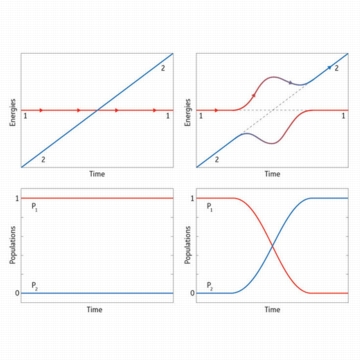 |
| Figure 1: The slow and robust transfer of a qubit from one quantum state (1) to another (2). The temporal evolution of the energy levels (upper panels) and the populations of those energy levels (lower panels) are shown for a two-state quantum system. The population transfer from one quantum state to another occurs only in the circuits with an electromagnetic (coupling) pulse (right-hand panels). |
Abstract:
Over the past decade scientists have made rapid progress towards building a quantum computer, but many obstacles still remain. One important requirement is that researchers must achieve extremely accurate control of the electrical signals used in quantum logic gates. A research team based at the RIKEN Advanced Sciences Institute (formerly the Frontier Research System) in Wako has proposed a new method for operating quantum logic gates that could help reach the required accuracy1.
Slower switching for quantum coherence: The performance of quantum computing can be improved by operating logic gates slowly
Japan | Posted on July 25th, 2008Calculations in quantum computing are performed on units of quantum information called qubits, which can be implemented in superconductors. The slightest noise or interference from the external world can cause qubits to lose their quantum information and revert to classical behavior. This problem, known as decoherence, has been partly overcome by ‘adiabatic' quantum computing in which the quantum algorithm is designed to keep the whole system in a relatively robust state throughout the calculation.
The researchers' proposal could reduce decoherence further by avoiding the need for fast logic gates acting on qubits. Their alternative approach involves slowly transferring populations of qubits between selected quantum states (Fig. 1).
The quantum algorithm is not changed in the new proposal. Franco Nori of RIKEN and the University of Michigan in the USA, explains: "The only thing that has changed is the way that the gates are operated. Instead of using so-called pi-pulses, which require very accurate electrical signals to manipulate the qubits, we propose using slow population transfers, which are not affected by imperfections in the manipulation signal."
The qubits must still be very accurately controlled, but now the strict requirement is shifted to a different step in the quantum gate, sometimes referred to as the phase gate. This step is easier to perform than the population transfer. Thus, the strictest accuracy requirement is now imposed on a step where the available technology allows accurate design.
"When you manipulate quantum states slowly, nature works on your side and protects the quantum state against imperfections in the control signals," says Lian-Fu Wei of the RIKEN team, now at Southwest Jiaotong University in Chengdu, China.
Team-member Sahel Ashhab summarizes the approach by saying: "We identified a difficulty in the requirement of accurate control pulses and asked the question: can we perform quantum gates without having to deal with this?" The theoretical analysis has shown that it is indeed possible to do so, and the researchers hope that experimental tests of their idea will be performed in the near future.
Reference
1. Wei, L.F., Johansson, J.R., Cen, L.X., Ashhab, S. & Nori, F. Controllable coherent population transfers in superconducting qubits for quantum computing. Physical Review Letters 100, 113601 (2008).
####
For more information, please click here
Copyright © Riken
If you have a comment, please Contact us.Issuers of news releases, not 7th Wave, Inc. or Nanotechnology Now, are solely responsible for the accuracy of the content.
Bookmark:


| Related News Press |
News and information
 Quantum computer improves AI predictions April 17th, 2026
Flexible sensor gains sensitivity under pressure April 17th, 2026
A reusable chip for particulate matter sensing April 17th, 2026
Detecting vibrational quantum beating in the predissociation dynamics of SF6 using time-resolved photoelectron spectroscopy April 17th, 2026
Quantum Computing
Quantum computer improves AI predictions April 17th, 2026
UC Irvine physicists discover method to reverse ‘quantum scrambling’ : The work addresses the problem of information loss in quantum computing system April 17th, 2026
Researchers develop molecular qubits that communicate at telecom frequencies October 3rd, 2025
Discoveries
Quantum computer improves AI predictions April 17th, 2026
Flexible sensor gains sensitivity under pressure April 17th, 2026
A reusable chip for particulate matter sensing April 17th, 2026
Detecting vibrational quantum beating in the predissociation dynamics of SF6 using time-resolved photoelectron spectroscopy April 17th, 2026
Announcements
A fundamentally new therapeutic approach to cystic fibrosis: Nanobody repairs cellular defect April 17th, 2026
UC Irvine physicists discover method to reverse ‘quantum scrambling’ : The work addresses the problem of information loss in quantum computing system April 17th, 2026
 |
||
 |
||
| The latest news from around the world, FREE | ||
 |
||
|
|
||
| Premium Products | ||
 |
||
|
Only the news you want to read!
Learn More |
||
 |
||
|
Full-service, expert consulting
Learn More |
||
|
|
||