Home > Press > Three of MIT's thinkers named to top 100 intellectuals list
 |
Abstract:
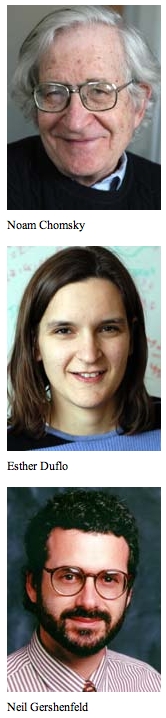
Three of MIT's thinkers--Noam Chomsky, Esther Duflo and Neil Gershenfeld--have been named among 100 other "global intellectuals" by Prospect Magazine.
Three of MIT's thinkers named to top 100 intellectuals list
Cambridge, MA | Posted on May 1st, 2008The three are cited in the web-exclusive portion of the British monthly magazine's web site for their work on foreign policy, poverty and quantum computing.
Chomsky, a professor of linguistics, is cited as being "a groundbreaking linguist and a prominent critic of U.S. foreign policy" as well as the winner of the magazine's 2005 global intellectuals poll.
Duflo, the Abdul Latif Jameel Professor of Poverty Alleviation and Development Economics, was noted for her work on "health, poverty and credit issues in the developing world."
Gershenfeld, director of the Center for Bits and Atoms at MIT, "takes an interdisciplinary approach to quantum computing, nanotechnology and personal fabrication," the magazine's citation notes.
Readers will now vote on their choice for "top global public intellectuals"--for the first time since Chomsky won the title in 2005--until May 15 at www.prospect-magazine.co.uk/intellectuals/.
Prospect touts itself as a monthly that is "more readable than the Economist, more relevant than the Spectator, more romantic than the New Statesman," according to its web site.
####
About MIT
The mission of MIT is to advance knowledge and educate students in science, technology, and other areas of scholarship that will best serve the nation and the world in the 21st century.
For more information, please click here
Contacts:
news office
77 massachusetts avenue 617-253-2700
room 11-400
cambridge, ma 02139-4307
Copyright © MIT
If you have a comment, please Contact us.Issuers of news releases, not 7th Wave, Inc. or Nanotechnology Now, are solely responsible for the accuracy of the content.
Bookmark:


| Related News Press |
News and information
 Simulating magnetization in a Heisenberg quantum spin chain April 5th, 2024
NRL charters Navy’s quantum inertial navigation path to reduce drift April 5th, 2024
Discovery points path to flash-like memory for storing qubits: Rice find could hasten development of nonvolatile quantum memory April 5th, 2024
Academic/Education
Rice University launches Rice Synthetic Biology Institute to improve lives January 12th, 2024
Multi-institution, $4.6 million NSF grant to fund nanotechnology training September 9th, 2022
Announcements
NRL charters Navy’s quantum inertial navigation path to reduce drift April 5th, 2024
Discovery points path to flash-like memory for storing qubits: Rice find could hasten development of nonvolatile quantum memory April 5th, 2024
Grants/Sponsored Research/Awards/Scholarships/Gifts/Contests/Honors/Records
Discovery points path to flash-like memory for storing qubits: Rice find could hasten development of nonvolatile quantum memory April 5th, 2024
Chemical reactions can scramble quantum information as well as black holes April 5th, 2024
 |
||
 |
||
| The latest news from around the world, FREE | ||
 |
||
|
|
||
| Premium Products | ||
 |
||
|
Only the news you want to read!
Learn More |
||
 |
||
|
Full-service, expert consulting
Learn More |
||
|
|
||