Home > Press > Nanotechnology Consumer Products Are in Your Mouth and On Your Face
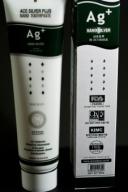 |
| Silver Nano Toothpaste purchased at a local market. This and other nanotech enabled consumer products inventoried at www.nanotechproject.org/consumer. Alex Parlini, 2008 - Project on Emerging Nanotechnologies. (PRNewsFoto/The Project on Emerging Nanotechnologies) |
Abstract:
New Nanotech Products Hitting the Market at the Rate of 3-4 Per Week
Nanotechnology Consumer Products Are in Your Mouth and On Your Face
Washington, DC | Posted on April 23rd, 2008New nanotechnology consumer products are coming on the market at the rate of 3-4 per week, a
finding based on the latest update to the nanotechnology consumer productinventory maintained by the Project on Emerging Nanotechnologies (PEN).
One of the new items among the more than 600 products now in the
inventory is Swissdent Nanowhitening Toothpaste with "calcium peroxides, in
the form of nano-particles." Today, in testimony before the Senate Commerce
Committee, PEN Project Director David Rejeski cited Ace Silver Plus --
another of the nine nano toothpastes in the inventory -- as an example of
the upsurge in nanotechnology consumer products in stores. The hearing
marks the start of U.S. Senate debate on the future direction of the annual
$1.5 million federal investment in nanotechnology research and development
(R&D).
The number of consumer products using nanotechnology has grown from 212
to 609 since PEN launched the world's first online inventory of
manufacturer-identified nanotech goods in March 2006. Health and fitness
items, which include cosmetics and sunscreens, represent 60 percent of
inventory products. The colorful and searchable list of nanotechnology
merchandise -- containing everything from nanotech diamonds and cooking
oil, to golf clubs and iPhones -- is available free at
www.nanotechproject.org/consumerproducts.
There are 35 automotive products in the PEN inventory, including the
Hummer H2. General Motors Corporation bills the H2 as having a cargo bed
that "uses about seven pounds of molded-in-color nanocomposite parts for
its trim, center bridge, sail panel and box rail protector."
Nanoscale silver is the most cited nanomaterial used. It is found in
143 products or over 20 percent of the inventory. Carbon, including carbon
nanotubes and fullerenes, is the second highest nanoscale material cited.
Other nanoscale materials explicitly referenced in products are zinc
(including zinc oxide) and titanium (including titanium dioxide), silica
and gold.
While polls show most Americans know little or nothing about
nanotechnology, in 2006 nanotechnology was incorporated into more than $50
billion in manufactured goods. By 2014, Lux Research estimates $2.6
trillion in manufactured goods will incorporate nanotechnology -- or about
15 percent of total global output. Despite a 2006 worldwide investment of
$12.4 billion in nanotech R&D, comparatively little was spent on examining
nanotechnology's potential environmental, health and safety risks.
"Public trust is the 'dark horse' in nanotechnology's future," says
Rejeski in his testimony. "If government and industry do not work to build
public confidence in nanotechnology, consumers may reach for the 'No-Nano'
label in the future and investors will put their money elsewhere."
According to Rejeski, "The use of nanotechnology in consumer products
and industrial applications is growing rapidly, with the products listed in
the PEN inventory showing just the tip of the iceberg. Public perceptions
about risks -- real and perceived -- can have large economic consequences.
How consumers respond to these early products -- in food, electronics,
health care, clothing and cars -- is a litmus test for broader market
acceptance of nanotechnologies in the future."
Nanotechnology is the ability to measure, see, manipulate and
manufacture things usually between 1 and 100 nanometers (nm). A nanometer
is one billionth of a meter. A human hair is roughly 100,000 nanometers
wide. The limit of the human eye's capacity to see without a microscope is
about 10,000 nm.
####
About The Project on Emerging Nanotechnologies
The Project on Emerging Nanotechnologies is an initiative launched by
the Woodrow Wilson International Center for Scholars and The Pew Charitable
Trusts in 2005. It is dedicated to helping business, government and the
public anticipate and manage possible health and environmental implications
of nanotechnology.
For more information, please click here
Contacts:
Julia Moore
+1-202-691-4025
+1-202-277-1415 (mobile)
or
Sharon McCarter
+1-202-691-4016
Copyright © PR Newswire Association LLC.
If you have a comment, please Contact us.Issuers of news releases, not 7th Wave, Inc. or Nanotechnology Now, are solely responsible for the accuracy of the content.
Bookmark:


| Related News Press |
News and information
 Quantum computer improves AI predictions April 17th, 2026
Flexible sensor gains sensitivity under pressure April 17th, 2026
A reusable chip for particulate matter sensing April 17th, 2026
Detecting vibrational quantum beating in the predissociation dynamics of SF6 using time-resolved photoelectron spectroscopy April 17th, 2026
Products
Spectradyne Partners with Particle Technology Labs for Measurement Services December 6th, 2018
Mode-Changing MEMS Accelerometer from STMicroelectronics Combines High Measurement Resolution and Ultra-Low Power for Industrial Applications November 7th, 2018
Fat-Repellent Nanolayers Can Make Oven Cleaning Easier October 17th, 2018
Aculon, Inc. Enters into Strategic Partnership Agreement with Henkel Corporation to Supply Key Mobile Device Manufacturers with NanoProof® PCB Waterproof Technology October 17th, 2018
Announcements
A fundamentally new therapeutic approach to cystic fibrosis: Nanobody repairs cellular defect April 17th, 2026
UC Irvine physicists discover method to reverse ‘quantum scrambling’ : The work addresses the problem of information loss in quantum computing system April 17th, 2026
 |
||
 |
||
| The latest news from around the world, FREE | ||
 |
||
|
|
||
| Premium Products | ||
 |
||
|
Only the news you want to read!
Learn More |
||
 |
||
|
Full-service, expert consulting
Learn More |
||
|
|
||