Home > Press > Professor Strauf’s research is Nature Photonics’ cover article
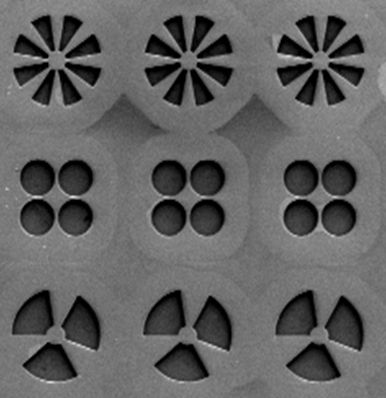 |
| Electron micrograph of the single-photon source trench design developed at UC Santa Barbara. |
Abstract:
Stefan Strauf, Assistant Professor in the Department of Physics & Engineering Physics at Stevens Institute of Technology, along with colleagues from the University of California, Santa Barbara and Leiden University (Netherlands), has authored the article, "High-frequency single-photon source with polarization control," the cover article of the December 2007 issue of Nature Photonics.
Professor Strauf’s research is Nature Photonics’ cover article
HOBOKEN, NJ | Posted on December 6th, 2007 The article reports on important advances in high-performance single-photon sources that bring such possibilities closer to reality. In particular, single photons can be used to implement absolutely secure optical communication, also known as Quantum Cryptography. With this new source, recording a single-photon signature that took eight hours five years back can now be achieved on a millisecond time scale. This remarkable progress was achieved by developing a novel type of microcavity structure which strongly enhances the light extraction from the optically active material. Moreover, with the help of embedded electrical gates, the researchers demonstrated suppression of unwanted dead-times in the emission process itself resulting in a net single photon generation rate of 100 MHz into an optical fiber.
As described in the News & Views section of the issue, "More futuristic applications of single photon states include photonic networks designed to achieve scalable quantum computation, which one day will hopefully solve problems exponentially faster than classical computers."
Strauf also was interviewed by the publication regarding his work on the project." The traditional approach to generating single photons is to use weak laser pulses. In order to reach the single-photon level, you have to attenuate the light very strongly, limiting the efficiency of the device. Also, the photons emitted are governed by statistics. What we need is a high-efficiency source where we can generate photons one by one. Luckily, nature provides a solution in the form of the two-level system, just like the one we use: self-assembled quantum dots," said Strauf.
Strauf's coauthors on the paper are Nick G. Stoltz (Materials Department, University of California, Santa Barbara); Matthew T. Rakher (Department of Physics, University of California, Santa Barbara); Larry A. Coldren (Materials Department and the ECE department, University of California, Santa Barbara); Pierre M. Petroff (Materials Department and the ECE department, University of California, Santa Barbara); and Dirk Bouwmeester (Department of Physics, University of California, Santa Barbara and Huygens Laboratory, Leiden University, the Netherlands).
####
About Stevens Institute of Technology
Founded in 1870, Stevens Institute of Technology is one of the leading technological universities in the world dedicated to learning and research. Through its broad-based curricula, nurturing of creative inventiveness, and cross disciplinary research, the Institute is at the forefront of global challenges in engineering, science, and technology management. Partnerships and collaboration between, and among, business, industry, government and other universities contribute to the enriched environment of the Institute. A new model for technology commercialization in academe, known as Technogenesis®, involves external partners in launching business enterprises to create broad opportunities and shared value.
Stevens offers baccalaureates, master’s and doctoral degrees in engineering, science, computer science and management, in addition to a baccalaureate degree in the humanities and liberal arts, and in business and technology. The university has a total enrollment of 2,040 undergraduate and 3,085 graduate students, and a worldwide online enrollment of 2,250, with a full-time tenured/tenure-track faculty of 140 and more than 200 full-time special faculty. Stevens’ graduate programs have attracted international participation from China, India, Southeast Asia, Europe and Latin America. Additional information may be obtained from its web page at http://www.stevens.edu .
For more information, please click here
Contacts:
Stephanie Mannino
+1-201-216-5602
Stevens Institute of Technology
Castle Point on Hudson
Hoboken NJ 07030-5991 USA
+1.201.216.5000
Copyright © Stevens Institute of Technology
If you have a comment, please Contact us.Issuers of news releases, not 7th Wave, Inc. or Nanotechnology Now, are solely responsible for the accuracy of the content.
Bookmark:


| Related Links |
| Related News Press |
Discoveries
 Chemical reactions can scramble quantum information as well as black holes April 5th, 2024
New micromaterial releases nanoparticles that selectively destroy cancer cells April 5th, 2024
Utilizing palladium for addressing contact issues of buried oxide thin film transistors April 5th, 2024
Announcements
NRL charters Navy’s quantum inertial navigation path to reduce drift April 5th, 2024
Discovery points path to flash-like memory for storing qubits: Rice find could hasten development of nonvolatile quantum memory April 5th, 2024
Photonics/Optics/Lasers
With VECSELs towards the quantum internet Fraunhofer: IAF achieves record output power with VECSEL for quantum frequency converters April 5th, 2024
Nanoscale CL thermometry with lanthanide-doped heavy-metal oxide in TEM March 8th, 2024
Optically trapped quantum droplets of light can bind together to form macroscopic complexes March 8th, 2024
HKUST researchers develop new integration technique for efficient coupling of III-V and silicon February 16th, 2024
 |
||
 |
||
| The latest news from around the world, FREE | ||
 |
||
|
|
||
| Premium Products | ||
 |
||
|
Only the news you want to read!
Learn More |
||
 |
||
|
Full-service, expert consulting
Learn More |
||
|
|
||