Home > Press > 2008 Nanobio Symposium Preview: Andrew D. Maynard
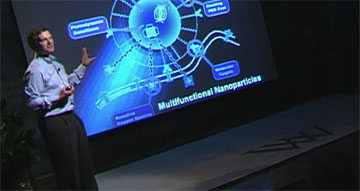 |
| Andrew D Maynard. Credit: Wilson Center. |
Abstract:
Wilson Center Expert Says Public Dialog Key to Nanotech's Future
2008 Nanobio Symposium Preview: Andrew D. Maynard
Baltimore, MD | Posted on November 12th, 2007New consumer products using nanotechnology are showing up all the time—from medical devices to computer hard drives and from cleaner energy to clearer water. In fact, the Project on Emerging Nanotechnologies (PEN) at the Woodrow Wilson International Center for Scholars in Washington, D.C., maintains a web inventory of more than 575 consumer products identified by manufacturers as containing nanotechnology.
"Nanotechnology has the potential to change society," says Andrew D. Maynard, chief science advisor for the Wilson Center project. "The amount of change nanotechnology will ultimately affect, however, deals in part with how readily the technology is accepted by the public."
Maynard will present his views during the Johns Hopkins University 2008 NanoBio Symposium hosted by the Institute for NanoBioTechnology (INBT) to be held May 1-2, 2008 at the University's East Baltimore campus.
"Nanotechnology Applied to Cancer Treatment and Diagnosis" will be the theme of the Thursday afternoon workshop at the newly expanded two-day event. Friday's events include a morning symposium and an afternoon poster session.
Thanks to the internet and other means of mass communication, the general public has access to more information about this emerging science than it ever has had about any previous technological breakthrough or scientific advancement, Maynard says, but not all of what's out there is good information. "There is so much available, that it is impossible for anyone to assimilate it and make a sound decision," he says.
To sort through some of these messages, PEN hosted a web-based public dialog on nanotechnology on October 23 and 24, 2007. Expert panelists and members of the general public discussed the risks and benefits of nanotechnology, product labeling, and regulation and oversight. Transcripts of the discussions may be viewed here.
Maynard believes that soliciting public input proactively will have a positive impact on the future of nanotechnology research. "Consumers have a very powerful voice about which technologies move forward," he says. "Establishing a dialog about nanotechnology with the public at this early stage in its development means that we can do something different. We can include all the stakeholders, and we can change the social contract."
# To watch Maynard's entertaining video presentation "The Twinkie Guide To Nanotechnology", click here.
Other confirmed speakers for the 2008 Johns Hopkins University Nano-Bio Symposium include:
Donald E. Ingber, M.D., Ph.D.
Judah Folkman Professor of Vascular Biology
Department of Pathology, Harvard Medical School
Vascular Biology Program, Children's Hospital
Jeffery A. Schloss, Ph.D.
Co-chair, Trans-NIH NANO Task Force
Program Director, Technology Development Coordination
National Human Genome Research Institute, National Institutes of Health
Jennifer L. West, Ph.D.
Isabel C. Cameron Professor of Bioengineering
Rice University
Participant registration and guidelines for poster submission will be available soon.
Sponsorships opportunities are available now. For information about sponsorship opportunities, contact Mary Spiro, INBT's media relations coordinator, at , or call 410-516-4802.
####
About Institute for NanoBioTechnology
The Institute for NanoBioTechnology at Johns Hopkins University will revolutionize health care by bringing together internationally renowned expertise in medicine, engineering, the sciences, and public health to create new knowledge and groundbreaking technologies.
INBT programs in research, education, outreach, and technology transfer are designed to foster the next wave of nanobiotechnology innovation.
Approximately 150 faculty are affiliated with INBT and are also members of the following Johns Hopkins institutions: Krieger School of Arts and Sciences, Whiting School of Engineering, School of Medicine, Bloomberg School of Public Health, and Applied Physics Laboratory.
For more information, please click here
Contacts:
* Institute for NanoBioTechnology
214 Maryland Hall
3400 North Charles Street
Baltimore, MD 21218
* Email:
* Phone: (410) 516-3423
* Fax: (410) 516-2355
Copyright © Institute for NanoBioTechnology
If you have a comment, please Contact us.Issuers of news releases, not 7th Wave, Inc. or Nanotechnology Now, are solely responsible for the accuracy of the content.
Bookmark:


| Related News Press |
Announcements
 NRL charters Navy’s quantum inertial navigation path to reduce drift April 5th, 2024
Discovery points path to flash-like memory for storing qubits: Rice find could hasten development of nonvolatile quantum memory April 5th, 2024
Events/Classes
Researchers demonstrate co-propagation of quantum and classical signals: Study shows that quantum encryption can be implemented in existing fiber networks January 20th, 2023
Nanobiotechnology
New micromaterial releases nanoparticles that selectively destroy cancer cells April 5th, 2024
Good as gold - improving infectious disease testing with gold nanoparticles April 5th, 2024
Researchers develop artificial building blocks of life March 8th, 2024
 |
||
 |
||
| The latest news from around the world, FREE | ||
 |
||
|
|
||
| Premium Products | ||
 |
||
|
Only the news you want to read!
Learn More |
||
 |
||
|
Full-service, expert consulting
Learn More |
||
|
|
||