Home > Press > Microgrid Allows Simultaneous Study of Multiple Variables
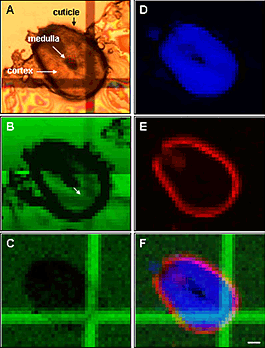 |
| (A) Cross-section of human hair under visible light illumination. The cuticle, cortex, and medulla are indicated. (B) FTIRM reflectivity image of the Au grid. The white arrow indicates the grid intersection, used for the image correlation. (C) Au SXRF microprobe image of the Au grid. (D) FTIRM image of the protein content in the hair, generated by plotting the Amide I peak area from 1600 - 1700 cm-1. (E) XRF microprobe image of copper content in the hair. (F) A red-green-blue (RGB) color image illustrating the correlation of the protein from FTIRM (blue channel) and Cu content from XRF microprobe (red channel) in the tissue. The gold grid pattern from SXRF microprobe is placed in the green channel. Scale bar for all images is 20 µm. |
Abstract:
Could improve understanding, diagnosis of Alzheimer's and other diseases
Microgrid Allows Simultaneous Study of Multiple Variables
UPTON, NY | Posted on October 10th, 2007Scientists at the U.S. Department of Energy's Brookhaven National Laboratory have developed a method for correlating the results of microscopic imaging techniques in a way that could lead to improved understanding, diagnosis, and possibly treatment of a variety of disease conditions, including Alzheimer's disease. The Laboratory has filed a U.S. provisional patent application for the invention.
The invention is essentially a micron-scale metallic marking grid upon which scientists place their samples - biological tissues or inorganic samples such as minerals - prior to imaging with different methods. "When the findings are analyzed, the grid can be used to 'map,' or orient, the images to one another, allowing us to study multiple variables in a single sample and better understand how they relate to one another," said biophysicist Lisa Miller, leader of the team that developed the new method.
For example, many diseases such as Alzheimer's are characterized by changes in both organic materials, such as proteins, as well as changes in the composition or concentration of inorganic trace metals (e.g., iron, copper, and zinc). Scientists have techniques - infrared spectroscopy and x-ray fluorescence - for studying each of these independently. But without a way to correlate the findings from the two methods, important information about the relationship between the organic and inorganic components can be missed.
"The x-ray and infrared-sensitive grid allows for the study of both pathological symptoms by precisely overlapping the results of these imaging methods," Miller said. "This ability to correlate images will ultimately lead to a more complete picture of many disease states." The grid is deposited in two thicknesses onto an x-ray transparent material like mylar. It can be made of any metal, but gold is preferred. The "bars" of the grid are only a couple of nanometers thick, whereas the remainder of the metal surface is thicker. The dual thicknesses make the pattern sensitive to both infrared reflectivity and x-ray fluorescence imaging.
In another version of the invention, a single-layered grid is used to correlate light microscopy with x-ray fluorescence imaging.
Once the images are collected, custom software uses the grid patterns to align the images and correlate them with each other.
In addition to helping scientists study disease processes, the method could also be applied in monitoring and/or cleaning up environmental contamination, which is also characterized by the interplay of organic and inorganic factors.
This work was performed at Brookhaven Lab's National Synchrotron Light Source (NSLS), a source of intense infrared, ultraviolet, and x-ray beams used for studying atomic level details of a wide range of materials from biological molecules to semiconductor devices. More information on this study can be found at: http://www.nsls.bnl.gov/newsroom/science/2007/09-Miller.htm .
This project was funded by the National Institutes of Health with operational support for the NSLS provided by the Office of Basic Energy Sciences within the U.S. Department of Energy's Office of Science.
####
About Brookhaven National Laboratory
One of ten national laboratories overseen and primarily funded by the Office of Science of the U.S. Department of Energy (DOE), Brookhaven National Laboratory conducts research in the physical, biomedical, and environmental sciences, as well as in energy technologies and national security. Brookhaven Lab also builds and operates major scientific facilities available to university, industry and government researchers. Brookhaven is operated and managed for DOE’s Office of Science by Brookhaven Science Associates, a limited-liability company founded by Stony Brook University, the largest academic user of Laboratory facilities, and Battelle, a nonprofit, applied science and technology organization.
For more information, please click here
Contacts:
Dorene Price
631-344-4153
Copyright © Brookhaven National Laboratory
If you have a comment, please Contact us.Issuers of news releases, not 7th Wave, Inc. or Nanotechnology Now, are solely responsible for the accuracy of the content.
Bookmark:


| Related News Press |
Nanomedicine
 New micromaterial releases nanoparticles that selectively destroy cancer cells April 5th, 2024
Good as gold - improving infectious disease testing with gold nanoparticles April 5th, 2024
Researchers develop artificial building blocks of life March 8th, 2024
Discoveries
Chemical reactions can scramble quantum information as well as black holes April 5th, 2024
New micromaterial releases nanoparticles that selectively destroy cancer cells April 5th, 2024
Utilizing palladium for addressing contact issues of buried oxide thin film transistors April 5th, 2024
Announcements
NRL charters Navy’s quantum inertial navigation path to reduce drift April 5th, 2024
Discovery points path to flash-like memory for storing qubits: Rice find could hasten development of nonvolatile quantum memory April 5th, 2024
 |
||
 |
||
| The latest news from around the world, FREE | ||
 |
||
|
|
||
| Premium Products | ||
 |
||
|
Only the news you want to read!
Learn More |
||
 |
||
|
Full-service, expert consulting
Learn More |
||
|
|
||