Home > Press > Extremely durable, soft feeling silicone button
Abstract:
Nanon, the specialist in nanoscale manipulation of polymers and glass, equips the new Seat Leon from the Volkswagen Group with the unique SoftFeel™ key-pads
Extremely durable, soft feeling silicone button
Posted on March 28, 2006
Nanon, the specialist in nanoscale manipulation of polymers and glass, equips the new Seat Leon from the Volkswagen Group with the unique SoftFeel™ key-pads. It is a soft, smooth, flexible and polyurethane painted silicone key-pad mounted on the steering wheel. A new nanoscale treatment means that the key-pad withstand at least 100,000 pushes. Seat decided for the SoftFeel™ key-pads because it brings an exclusive feeling - at a low cost - to the interior of the car. Seat is excited about the result and has decided to use the key-pad in the new and upcoming models, Altea, Ibiza and Cordoba.
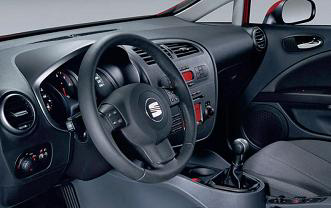
The Seat Leon silicone key-pad on the steering wheel with a durable coating on the 3D trim. Copyright © Nanon A/S |
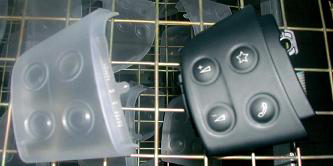
The SoftPlasma™ process makes it possible to paint on silicone and enables rear illumination. Copyright © Nanon A/S |
Silicone and paint can go together
Normally, the soft and flexible properties of silicone rubber cannot be combined with paint as paint does not stick to silicone.
Thomas Christensen, Business Development Manager at Nanon A/S, explains:
"The SoftFeel™ product is unique because silicone rubber and polyurethane paint can now go together. Complicated 3-D things can be painted too. Nanon's patented plasma polymerisation process, SoftPlasma™, where a chemically bonded coating of 10-100 nanometres is created, is the secret behind. The coating acts as a unique primer for the paint.
"The product offers great potential for the automotive industry, where it can be used for all kinds of switches - on steering wheels, doors, windows and seats. But it is also suitable for the telecommunications industry which could use it for mobile phone keypads, for example," he says.
Moulding elastomer rubber on plastics or metals
The SoftPlasma™ technology has other unique advantages. By creating a elastomer-like surface on the substrate, the SoftPlasma™ polymerisation technology makes it possible to mould elastomer rubber on plastics or metals without using any primer, glue or additives. The surface modification of the substrate is permanent and allows a chemical bonding of the substrate with the elastomer rubber.
Advanced process
The SoftPlasma™ process is conducted under very low pressure in a vacuum container into which gas is injected. It ionises in a high-pressure field (plasma). At the same time, a special monomer is atomized into the vacuum container to activate and polymerise the silicone rubber surface or other substrates. A coating of 10-100 nanometres is then created. As the treatment is permanent, subsequent treatment such as coating with polyurethane paint may be done either at this stage or later.
OEM supplier or licensee
Nanon can deliver the SoftFeel™ products as a sub-supplier. Alternatively the company says it is able either to supply the complete installation for the SoftPlasma™ process, or the technology can be licensed.
Media Contact:
Thomas Christensen
Business Development Manager
Nanon A/S
Phone:+45 4348 3569
Mobile:+45 2027 3675
tc@nanon.dk
Copyright © Nanon A/S
If you have a comment, please Contact us.
Issuers of news releases, not 7th Wave, Inc. or Nanotechnology Now, are solely responsible for the accuracy of the content.
Bookmark:


| Related News Press |
Products
 Spectradyne Partners with Particle Technology Labs for Measurement Services December 6th, 2018
Mode-Changing MEMS Accelerometer from STMicroelectronics Combines High Measurement Resolution and Ultra-Low Power for Industrial Applications November 7th, 2018
Fat-Repellent Nanolayers Can Make Oven Cleaning Easier October 17th, 2018
Aculon, Inc. Enters into Strategic Partnership Agreement with Henkel Corporation to Supply Key Mobile Device Manufacturers with NanoProof® PCB Waterproof Technology October 17th, 2018
Materials/Metamaterials/Magnetoresistance
First real-time observation of two-dimensional melting process: Researchers at Mainz University unveil new insights into magnetic vortex structures August 8th, 2025
Researchers unveil a groundbreaking clay-based solution to capture carbon dioxide and combat climate change June 6th, 2025
A 1960s idea inspires NBI researchers to study hitherto inaccessible quantum states June 6th, 2025
Institute for Nanoscience hosts annual proposal planning meeting May 16th, 2025
Announcements
Rice membrane extracts lithium from brines with greater speed, less waste October 3rd, 2025
Researchers develop molecular qubits that communicate at telecom frequencies October 3rd, 2025
Next-generation quantum communication October 3rd, 2025
"Nanoreactor" cage uses visible light for catalytic and ultra-selective cross-cycloadditions October 3rd, 2025
Automotive/Transportation
Sensors innovations for smart lithium-based batteries: advancements, opportunities, and potential challenges August 8th, 2025
Simple algorithm paired with standard imaging tool could predict failure in lithium metal batteries August 8th, 2025
 |
||
 |
||
| The latest news from around the world, FREE | ||
 |
||
|
|
||
| Premium Products | ||
 |
||
|
Only the news you want to read!
Learn More |
||
 |
||
|
Full-service, expert consulting
Learn More |
||
|
|
||