Home > Nanotechnology Columns > Project on Emerging Nanotechnologies > The Rise of the Molecular Economy
 |
David Rejeski Director Project on Emerging Nanotechnologies |
Abstract:
Today's molecular economy, where info-, nano-, and bio-technology converge, has the potential to yield great advances in all sectors, including medicine and energy, through the use of a new constructivist toolkit and a new recipe book. This creative convergence sounds exciting, but scientific advance and technological innovation do not come without some risks. Our regulatory agencies need to study the recipe book that is driving change on the technological frontier and stop re-heating yesterday's meals.
May 27th, 2009
The Rise of the Molecular Economy
In 2003, business writers Chris Meyer and Stan Davis published a book called It's Alive: The Coming Convergence of Information, Biology and Business. In this book, they described the emergence of a new "molecular economy" based on an increasing ability to "...see, simulate, and manipulate matter at a molecular level" (1). Today, one could argue that this ability to control matter extends below the molecular level to the atomic level, a scale at which nanoscience and nanoengineering operate.
Talk to anybody who studies the evolution of manufacturing and they will tell you that production is all about process control (2). It is about being able to make things with ever greater precision and then reproduce that precision at ever greater speed. Cheap precision manufacturing put a car in every garage, but it also allowed companies like Intel to pack one billion transistors on a tiny piece of silicon.
In today's molecular economy, where info-, nano-, and bio-technology converge, we are beginning to achieve control at an atomic scale and with reproducible results. Some view this as old science in a new package, often describing the future in terms of the past with a dash of hyperbole. For instance, the new field of synthetic biology has been described as recombinant DNA (invented in 1973) on steroids. But as Stanford University economist Paul Romer once noted about innovation, "...it springs from better recipes, not just more cooking" (3). The molecular economy is based on a new recipe book.
Since Meyer and Davis developed this notion of a molecular economy, nanoscale manufacturing has become a reality. What is emerging from this Willy Wonka world is not chocolate but an amazing array of innovations that will underlie everything from new cancer treatments to high efficiency solar cells and made-to-order fuel production systems. The biobricks, quantum dots, and nanobots being developed will form the basis of the ultimate constructivist toolkit for the molecular economy, blurring the traditional lines between science and engineering, design and production, and the organic and inorganic worlds.
Just how big will this new economy be? In 2007, the global market for goods incorporating nanotechnology totaled $147 billion. Independent research and advisory firm Lux Research projects that this figure will grow to $3.1 trillion by 2015. The number of nanotechnology patents has doubled in the past 7 years, and the number of nanotechnology-based products on the market has doubled in the last 14 months, now exceeding 800 products from 25 nations (4). In the emerging field of synthetic biology, the Utah-based life sciences firm Beachhead Consulting estimates that the synthetic biology research market (presently worth around $600 million) has the potential to grow to $3.5 billion over the next decade, while current estimates by Lux Research indicate that one-fifth of the chemical industry (now estimated at $1.8 trillion) could be dependent on synthetic biology by 2015 (5).
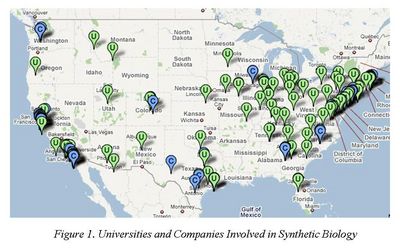
But the most interesting indicator may be in the sheer number of universities, businesses, and other organizations thinking and creating at the nanoscale. The molecular economy clearly has a foothold in the American landscape and not just in obvious places like Silicon Valley and Boston's technology corridor. Every state in the United States has organizations involved in nanotechnology (including states like New York, Texas, North Carolina, Ohio, and Pennsylvania), and 33 states already have some activities focused on synthetic biology, with the highest concentrations in California, Massachusetts, and New York (see Figure 1, below) (6). These patterns raise interesting questions about how the clustering of human capital and knowledge resources will drive the growth of the molecular economy in the future (7, 8). Specifically, what attributes, amenities, or investments might shape the flow of human resources critical to regional development in the molecular economy (9)?
 |
This creative convergence sounds exciting but scientific advance and technological innovation do not come without some risks, so it is important to tackle concerns early to maintain high levels of public and investor confidence. Despite a federal investment of $1.5 billion in nanotechnology research and development in 2008, the amount devoted to understanding environmental, health and safety impacts is still a small fraction (below 4 percent). It is unclear how much is being spent on addressing the potential risks of synthetic biology, but the numbers and the strategy need to be openly debated and soon. Navigating the shoals of public opinion around synthetic biology will be much more difficult than nanotechnology. The public and the press, especially in Europe, will view synthetic biology through the lens created by the debate over genetically modified organisms, and some recent research shows that the American public may be highly suspicious of scientists creating novel genetic code (10, 11, 12).
Turning innovations in the molecular economy into viable products, jobs, and commercial markets is not a given. It will require some new thinking and new relationships between government, business, and the public. For instance, most of our oversight system is still stuck in the old economy of bulk chemicals, paper-based transactions, and bricks-and-mortar commerce. Our regulatory agencies - from the Environmental Protection Agency to the Food and Drug Administration - need to study the recipe book that is driving change on the technological frontier and stop re-heating yesterday's meals. We may need new statutes, new organizations, and even a new social contract between scientists and the public, but, given the promises of the molecular economy, it will be worth the effort (13, 14).
REFERENCES
(1) Meyer, C. & Davis, S. (2003). It's Alive: The Coming Convergence of Information, Biology and Business. NY: Random House.
(2) Jaikumar, R. (1988). From Filing to Fitting to Flexible Manufacturing: A Study in the Evolution of Process Control (Harvard Business School Working Paper #88-045).
(3) Romer, P. (1991). Increasing Returns and New Development in the Theory of Growth. In W. Barnett, B. Cornet & C. D'Aspremont (Eds.), Equilibrium Theory and Applications: Proceedings of the 6th International Symposium in Economic Theory and Econometrics . Cambridge University Press.
(4) An inventory of manufacturer-identified, nano-based consumer products is available at: http://www.nanotechproject.org/44
(5) Beachhead Consulting. (2006). Synthetic Biology, A New Paradigm For Biological Discovery.
(6) An interactive map of nanotechnology activities can be found at: http://www.nanotechproject.org/inventories/map/ . An inventory of entities involved in synthetic biology can be found at: http://www.synbioproject.org/library/inventories/map/ .
(7) Lucas, R. (1988). On the Mechanics of Economic Development. Journal of Monetary Economics, 22, 3-42.
(8) Florida, R. (2006, October). Where the Brains Are. The Atlantic Monthly. Retrieved: http://www.theatlantic.com/doc/200610/american-brains .
(9) See: Do-It-Yourself Biology at http://diybio.org/ .
(10) Kronberger, N., et al. (2009). Old Wine in New Bottles?: Communicating Synthetic Biology in the Public Sphere. Systems and Synthetic Biology (forthcoming).
(11) Hart Research. (2008). Awareness Of and Attitudes Towards Nanotechnology and Synthetic Biology. Washington, DC: Synthetic Biology Project. Available at: http://www.synbioproject.org/library/publications/archive/6019/
(12) Pauwels, E. & Ifrim, I. (2008). Trends in American and European Press Coverage of Synthetic Biology. Washington, DC: Synthetic Biology Project. Available at: http://www.synbioproject.org/library/publications/archive/why_scientists_should_care/
(13) Bonini, S. M., et al. (2006, May). When Social Issues Become Strategic. McKinsey Quarterly.
(14) A recent proposal to create a new Department of Consumer and Environmental Protection can be found in: Davies, T. (2009). Oversight of Next Generation Nanotechnology. Washington, DC: Project on Emerging Nanotechnologies. Available at: http://www.nanotechproject.org/news/archive/davies4/
Bookmark:


 |
||
 |
||
| The latest news from around the world, FREE | ||
 |
||
|
|
||
| Premium Products | ||
 |
||
|
Only the news you want to read!
Learn More |
||
 |
||
|
Full-service, expert consulting
Learn More |
||
|
|
||