Home > Nanotechnology Columns > Center for Responsible Nanotechnology > What the US can learn from the UK
 |
Mike Treder Center for Responsible Nanotechnology |
Abstract:
A new report from the British goverment's Royal Commission on Environmental Pollution says "new governance arrangements are necessary" to deal with the profound implications of advanced nanotechnology, and warns that this "will take time, possibly decades, to develop and implement." It's gratifying to see these issues taken seriously (finally!) and we hope the US will follow the lead of their UK counterparts.
November 21st, 2008
What the US can learn from the UK
Born only recently, nanotech is still an infant technology, but already it's growing too fast for regulators to keep up with. And the worst -- or best -- is yet to come.
Advanced nanotechnology will make early generations look simple and comparatively benign. Offering both huge upsides and perilous downsides, it will bring wildly unfamiliar challenges. Plus, unless things change quickly, it could catch us by surprise, totally unprepared.
A new report from the UK's Royal Commission on Environmental Pollution titled "Novel Materials in the Environment -- The case of nanotechnology" makes a convincing argument that: 1) national regulatory agencies throughout the world are lagging way behind the pace of development in current early-generation nanotechnologies; 2) advanced generations of nanotechnology may not be too far in the future and could bring significant new challenges; and therefore, 3) novel approaches to regulation and governance for both early and later versions of nanotech should be given high priority by both national and international governing bodies.
The full report is available in PDF form for free download on their site at http://www.rcep.org.uk/novelmaterials.htm
Although most of the Royal Commission's findings deal with current-day nanoscale technologies that lie outside the focus of our work at the Center for Responsible Nanotechnology (CRN), the general theme and tenor of the report align closely with our approach toward these issues.
As a nonprofit advocacy group with global concerns, but based in the United States, CRN is happy to promote this important study and hopeful that its message will resonate around the world. In particular, we'd like to see relevant governing bodies in the U.S. -- such as the National Nanotechnology Initiative (NNI) and the Environmental Protection Agency (EPA) -- learn a lesson from their British counterparts and take a far more vigorous approach to preparing for the potentially disruptive impacts of advanced nanotechnology.
Among the most significant portions of the study from CRN's point of view are these:
From section 3.110, "Nanomaterials in the Future" --
While primarily gathering evidence on first and second generation nanomaterials we have been alerted to the likely development of third and fourth generation nanoproducts. These materials might involve self-assembly capabilities, self-replication and artificial intelligence. There are suggestions that the newly-emerging discipline of synthetic biology might utilise nanotechnologies and nanomaterials in the pursuit of novel products, some of which may have military and space applications where enhanced performance may outweigh cost factors. Much of the discussion of these products is considered to fall well outside conventional regulation of chemicals; their properties raise wider ethical issues as well as health and environmental ones.
The chart below illustrates the four generations of nanotechnology to which they refer. Molecular manufacturing is generally agreed to fall within the fourth generation ("Molecular nanosystems"), although whether it will be achieved through top-down or bottom-up approaches, and whether it will comprise strictly "dry" nano or will incorporate "wet" nano is still far from certain.
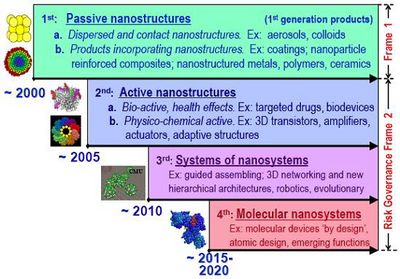 |
| NANOTECHNOLOGY'S FOUR GENERATIONS |
Next, from section 3.111 --
We are of the view that it is not too soon to consider the challenges that later generation nanomaterials will pose to conventional procedures for evaluating their potential threats or to the measures which might be incorporated into their design to avoid or minimise such threats. While these challenges lie outside the scope of this study, the governance issues discussed in Chapter 4, in particular how society deals with novel technologies in the face of profound uncertainties, apply in principle to any novel material, and may be helpful as we struggle with the benefits and risks posed by third and fourth generation nanomaterials.
Certainly we are pleased to see this official recognition of the "profound uncertainties" and "potential threats" posed by advanced nanotechnology, and we strongly endorse the notion that "it is not too soon to consider the challenges" of "later generation" nanotech.
But the report doesn't stop there. We also get this, from section 4.4, "The Challenges Presented by Nanomaterials" --
Nanotechnologies cover an enormous range of possibilities with profound implications. Looking to the future, what are sometimes characterised as third and fourth generation nanotechnologies raise ethical and political questions (concerning, for example, human identity, performance and privacy) which call for the widest possible debate. We emphasise, as we did in a much earlier discussion of nuclear technologies, that our concern should not only be with the position at present, or even in the next decade, but with what it might become within the next fifty years.
Again, arguments that we and others have made for years are emphasized here, to our great pleasure. And in the several sections quoted below -- under the heading "Beyond Our Reach" -- it seemed almost as if the writers were quoting from CRN:
Section 4.54 -- Innovation is, or soon will be, driving new products onto the market at rates that are orders of magnitude faster than they can currently hope to manage with the resources at their disposal. We heard from one regulatory body that it was not even considering how to address third and fourth generation nanomaterials because they were fully occupied with those currently at the commercial stage. The magnitude of the task combined with constraints on resources tends to create an attitude of regulatory fatalism.
Section 4.55 -- One expert likened the challenge of risk governance in this field to that of shouting a warning to the driver of an express train as it thunders past. An understandable reaction in such circumstances is to call for a moratorium on the manufacture and use of nanomaterials...
Section 4.56 -- We have not been persuaded that a blanket ban would be appropriate; nor do we consider that such an approach could be justified on current evidence. Nanomaterials are already widely marketed and their production is globally distributed; at present we see no prospect for the negotiation of a global moratorium... We therefore consider that a blanket ban would be neither practicable nor proportionate...
This is precisely CRN's position - see http://crnano.org/PR-shutdown.htm
Section 4.57 -- Nor, at the other extreme, can we afford to stand back and conclude that this is all too difficult.
Quite so. We like the model that prefers responsible regulation in between the extreme poles of relinquishment and resignation.
Section 4.59 -- The measures recommended above will take time, possibly decades, to develop and implement, as will the accumulation of knowledge on the properties and potential impacts of nanomaterials. In the meantime, it will be vital to make every effort to narrow the gap, and to do so in two senses. One is in improving our understanding of the implications of nanomaterials. The other is in finding ways to anticipate, and as far as possible avoid, harmful effects that would not be captured by current regulations; this is needed in advance of, or in addition to, the kinds of amendments to the regulations outlined above.
Section 4.60 -- The first, indeed key, requirement to improve understanding is research. [Emphasis theirs.]
Section 4.63 -- [T]here remains a substantial mismatch of funding between research on the applications of nanotechnologies and nanomaterials and investigation of their implications for society, the environment and human health. We find this disturbing... [Emphasis theirs.]
So do we!
Section 5.3, "Summary of Recommendations" -- However, we are very conscious of the extent to which knowledge about the potential health and environmental impacts of nanomaterials lags significantly behind the pace of innovation and these areas of concern could change as new scientific information arises. This is an area of considerable uncertainty.
Section 5.4 -- In the longer term, we are also concerned that more sophisticated third and fourth generation nanoproducts may represent a further step change in functionalities and properties, which would be even more difficult to capture in a regulatory system primarily focused on the bulk chemical properties of the material. We concluded that new governance arrangements are necessary to deal with ignorance and uncertainty in this rapidly developing area. It has not escaped our notice that, in principle, these arrangements could also apply in areas of technology other than novel materials where similar issues might arise.
"...new governance arrangements are necessary..."
"...measures recommended above will take time, possibly decades, to develop and implement..."
As CRN has said before - at http://crnano.org/action.htm
Molecular manufacturing will arrive suddenly, perhaps within the next ten years, and almost certainly within the next twenty. If it takes the world by surprise, we will not have systems in place that can deal with it effectively.
No single organization or mindset can create a full and appropriate policy—and inappropriate policy will only make things worse. A combination of separate policy efforts will get in each other's way, and the risks will slip through the cracks.
By the time this technological capability arrives, we must have accomplished several things that each will take significant time. First, we must understand the risks. Second, make policy. Third, design institutions. Fourth, create the institutions—at all levels including international levels, where things move slowly. This could easily take twenty years. If advanced nanotechnology could arrive in ten or fifteen years, then we'd better get to work.
We are gratified that the Commission involved in this study has accurately seen the scope and depth of the risks involved and has pulled no punches in stating their conclusions. We hope, first of all, that the UK government will take their advice seriously and act quickly to implement their recommendations. Second, we hope that the United States, Japan, China, Russia, and other major players in nanotechnology will also be as responsible.
Bookmark:


 |
||
 |
||
| The latest news from around the world, FREE | ||
 |
||
|
|
||
| Premium Products | ||
 |
||
|
Only the news you want to read!
Learn More |
||
 |
||
|
Full-service, expert consulting
Learn More |
||
|
|
||