Home > Nanotechnology Columns > Vivek Srivastava > Achieving the balance between public awareness and Nano hype - The launch of Tata Nano
 |
Vivek Srivastava Dr. |
Abstract:
Skeptics fear a nanotech hype in coming years leading to a dot-com type bubble adversely effecting the industry. Despite a number of differences between internet technologies and nanotechnologies, the fear is well founded as most major technological innovations follow a similar adoption curve as captured by Gartner. A quick look at Google trends does not show any correlation between launch of "Nano" branded products (IPod Nano and Tata Nano) and public interest in nanotechnologies. More efforts are needed to educate the public on the potential risks and benefits of nanotechnologies to minimize the impact of a possible hype by adopting an attitude of "cautious optimism".
February 2nd, 2008
Achieving the balance between public awareness and Nano hype - The launch of Tata Nano
Last week, I was discussing the formation of "The Indus Nanotechnology Association" (TINA) by a group of Indian Americans in the valley ( http://www.altassets.com/casefor/sectors/2003/nz2940.php ) and somebody mentioned the word "hype" and drew parallel with the "dot com bubble" of 2001 when start-up companies with little or no revenues (and oftentimes without a product) demanded sky-high valuations on nothing more than an idea. Investor community was taken in by the hi-sounding jargons and by the early successes of companies like Yahoo, and Hotmail joined the bandwagon of "internet revolution". A similar pattern can be observed if we cursorily examine the state of affairs in the global nanotechnology "industry". Early starters like Nanosys, CNI, Nanomat successfully managed to raise venture capital but have not been able to achieve profitability or indeed sustain themselves in some cases. A further argument is- unlike dot com companies, nanotech companies require lot more funding for R&D, product development and highly specialized equipments and therefore the potential adverse impact of a burst would be even more severe. To quote "in some years the dot come bubble will be nothing compared to this".
Quite obviously, I was defensive about the industry and made certain noises about why there should be no concerns of a nanotech bubble and how there are fundamental differences between internet technologies and nanotechnologies as summarized below
• Nanotechnologies are inherently interdisciplinary in nature. No single company (especially start ups) would have all the resources and competencies to exploit small tech, forcing them to collaborate. Such collaboration would necessitate verifiable value generation from each of the collaborators, thus minimizing the potential for a bubble.
• Dot com companies were started off for $5000 by lawyers and marketing agents with an idea. The essentials of the technology could be acquired by an average science graduate with a few months of IT training. Nanotechnology is a completely different beast and requires at least a Ph. D. level expertise (and most of the times even that is not enough) in the domain and significant capital to start off preventing mushrooming off of nanotech companies.
• The biggest differentiator between internet and nanotechnology remains generation of patentable intellectual property and thereby erecting significant, defensible entry barrier. Unlike in the dot com era, this effectively prevents competitors from copying the idea and replicating the product thus protecting R&D investments.
Back at office and after some further thought on the topic, I was able to better appreciate the concerns of my interlocutor. Not just internet technologies, all new technologies go through a similar pattern. IT research firm, Gartner, have captured the lifecycle of technologies quite precisely in what they term the "technology hype cycle" as one such illustration is shown below schematically.
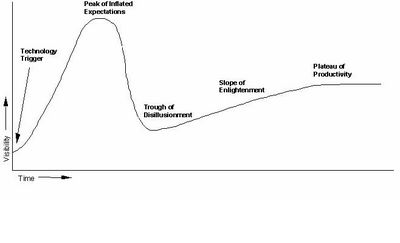 |
| Schematic illustration of the Gartner Hype Cycle |
I am yet to think of a good reason why nanotechnologies should not follow this well defined lifecycle, though I believe that nanotechnologies have already progressed past the "Peak of Inflated Expectations (PIE)" and are currently approaching the "Slope of Enlightenment" in the western world. The scenario in India, though, is quite different. In a recent interview I gave to EE Times ( http://www.eetimes.com/showArticle.jhtml?articleID=205204226 ), I estimated that India is about 5-7 years behind the developed world when it comes to nanotechnologies. By that yardstick, I expect India to be approaching PIE in the coming months. I had written about the increasing public awareness of nanotechnologies in India in one of my past articles at this column and believe that this is part of the lifecycle of the emerging technology.
In this context, I stumbled upon a very interesting and curious parallel, the launch of IPod Nano in Sep, 2005 and launch of Tata Nano in Jan, 2008. Neither of these products makes extensive use of nanotechnologies, yet use the word Nano to signify the miniaturization achieved. Critics can argue that such usage of the term Nano comprises "misinformation". My interest, however, lies in exploring the impact of these products in shaping public curiosity. I spent some time doing some research at Google Trends looking for correlations, if any, between these two events and number of searches conducted on Google. As expected, there was a surge in search term "Nano" with the launch of these two respective products. What was unexpected was that the launch of these two high impact products had no discernable impact on number of searches using the term "nanotechnology". The obvious conclusion from this evidence is that public interest (and therefore knowledge) in nanotechnologies remains low and interest in nanotechnologies remains confined to the few who are directly involved with the industry. Before we go any ahead, I would just like to highlight the following disclaimer from Google Trends " Google Trends aims to provide insights into broad search patterns. Several approximations are used when computing your results. Please keep this in mind when using it. "
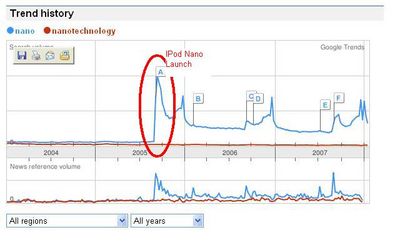 |
| Google Trends showing relative search patterns using search term "Nano" vis a vis "Nanotechnology" g |
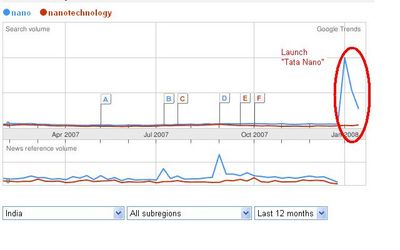 |
| Google Trends showing relative search patterns using search term "Nano" vis a vis "Nanotechnology" a |
This to me is a rather disturbing conclusion since it implies that general public is by and large ignorant and/or uninterested in nanotechnology. In the absence of such knowledge, valuation of an IPO or stocks of a nanotech company remains an open question. It also leaves the market vulnerable to manipulation by interested parties.
The question arises "what's the way forward". The answer is obvious but much easier said than done. The approach of the industry has to be one of "cautious optimism". This is particularly true for a country like India which has shown tendency towards jingoism and idol worshiping in recent times. Over emphasis towards IT and ITES sectors at the cost of manufacturing and agriculture is only partially being addressed now. Nanotechnology is currently a miniscule pie of the overall GDP of the country, which will inevitably occupy a larger share in years to come. Careful consideration towards achieving the right balance between skepticism and optimism right from the beginning would help avoid quite a few heart aches. Prevention is better than cure.
Aside: In an interesting conversation with one of the exhibitors at the recently concluded auto expo, the gentleman revealed that Indian auto companies do not publicize the use of nanotechnologies in their products for the fear of patent infringements. A very controversial issue indeed, if true. Any comments?
--------------
Please send your feedback, ideas, and suggestions to Vivek Srivastava at .
Vivek hold a Ph. D. in materials science and has published over a dozen papers in international journals and contributed to international conferences and seminars. He has interests in commercialization of nanotechnology & new ventures with innovative business models to exploit the advantages India offers. He consults existing businesses to grow and expand in new technology areas, and serves as mentor to budding entrepreneurs. His current research interest are "severe plastic deformation methods for production of bulk nanomaterials" and "Role of industry dynamics on making R&D funding decisions".
Bookmark:


 |
||
 |
||
| The latest news from around the world, FREE | ||
 |
||
|
|
||
| Premium Products | ||
 |
||
|
Only the news you want to read!
Learn More |
||
 |
||
|
Full-service, expert consulting
Learn More |
||
|
|
||