Home > Nanotechnology Columns > Project on Emerging Nanotechnologies > The Strategic Risk of Nanotechnology
 |
David Rejeski Director Project on Emerging Nanotechnologies |
Abstract:
There has been much talk and hand-wringing about health and environmental risks associated with nanotechnology, but fewer discussions focus on what is termed "strategic risk." To begin to sort out strategic risks across sectors in which nanotechnology is being used, we developed a simple algorithm that takes into account some basic parameters, such as market penetration, exposure route (as a surrogate indicator of health risk), government oversight (or lack thereof), industry stewardship (or lack thereof), and the level of public scrutiny by media and/or NGOs. When we ran numbers through the formula, two sectors came out with a high value for strategic risk: cosmetics/sunscreens and dietary supplements. The food sector is saved (temporarily) by the lack of any real nano-engineered products on the market, but that could change very quickly and radically, given the long history of intense concern over genetic engineering in the food sector. In dealing with the strategic risk assessment of nanotechnologies, we need to be thinking more about combining narrative and computational approaches.
January 23rd, 2008
The Strategic Risk of Nanotechnology
There has been much talk and hand-wringing about health and environmental risks associated with nanotechnology, but fewer discussions focus on what is termed "strategic risk." One definition of strategic risk, from a recent Ernst & Young report, is "[a] risk that could cause severe financial loss or fundamentally undermine the competitive position of a company" (1). Regulators and NGOs pay attention to health risks, but strategic risks are the bread-and-butter of investors, insurers, Wall Street analysts, and corporate boards. The insurance sector has been very clear that it views nanotechnology as a looming issue. Lloyd's Emerging Risks Team just issued a report on nano that noted that "due to the potential impact to the insurance industry if something were to go wrong, nanotechnology features very highly in Lloyd's top emerging risks" (2). Similarly, Zurich Insurance's Canadian office ranked nano in the top tier of emerging global risks (along with climate change and deteriorating infrastructure) (3).
All strategic risks are not created equal; they are affected by large macrotrends (such as geopolitics) and vary based on industry sector and the operating strategies of individual firms. Strategic risk is also composed of both real and perceived components. Since perceptions can drive investments, grow markets, or kill stock options, strategic risk analysis must consider public attitudes, media coverage, and consumer whims, which are often fluid and difficult to quantify.
Since more and more sectors are now using nanotechnology in their products, it is worth beginning to sort out the strategic risks. But how? We could fall back on the work of the Italian economist Vilfredo Pareto, who stipulated that, for many phenomena, 20 percent of the people or activities accounts for 80 percent of the results. Most of the risk associated with driving can be linked to errors made by a small number of male, adolescent drivers; most of the risk associated with developing lung cancer can be associated with smoking, even in moderate amounts; etc. So Pareto's Principle would suggest that a few sectors account for a bulk of the risk associated with nanotechnology (or a few firms, or a few products). But which ones?
To begin to sort out strategic risks across sectors in which nanotechnology is being used, we developed a simple algorithm that takes into account some basic parameters, such as market penetration, exposure route (as a surrogate indicator of health risk), government oversight (or lack thereof), industry stewardship (or lack thereof), and the level of public scrutiny by media and/or NGOs (4). The formula and outcomes are shown in Figure 1.
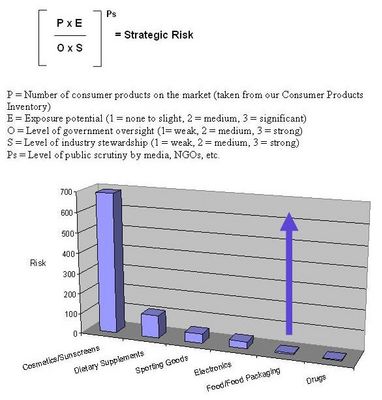 |
| Figure 1. Relative Strategic Risk Values for Sectors Using Nanotechnology. |
When we ran numbers through the formula, two sectors came out with a high value for strategic risk: cosmetics/sunscreens and dietary supplements - this can be partially attributed to the high exposure potential for products that are swallowed or applied directly to the skin and the significant number of actual products already on the market, according to our Consumer Products Inventory (5). The food sector is saved (temporarily) by the lack of any real nano-engineered products on the market, but that could change very quickly and radically, given the long history of intense concern over genetic engineering in the food sector. The reason we raised our initial formula by "the power of public scrutiny" is to take into account the high potential impact that the media and consumer or environmental groups can have on the viability of nano-based products, market growth, and the competitive position of firms. Recently, the Soil Association in the UK, which provides certification for organic products, issued a statement banning the use of nanotechnology in the cosmetics, personal care products, and food that it certifies. This includes 2,600 individual products from 80 manufacturers in the health and beauty sector (6).
It is important to point out that this formula does not deal with tipping points or other varieties of radical change, which are better explored using scenarios. The Lloyd's of London report contains a number of speculative disaster scenarios that could occur with nanotechnology and is worth a close look. In dealing with the strategic risk assessment of nanotechnologies, we need to be thinking more about combining narrative and computational approaches (7).
If you'd like to play with the algorithm, you can download the spreadsheet and put in your own assumptions or add/subtract variables (8). Have fun! Our next task is to explore the use of prediction markets to better assess strategic risks across nanotechnology sectors.
REFERENCES
(1) Ernst & Young (in collaboration with Oxford Analytica). Strategic Business Risk 2008 - The Top 10 Risks for Business, 2008. This report identified regulatory and compliance risk as its number one risk. Obviously, this has high relevance to any industry using nanotechnology.
(2) Lloyd's Emerging Risks Team. Nanotechnology: Recent Developments, Risks and Opportunities, 2007. Available at http://www.lloyds.com/Lloyds_Market/Tools_and_reference/Exposure_Management/Emerging_risks.htm
(3) Zurich's view was covered in the following article: "Nanotechnology, climate change, infrastructure among top risks," Canadian Underwriter, November 22, 2007. Available at
http://www.canadianunderwriter.ca/issues/ISArticle.asp?id=76768&issue=11222007
(4) We applied the principle of Ockham's razor to the formula, adding and subtracting variables to make it as simple as possible while retaining its predictive utility.
(5) The inventory presently includes 103 nano-based cosmetic products/sunscreens and 39 dietary supplements. The inventory of manufacturer-identified, nano-based consumer products is available at: http://www.nanotechproject.org/44
(6) Press Release: "Soil Association first organization in the world to ban nanoparticles -
potentially toxic beauty products that get right under your skin," January 15, 2008. Available at http://www.soilassociation.org/web/sa/saweb.nsf/89d058cc4dbeb16d80256a73005a2866/42308d944a3088a6802573d100351790!OpenDocument
(7) A good example of combining structured scenarios with computational models is covered in the article: Fischhoff, B., et al.. "Analyzing Disaster Risks and Plans: An Avian Flu Example," Journal of Risk Uncertainty, volume 33, pp. 131-149, 2006.
(8) The spreadsheet is available at: http://www.penmedia.org/download/risk_figures.xls
Bookmark:


 |
||
 |
||
| The latest news from around the world, FREE | ||
 |
||
|
|
||
| Premium Products | ||
 |
||
|
Only the news you want to read!
Learn More |
||
 |
||
|
Full-service, expert consulting
Learn More |
||
|
|
||