Home > Press > ASU Biodesign Institute scientists develop innovative twists to DNA nanotechnology
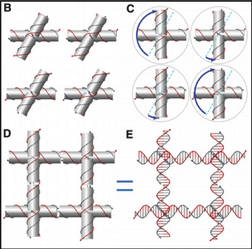 |
| The fundamental unit in Hao Yan's new nanostructures rely on modifying a 4-arm DNA junction. The relaxed DNA geometry found in a 4-arm junction (B) can be rotated 150 degrees clockwise or 30 degrees counterclockwise (C) to form the right angles needed to make a DNA Gridiron (D and E). Photo by: Biodesign Institute |
Abstract:
In a new discovery that represents a major step in solving a critical design challenge, Arizona State University Professor Hao Yan has led a research team to produce a wide variety of 2-D and 3-D structures that push the boundaries of the burgeoning field of DNA nanotechnology.
A sphere made entirely from DNA
How DNA folds onto itself to make nano structures
ASU Biodesign Institute scientists develop innovative twists to DNA nanotechnology
Tempe, AZ | Posted on March 21st, 2013The field of DNA nanotechnology utilizes nature's design rules and the chemical properties of DNA to self-assemble into an increasingly complex menagerie of molecules for biomedical and electronic applications. Some of the Yan lab's accomplishments include building Trojan horse-like structures to improve drug delivery to cancerous cells, electrically conductive gold nanowires, single molecule sensors and programmable molecular robots.
With their bio-inspired architectural works, the group continues to explore the geometrical and physical limits of building at the molecular level.
"People in this field are very interested in making wire frame or mesh structures," said Yan. "We needed to come up with new design principles that allow us to build with more complexity in three dimensions."
In their latest twist to the technology, Yan's team made new 2-D and 3-D objects that look like wire-frame art of spheres as well as molecular tweezers, scissors, a screw, hand fan, and even a spider web.
The Yan lab, which includes ASU Biodesign Institute colleagues Dongran Han, Suchetan Pal, Shuoxing Jiang, Jeanette Nangreave and assistant professor Yan Liu, published their results in the March 22 issue of Science.
The twist in their 'bottom up,' molecular Lego design strategy focuses on a DNA structure called a Holliday junction. In nature, this cross-shaped, double-stacked DNA structure is like the 4-way traffic stop of genetics --- where 2 separate DNA helices temporality meet to exchange genetic information. The Holliday junction is the crossroads responsible for the diversity of life on Earth, and ensures that children are given a unique shuffling of traits from a mother and father's DNA.
In nature, the Holliday junction twists the double-stacked strands of DNA at an angle of about 60-degrees, which is perfect for swapping genes but sometimes frustrating for DNA nanotechnology scientists, because it limits the design rules of their structures.
"In principal, you can use the scaffold to connect multiple layers horizontally," [which many research teams have utilized since the development of DNA origami by Cal Tech's Paul Rothemund in 2006]. However, when you go in the vertical direction, the polarity of DNA prevents you from making multiple layers," said Yan. "What we needed to do is rotate the angle and force it to connect."
Making the new structures that Yan envisioned required re-engineering the Holliday junction by flipping and rotating around the junction point about half a clock face, or 150 degrees. Such a feat has not been considered in existing designs.
"The initial idea was the hardest part," said Yan. "Your mind doesn't always see the possibilities so you forget about it. We had to break the conceptual barrier that this could happen."
In the new study, by varying the length of the DNA between each Holliday junction, they could force the geometry at the Holliday junctions into an unconventional rearrangement, making the junctions more flexible to build for the first time in the vertical dimension. Yan calls the backyard barbeque grill-shaped structure a DNA Gridiron.
"We were amazed that it worked!" said Yan. "Once we saw that it actually worked, it was relatively easy to implement new designs. Now it seems easy in hindsight. If your mindset is limited by the conventional rules, it's really hard to take the next step. Once you take that step, it becomes so obvious."
The DNA Gridiron designs are programmed into a viral DNA, where a spaghetti-shaped single strand of DNA is spit out and folded together with the help of small 'staple' strands of DNA that help mold the final DNA structure. In a test tube, the mixture is heated, then rapidly cooled, and everything self-assembles and molds into the final shape once cooled. Next, using sophisticated AFM and TEM imaging technology, they are able to examine the shapes and sizes of the final products and determine that they had formed correctly.
This approach has allowed them to build multilayered, 3-D structures and curved objects for new applications.
"Most of our research team is now devoted toward finding new applications for this basic toolkit we are making," said Yan. "There is still a long way to go and a lot of new ideas to explore. We just need to keep talking to biologists, physicists and engineers to understand and meet their needs."
Yan's research is funded by several grants from the National Science Foundation, Office of Naval Research, Army Research Office grant and an Army Research Office MURI award, and an ASU Presidential Strategic Initiative Fund. Hao Yan and Yan Liu are part of the Center for Bio-Inspired Solar Fuel Production, an Energy Frontier Research Center funded by the U.S. Department of Energy, Office of Science, Office of Basic Energy Sciences.
Hao Yan is the Milton Glick Chair in the Department of Chemistry and Biochemistry and researcher at ASU's Biodesign Institute.
####
For more information, please click here
Contacts:
Joe Caspermeyer
480-727-0369
Copyright © Arizona State University
If you have a comment, please Contact us.Issuers of news releases, not 7th Wave, Inc. or Nanotechnology Now, are solely responsible for the accuracy of the content.
Bookmark:


| Related News Press |
News and information
 Simulating magnetization in a Heisenberg quantum spin chain April 5th, 2024
NRL charters Navy’s quantum inertial navigation path to reduce drift April 5th, 2024
Discovery points path to flash-like memory for storing qubits: Rice find could hasten development of nonvolatile quantum memory April 5th, 2024
Govt.-Legislation/Regulation/Funding/Policy
NRL charters Navy’s quantum inertial navigation path to reduce drift April 5th, 2024
Discovery points path to flash-like memory for storing qubits: Rice find could hasten development of nonvolatile quantum memory April 5th, 2024
Chemical reactions can scramble quantum information as well as black holes April 5th, 2024
Molecular Machines
First electric nanomotor made from DNA material: Synthetic rotary motors at the nanoscale perform mechanical work July 22nd, 2022
Nanotech scientists create world's smallest origami bird March 17th, 2021
Giant nanomachine aids the immune system: Theoretical chemistry August 28th, 2020
Molecular Nanotechnology
Scientists push the boundaries of manipulating light at the submicroscopic level March 3rd, 2023
First electric nanomotor made from DNA material: Synthetic rotary motors at the nanoscale perform mechanical work July 22nd, 2022
Nanotech scientists create world's smallest origami bird March 17th, 2021
Self Assembly
Liquid crystal templated chiral nanomaterials October 14th, 2022
Nanoclusters self-organize into centimeter-scale hierarchical assemblies April 22nd, 2022
Atom by atom: building precise smaller nanoparticles with templates March 4th, 2022
Nanostructures get complex with electron equivalents: Nanoparticles of two different sizes break away from symmetrical designs January 14th, 2022
Nanomedicine
New micromaterial releases nanoparticles that selectively destroy cancer cells April 5th, 2024
Good as gold - improving infectious disease testing with gold nanoparticles April 5th, 2024
Researchers develop artificial building blocks of life March 8th, 2024
Sensors
Nanoelectronics
Interdisciplinary: Rice team tackles the future of semiconductors Multiferroics could be the key to ultralow-energy computing October 6th, 2023
Key element for a scalable quantum computer: Physicists from Forschungszentrum Jülich and RWTH Aachen University demonstrate electron transport on a quantum chip September 23rd, 2022
Reduced power consumption in semiconductor devices September 23rd, 2022
Atomic level deposition to extend Moore’s law and beyond July 15th, 2022
Discoveries
Chemical reactions can scramble quantum information as well as black holes April 5th, 2024
New micromaterial releases nanoparticles that selectively destroy cancer cells April 5th, 2024
Utilizing palladium for addressing contact issues of buried oxide thin film transistors April 5th, 2024
Announcements
NRL charters Navy’s quantum inertial navigation path to reduce drift April 5th, 2024
Discovery points path to flash-like memory for storing qubits: Rice find could hasten development of nonvolatile quantum memory April 5th, 2024
Military
NRL charters Navy’s quantum inertial navigation path to reduce drift April 5th, 2024
What heat can tell us about battery chemistry: using the Peltier effect to study lithium-ion cells March 8th, 2024
New chip opens door to AI computing at light speed February 16th, 2024
Nanobiotechnology
New micromaterial releases nanoparticles that selectively destroy cancer cells April 5th, 2024
Good as gold - improving infectious disease testing with gold nanoparticles April 5th, 2024
Researchers develop artificial building blocks of life March 8th, 2024
 |
||
 |
||
| The latest news from around the world, FREE | ||
 |
||
|
|
||
| Premium Products | ||
 |
||
|
Only the news you want to read!
Learn More |
||
 |
||
|
Full-service, expert consulting
Learn More |
||
|
|
||