Home > Press > The nano-channel that disentangles knots
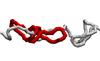 |
| Knotted DNA |
Abstract:
The DNA, just like hair, has a tendency to become knotted, thus it may be useful to disentangle it.
Unfortunately, it is not possible to "actively" choose at random (or better, in one solution) the filaments with the desired features, and this is why scientists adopt "passive" solutions like, for instance, having the DNA pass through nano-pores or nano-channels.
The nano-channel that disentangles knots
Trieste, Italy | Posted on February 20th, 2013"Channels and filaments have physical features we may exploit to selectively let a type of molecule pass through" explains Micheletti. "You can have more or less entangled filaments and featuring knots of different types. In our study we have considered a specific DNA filament model and examined its behavior within a nano-channel. We have observed that by varying the channel's width it is possible to drastically change the quantity and complexity of the knots formed by the DNA."
The nano-channels may therefore be a tool with a double function: on one side they are used to understand the "knotting pattern" of a DNA fragment, on the other they may be used to select entangled filaments in the desired manner. The sectors employing DNA, mainly in sequencing, require an increasing number of new techniques to select the DNA filaments according to their characteristics, such as length, shape as well as entanglement.
More in detail...
"Experimental physicists will be, in the first instance, interested is such technique to obtain knot-free DNA", explains Micheletti referring to the usefulness of the methodology (that for now has been studied through simulation). "We should not forget that such method may also help us better understand, for instance, the functioning of topoisomerases, enzymes that have a very important role in cell metabolism."
Such enzymes play a key role in an organism: they maintain the DNA stretched out when the cell is not undergoing the cell division process.
"We are used to envisage chromosomes in their typical rod shaped appearance, the one preceding mitosis, that is to say cell reproduction," adds Micheletti. "However, usually the DNA is a sort of indistinct bundle that fills up the cell's nucleus. The topoisomerases maintain the disentangled filaments with the lowest possible rate of knotting, and do so by snipping and reattaching the little pieces of genetic material." Only on the "disentangled" filament all those transcription processes which are fundamental to the survival of an organism can actually function.
"The functioning of such enzymes may be better grasped if, before having them perform, we already know to what extent the molecule was entangled in the first place, and our methodology may be useful to this purpose." concludes Micheletti.
####
For more information, please click here
Contacts:
Federica sgorbissa
Copyright © AlphaGalileo
If you have a comment, please Contact us.Issuers of news releases, not 7th Wave, Inc. or Nanotechnology Now, are solely responsible for the accuracy of the content.
Bookmark:


| Related Links |
| Related News Press |
News and information
 Simulating magnetization in a Heisenberg quantum spin chain April 5th, 2024
NRL charters Navy’s quantum inertial navigation path to reduce drift April 5th, 2024
Discovery points path to flash-like memory for storing qubits: Rice find could hasten development of nonvolatile quantum memory April 5th, 2024
Nanomedicine
New micromaterial releases nanoparticles that selectively destroy cancer cells April 5th, 2024
Good as gold - improving infectious disease testing with gold nanoparticles April 5th, 2024
Researchers develop artificial building blocks of life March 8th, 2024
Discoveries
Chemical reactions can scramble quantum information as well as black holes April 5th, 2024
New micromaterial releases nanoparticles that selectively destroy cancer cells April 5th, 2024
Utilizing palladium for addressing contact issues of buried oxide thin film transistors April 5th, 2024
Announcements
NRL charters Navy’s quantum inertial navigation path to reduce drift April 5th, 2024
Discovery points path to flash-like memory for storing qubits: Rice find could hasten development of nonvolatile quantum memory April 5th, 2024
Nanobiotechnology
New micromaterial releases nanoparticles that selectively destroy cancer cells April 5th, 2024
Good as gold - improving infectious disease testing with gold nanoparticles April 5th, 2024
Researchers develop artificial building blocks of life March 8th, 2024
 |
||
 |
||
| The latest news from around the world, FREE | ||
 |
||
|
|
||
| Premium Products | ||
 |
||
|
Only the news you want to read!
Learn More |
||
 |
||
|
Full-service, expert consulting
Learn More |
||
|
|
||