Home > Press > Flat boron by the numbers: Rice University researchers calculate what it would take to make new two-dimensional material
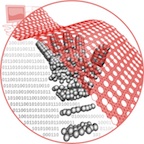 |
| Two-dimensional sheets of boron that can be lifted off a substrate are possible to make via several theoretical methods suggested in a new paper by Rice University scientists. The material could be a useful complement to graphene and other 2-D materials for electronics, they said. (Credit: Evgeni Penev/Rice University) |
Abstract:
Rice theoretical physicist Boris Yakobson and his colleagues detail several possible routes to the creation of two-dimensional sheets of boron. They say such sheets would be more conductive than graphene and thus useful in electronic applications.
Flat boron by the numbers: Rice University researchers calculate what it would take to make new two-dimensional material
Houston, TX | Posted on January 31st, 2013It would be a terrible thing if laboratories striving to grow graphene from carbon atoms kept winding up with big pesky diamonds.
"That would be trouble, cleaning out the diamonds so you could do some real work," said Rice University theoretical physicist Boris Yakobson, chuckling at the absurd image.
Yet something like that keeps happening to experimentalists working to grow two-dimensional boron. Boron atoms have a strong preference to clump into three-dimensional shapes rather than assemble into pristine single-atom sheets, like carbon does when it becomes graphene. And boron clumps aren't nearly as sparkly.
Yakobson and his Rice colleagues have made progress toward 2-D boron through theoretical work that suggests the most practical ways to make the material and put it to work. Earlier calculations by the group indicated 2-D born would conduct electricity better than graphene.
Through first-principle calculations of the interaction of boron atoms with various substrates, the team came up with several possible paths experimentalists may take toward 2-D boron. Yakobson feels the work may point the way toward other useful two-dimensional materials.
The Rice team's results appear this week in the journal Angewandte Chemie International Edition. Rice graduate student Yuanyue Liu and research scientist Evgeni Penev are co-authors of the paper.
Yakobson's lab first reported in a Nano Letters paper last year that unlike graphene, 2-D boron rolled into a nanotube would always be metallic. Also unlike graphene, the atomic arrangement can change without changing the nature of the material. Instead of the steady rank-and-file of hexagons in a perfect graphene sheet, 2-D boron consists of triangles. But boron could have vacancies - missing atoms - without affecting its properties.
That's the theory. The problem that remains is how to make the stuff.
"We are, perhaps, so close," Penev said. "Here we have conceived a material that resembles graphene, but is always conductive no matter what form it takes. What we're doing now is exploring different possibilities to connect our theories with reality."
The best method, they calculated, might be to feed boron into a furnace with silver or gold substrates in a process called chemical vapor deposition, commonly used to make graphene. The substrate is important, Penev said, because the atoms have to spill onto the surface and stick, but not too strongly.
"You have to have a substrate that doesn't want to dissolve boron," he said. "On the other hand, you want a substrate that doesn't bind too strongly. You should be able to detach the boron layer."
Then, like graphene, these atom-thick boron sheets could be applied to other surfaces for testing and, ultimately, for use in applications.
The study also calculated methods for creating sheets via saturation of boron atoms on the surface of boride substrates, and the evaporation of metal atoms from metal borides that leaves just the target atoms in a sheet.
"There are a lot of reasons boron could be interesting," said Liu, the paper's first author. "Boron is carbon's neighbor on the periodic table, with one less electron, which might bring in lots of new physics and chemistry, especially on the nanoscale. For example, 2-D boron is more conductive than graphene because of its unique electronic structure and atomic arrangement.
"In fact, comparing (boron) with graphene is very helpful," he said. "The state-of-art synthesis methods for graphene provide us good templates to explore 2-D boron synthesis."
Yakobson is thinking a step beyond the current work. "There are many groups, at Rice and elsewhere, working on 2-D boron," he said. "To appreciate this work, you have to stand back and contrast it with graphene; in some sense, the synthesis of graphene is trivial.
"Why? Because graphene is a God-given material," he said. "It forms at the global minimum (energy) for carbon atoms - they go there willingly. But boron is a different story. It does not have a planar form as a global minimum, which makes it a really subtle problem. The novelty in this work is that we're trying to trick it into building a two-dimensional motif instead of three."
The search for 2-D materials with varying qualities is hot right now; another new paper from Rice on a hybrid graphene-hexagonal boron nitride shows the need for a 2-D semiconductor to complement the material's conducting and insulating elements.
Yakobson hopes his study serves as a guideline for practical routes to other novel materials. "Now that there is a growing interest in a variety of 2-D materials, this may be a template," he said.
Yakobson is Rice's Karl F. Hasselmann Professor of Mechanical Engineering and Materials Science and professor of chemistry.
The Department of Energy (DOE) supported the research. Computations were performed on the National Science Foundation-funded Data Analysis and Visualization Cyberinfrastructure at Rice, along with resources at the National Institute for Computational Sciences and the DOE's National Energy Research Scientific Computing Center.
####
About Rice University
Located on a 300-acre forested campus in Houston, Rice University is consistently ranked among the nation’s top 20 universities by U.S. News & World Report. Rice has highly respected schools of Architecture, Business, Continuing Studies, Engineering, Humanities, Music, Natural Sciences and Social Sciences and is home to the Baker Institute for Public Policy. With 3,708 undergraduates and 2,374 graduate students, Rice’s undergraduate student-to-faculty ratio is 6-to-1. Its residential college system builds close-knit communities and lifelong friendships, just one reason why Rice has been ranked No. 1 for best quality of life multiple times by the Princeton Review and No. 2 for “best value” among private universities by Kiplinger’s Personal Finance. To read “What they’re saying about Rice,” go to tinyurl.com/AboutRiceU.
For more information, please click here
Contacts:
David Ruth
713-348-6327
Mike Williams
713-348-6728
Copyright © Rice University
If you have a comment, please Contact us.Issuers of news releases, not 7th Wave, Inc. or Nanotechnology Now, are solely responsible for the accuracy of the content.
Bookmark:


| Related Links |
| Related News Press |
News and information
 Simulating magnetization in a Heisenberg quantum spin chain April 5th, 2024
NRL charters Navy’s quantum inertial navigation path to reduce drift April 5th, 2024
Discovery points path to flash-like memory for storing qubits: Rice find could hasten development of nonvolatile quantum memory April 5th, 2024
Graphene/ Graphite
NRL discovers two-dimensional waveguides February 16th, 2024
Chip Technology
Discovery points path to flash-like memory for storing qubits: Rice find could hasten development of nonvolatile quantum memory April 5th, 2024
Utilizing palladium for addressing contact issues of buried oxide thin film transistors April 5th, 2024
HKUST researchers develop new integration technique for efficient coupling of III-V and silicon February 16th, 2024
Nanotubes/Buckyballs/Fullerenes/Nanorods/Nanostrings
Tests find no free-standing nanotubes released from tire tread wear September 8th, 2023
Detection of bacteria and viruses with fluorescent nanotubes July 21st, 2023
Discoveries
Chemical reactions can scramble quantum information as well as black holes April 5th, 2024
New micromaterial releases nanoparticles that selectively destroy cancer cells April 5th, 2024
Utilizing palladium for addressing contact issues of buried oxide thin film transistors April 5th, 2024
Materials/Metamaterials/Magnetoresistance
Nanoscale CL thermometry with lanthanide-doped heavy-metal oxide in TEM March 8th, 2024
Focused ion beam technology: A single tool for a wide range of applications January 12th, 2024
Announcements
NRL charters Navy’s quantum inertial navigation path to reduce drift April 5th, 2024
Discovery points path to flash-like memory for storing qubits: Rice find could hasten development of nonvolatile quantum memory April 5th, 2024
 |
||
 |
||
| The latest news from around the world, FREE | ||
 |
||
|
|
||
| Premium Products | ||
 |
||
|
Only the news you want to read!
Learn More |
||
 |
||
|
Full-service, expert consulting
Learn More |
||
|
|
||