Home > Press > MS Spectral Overlap Evaluator - a new ipad app. for mass spectrometry
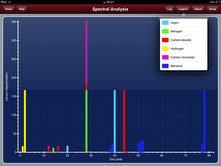 |
| Simulated mass spectrum screen shot from the Hiden MS ipad app. |
Abstract:
The new Overlap Evaluator ipad app. from Hiden Analytical is a reference tool for users of mass spectrometers operating in the fields of vacuum science and vacuum processing, and for advanced researchers using real time gas analysis systems. The evaluator enables the user to create a mass spectral overview of multiple fragmentation spectra to identify the mass peaks with least spectral interference and therefore most suited to species monitoring, and includes a quick mass peak look up table from a library of common gas and vapour species.
MS Spectral Overlap Evaluator - a new ipad app. for mass spectrometry
Warrington, UK | Posted on December 11th, 2012Based on the successful Hiden QGA quantitative gas analysis system software, up to 16 gas and vapour species can be added to an analysis ‘setup'. On adding the gases and vapours of interest, the MS overlap evaluator automatically provides a simulated analysis and displays the unique mass peaks together with any spectral overlaps. A spectral viewer is included to provide a histogram display of the simulated spectrum of the selected analysis.
The concentration levels for each component in the simulation mix can be adjusted, to provide a representative simulated mass spectrum of the users selected gas and vapour mixture.
The MS spectral overlap evaluator is available free to download from the Apple app. store.
For further information on this or any other Hiden Analytical products contact Hiden Analytical
at or visit the main website at www.HidenAnalytical.com.
####
For more information, please click here
Contacts:
Hiden Analytical Ltd
420 Europa Boulevard
Warrington, WA5 7UN, England
tel: +44 (0)1925 445 225
Copyright © Hiden Analytical Ltd
If you have a comment, please Contact us.Issuers of news releases, not 7th Wave, Inc. or Nanotechnology Now, are solely responsible for the accuracy of the content.
Bookmark:


| Related News Press |
News and information
 Simulating magnetization in a Heisenberg quantum spin chain April 5th, 2024
NRL charters Navy’s quantum inertial navigation path to reduce drift April 5th, 2024
Discovery points path to flash-like memory for storing qubits: Rice find could hasten development of nonvolatile quantum memory April 5th, 2024
Software
Visualizing nanoscale structures in real time: Open-source software enables researchers to see materials in 3D while they're still on the electron microscope August 19th, 2022
Luisier wins SNSF Advanced Grant to develop simulation tools for nanoscale devices July 8th, 2022
Oxford Instruments’ Atomfab® system is production-qualified at a market-leading GaN power electronics device manufacturer December 17th, 2021
Announcements
NRL charters Navy’s quantum inertial navigation path to reduce drift April 5th, 2024
Discovery points path to flash-like memory for storing qubits: Rice find could hasten development of nonvolatile quantum memory April 5th, 2024
Tools
Ferroelectrically modulate the Fermi level of graphene oxide to enhance SERS response November 3rd, 2023
The USTC realizes In situ electron paramagnetic resonance spectroscopy using single nanodiamond sensors November 3rd, 2023
 |
||
 |
||
| The latest news from around the world, FREE | ||
 |
||
|
|
||
| Premium Products | ||
 |
||
|
Only the news you want to read!
Learn More |
||
 |
||
|
Full-service, expert consulting
Learn More |
||
|
|
||