Home > Press > JPK reports on the use of AFM and single-cell force spectroscopy at the Interdisciplinary Nanoscience Center at Aarhus University, Denmark
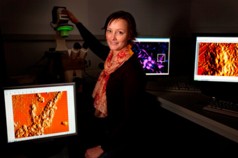 |
| Dr Rikke Meyer of iNANO at Aarhus University, Denmark, with her JPK NanoWizard SPM system: photograph courtesy of Mikal Schlosser, Herlev, DK, www.mikals.dk. |
Abstract:
JPK Instruments, a world-leading manufacturer of nanoanalytic instrumentation for research in life sciences and soft matter, reports on the research studies of Dr Rikke Meyer who is looking into biofilm formation from bacteria using atomic force microscopy, AFM, and single-cell force spectroscopy.
JPK reports on the use of AFM and single-cell force spectroscopy at the Interdisciplinary Nanoscience Center at Aarhus University, Denmark
Berlin, Germany | Posted on December 11th, 2012The interdisciplinary Nanoscience Center (iNANO) was formed by various research groups at Aarhus University together with groups from the Faculty of Science at Aalborg University. iNANO comprises facilities for the synthesis of nanostructured and nanopatterned 0D (i.e. nanoparticle), 1D, 2D and 3D materials.
The group of Dr Rikke Meyer works at the interface between microbiology and nanoscience in the quest to understand how bacteria form biofilms and how this may be prevented. AFM and optical microscopy are used to visualize bacterial cells and to study the interaction forces between cells and an abiotic substrate. AFM imaging and single-cell force spectroscopy are excellent tools to visualize detailed structures on the bacterial cell surface and to study how these contribute to cell adhesion to other substrates.
The motivation for using AFM in Dr Meyer's research was firstly to obtain detailed images of bacterial cells without extensive sample preparation. Furthermore, as she is interested in the interactions between bacteria and abiotic surfaces, she and her team use AFM force spectroscopy to quantify these interaction forces. AFM is one of several techniques used in these studies. These also include brightfield microscopy, fluorescence microscopy, confocal laser scanning microscopy, scanning electron microscopy and transmission electron microscopy.
Dr Meyer comments on her research and reasons behind her choice of AFM: "The coupling with optical microscopy is no doubt the feature that was most important for me in deciding to go with an AFM from JPK. As a microbiologist, I work with very heterogenous samples and it is not feasible to use AFM imaging to locate the field of interest, as large areas of the sample are often visualized to locate a site of interest. In the combined system, we can use the optical image to locate cells of interest before engaging the AFM for imaging or other measurements."
Continuing, she said, "AFM has mostly been used to study bacterial cells that are isolated in pure culture. However, the vast majority of the bacterial species we know to date have not been isolated and can only be studied in situ. Fluorescence labeling allows a rough identification of bacteria directly in the sample and fluorescence imaging can thus be used to locate cells of interest before AFM imaging begins. The combination of AFM with optical imaging is thus particularly important for the analysis of bacteria in environmental samples."
For more details about JPK's specialist products and applications for the bio and nano sciences, please contact JPK on +49 30533112070, visit the web site: www.jpk.com or see more on Facebook: www.jpk.com/facebook.
####
About JPK Instruments (JPK)
JPK Instruments AG is a world-leading manufacturer of nanoanalytic instruments - particularly atomic force microscope (AFM) systems and optical tweezers - for a broad range of applications reaching from soft matter physics to nano-optics, from surface chemistry to cell and molecular biology. From its earliest days applying atomic force microscope (AFM) technology, JPK has recognized the opportunities provided by nanotechnology for transforming life sciences and soft matter research. This focus has driven JPK's success in uniting the worlds of nanotechnology tools and life science applications by offering cutting-edge technology and unique applications expertise. Headquartered in Berlin and with direct operations in Dresden, Cambridge (UK), Singapore, Tokyo and Paris (France), JPK maintains a global network of distributors and support centers and provides on the spot applications and service support to an ever-growing community of researchers.
For more information, please click here
Contacts:
JPK Instruments AG
Bouchéstrasse 12
Haus 2, Aufgang C
Berlin 12435
Germany
T +49 30533112070
F +49 30 5331 22555
www.jpk.com
Talking Science Limited
39 de Bohun Court
Saffron Walden
Essex CB10 2BA
United Kingdom
T +44(0)1799 521881
M +44(0)7843 012997
www.talking-science.com
Copyright © JPK Instruments (JPK)
If you have a comment, please Contact us.Issuers of news releases, not 7th Wave, Inc. or Nanotechnology Now, are solely responsible for the accuracy of the content.
Bookmark:


| Related News Press |
News and information
 Simulating magnetization in a Heisenberg quantum spin chain April 5th, 2024
NRL charters Navy’s quantum inertial navigation path to reduce drift April 5th, 2024
Discovery points path to flash-like memory for storing qubits: Rice find could hasten development of nonvolatile quantum memory April 5th, 2024
Imaging
Nanoscale CL thermometry with lanthanide-doped heavy-metal oxide in TEM March 8th, 2024
The USTC realizes In situ electron paramagnetic resonance spectroscopy using single nanodiamond sensors November 3rd, 2023
Observation of left and right at nanoscale with optical force October 6th, 2023
Academic/Education
Rice University launches Rice Synthetic Biology Institute to improve lives January 12th, 2024
Multi-institution, $4.6 million NSF grant to fund nanotechnology training September 9th, 2022
Nanomedicine
New micromaterial releases nanoparticles that selectively destroy cancer cells April 5th, 2024
Good as gold - improving infectious disease testing with gold nanoparticles April 5th, 2024
Researchers develop artificial building blocks of life March 8th, 2024
Announcements
NRL charters Navy’s quantum inertial navigation path to reduce drift April 5th, 2024
Discovery points path to flash-like memory for storing qubits: Rice find could hasten development of nonvolatile quantum memory April 5th, 2024
Tools
Ferroelectrically modulate the Fermi level of graphene oxide to enhance SERS response November 3rd, 2023
The USTC realizes In situ electron paramagnetic resonance spectroscopy using single nanodiamond sensors November 3rd, 2023
Nanobiotechnology
New micromaterial releases nanoparticles that selectively destroy cancer cells April 5th, 2024
Good as gold - improving infectious disease testing with gold nanoparticles April 5th, 2024
Researchers develop artificial building blocks of life March 8th, 2024
New-Contracts/Sales/Customers
Bruker Light-Sheet Microscopes at Major Comprehensive Cancer Center: New Advanced Imaging Center Powered by Two MuVi and LCS SPIM Microscopes March 25th, 2021
Arrowhead Pharmaceuticals Announces Closing of Agreement with Takeda November 27th, 2020
Veeco Announces Aledia Order of 300mm MOCVD Equipment for microLED Displays: Propel™ Platform First 300mm System with EFEM Designed for Advanced Display Applications October 20th, 2020
GREENWAVES TECHNOLOGIES Announces Next Generation GAP9 Hearables Platform Using GLOBALFOUNDRIES 22FDX Solution October 16th, 2020
 |
||
 |
||
| The latest news from around the world, FREE | ||
 |
||
|
|
||
| Premium Products | ||
 |
||
|
Only the news you want to read!
Learn More |
||
 |
||
|
Full-service, expert consulting
Learn More |
||
|
|
||