Home > Press > JPK reports on the use of Tip Assisted Optics to characterize biomolecular hydrogels at CIC biomaGUNE in San Sebastian, Spain
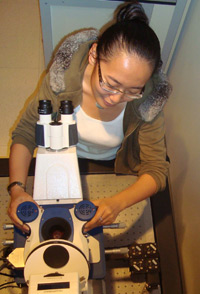 |
| PhD student, Xinyue Chen, works with the JPK NanoWizard AFM system in the group of Dr Ralf Richter in San Sebastian. |
Abstract:
PK Instruments, a world-leading manufacturer of nanoanalytic instrumentation for research in life sciences and soft matter, reports on the use of their Tip Assisted Optics module by Dr Ralf Richter at the CIC biomaGUNE, Biosurfaces Unit in San Sebastian, Spain.
JPK reports on the use of Tip Assisted Optics to characterize biomolecular hydrogels at CIC biomaGUNE in San Sebastian, Spain
Berlin, Germany | Posted on November 6th, 2012CIC biomaGUNE is a non-profit research organization created in 2006 to promote scientific research and technological innovation at the highest levels in the Basque Country. Dr Ralf Richter leads Laboratory 3 in the Biosurfaces Research Unit applying a number of techniques for surface nanostructure characterization and biofunctionalization to guide the assembly of molecules down to the nanometer-scale. For this characterization, his group has developed a toolbox of biophysical in-situ techniques including a quartz crystal microbalance with dissipation monitoring (QCM-D), atomic force microscopy (AFM), reflection interference contrast microscopy (RICM), ellipsometry and fluorescence methods. The current research work is centered on biomolecular hydrogels, a broad class of materials that are produced in the human body or by other bioorganisms. They are assembled from proteins and glycans. They are typically very soft and contain a lot of water. Even though biomolecular hydrogels play crucial roles in many fundamental biological processes, we lack understanding about how they function. Of particular interest for the group's research are cellular coats that are rich in the polysaccharide hyaluronan which are important in processes such as fertilization, osteoarthritis and inflammation.
Dr Richter's group develops methods to re-create these specialized natural hydrogels through the controlled assembly from their molecular components in vitro. Functionalized surfaces are used to guide the self-assembly process. The resulting model films have the advantage that they can be better controlled and studied in much greater detail than the original materials. By doing so, the hope is to understand the fundamental mechanisms behind the assembly and functions of biomolecular hydrogels.
While AFM is used to obtain nanoscale topographic information about the self-assembled architecture of the materials created, AFM is also used to quantify the mechanical properties of these hydrogels. Dr Richter explains: "We employ colloidal probe AFM. When analyzing polymer films, a fundamental problem in colloidal probe AFM experiments is to determine the distance at closest approach between the probe and the substrate on which the film is deposited. In a study published earlier this year (Attili & Richter, Langmuir, 2012, 28:3206) we have overcome this problem by combining optical interferometry (RICM) and AFM in situ. With the combined setup, forces and absolute distances between substrate and probe can be measured at the same time. Thanks to its tip-assisted optics (TAO™) module and the integration of high-resolution optical microscopy, the combination of RICM and AFM can be readily setup with the JPK NanoWizard® system. By using our toolbox of techniques, we are able to combine their results to produce a very detailed picture about the physico-chemical properties and dynamics of the films of interest."
He continued: "I have worked with NanoWizard systems since 2005. I particularly like its robust design where the integration of the AFM with high resolution optical microscopy is made very straightforward to set up and use. I also like the versatile data acquisition and evaluation software. The combination of high resolution optical and atomic force microscopy is critical for the combination of AFM and RICM. Here, the tip-assisted optics (TAO) module is also very useful. It keeps the colloidal probe in the center of the optical image, while probing different spots on the same surface."
For more details about JPK's specialist products and applications for the bio and nano sciences, please contact JPK on +49 30533112070, visit the web site: www.jpk.com or see more on Facebook: www.jpk.com/facebook.
####
About JPK Instruments (JPK)
JPK Instruments AG is a world-leading manufacturer of nanoanalytic instruments - particularly atomic force microscope (AFM) systems and optical tweezers - for a broad range of applications reaching from soft matter physics to nano-optics, from surface chemistry to cell and molecular biology. From its earliest days applying atomic force microscope (AFM) technology, JPK has recognized the opportunities provided by nanotechnology for transforming life sciences and soft matter research. This focus has driven JPK's success in uniting the worlds of nanotechnology tools and life science applications by offering cutting-edge technology and unique applications expertise. Headquartered in Berlin and with direct operations in Dresden, Cambridge (UK), Singapore, Tokyo and Paris (France), JPK maintains a global network of distributors and support centers and provides on the spot applications and service support to an ever-growing community of researchers.
For more information, please click here
Contacts:
JPK Instruments AG
Bouchéstrasse 12
Haus 2, Aufgang C
Berlin 12435
Germany
T +49 30533112070
F +49 30 5331 22555
www.jpk.com
Talking Science Limited
39 de Bohun Court
Saffron Walden
Essex CB10 2BA
United Kingdom
T +44(0)1799 521881
M +44(0)7843 012997
www.talking-science.com
Copyright © JPK Instruments (JPK)
If you have a comment, please Contact us.Issuers of news releases, not 7th Wave, Inc. or Nanotechnology Now, are solely responsible for the accuracy of the content.
Bookmark:


| Related News Press |
News and information
 Simulating magnetization in a Heisenberg quantum spin chain April 5th, 2024
NRL charters Navy’s quantum inertial navigation path to reduce drift April 5th, 2024
Discovery points path to flash-like memory for storing qubits: Rice find could hasten development of nonvolatile quantum memory April 5th, 2024
Announcements
NRL charters Navy’s quantum inertial navigation path to reduce drift April 5th, 2024
Discovery points path to flash-like memory for storing qubits: Rice find could hasten development of nonvolatile quantum memory April 5th, 2024
Tools
Ferroelectrically modulate the Fermi level of graphene oxide to enhance SERS response November 3rd, 2023
The USTC realizes In situ electron paramagnetic resonance spectroscopy using single nanodiamond sensors November 3rd, 2023
New-Contracts/Sales/Customers
Bruker Light-Sheet Microscopes at Major Comprehensive Cancer Center: New Advanced Imaging Center Powered by Two MuVi and LCS SPIM Microscopes March 25th, 2021
Arrowhead Pharmaceuticals Announces Closing of Agreement with Takeda November 27th, 2020
Veeco Announces Aledia Order of 300mm MOCVD Equipment for microLED Displays: Propel™ Platform First 300mm System with EFEM Designed for Advanced Display Applications October 20th, 2020
GREENWAVES TECHNOLOGIES Announces Next Generation GAP9 Hearables Platform Using GLOBALFOUNDRIES 22FDX Solution October 16th, 2020
 |
||
 |
||
| The latest news from around the world, FREE | ||
 |
||
|
|
||
| Premium Products | ||
 |
||
|
Only the news you want to read!
Learn More |
||
 |
||
|
Full-service, expert consulting
Learn More |
||
|
|
||